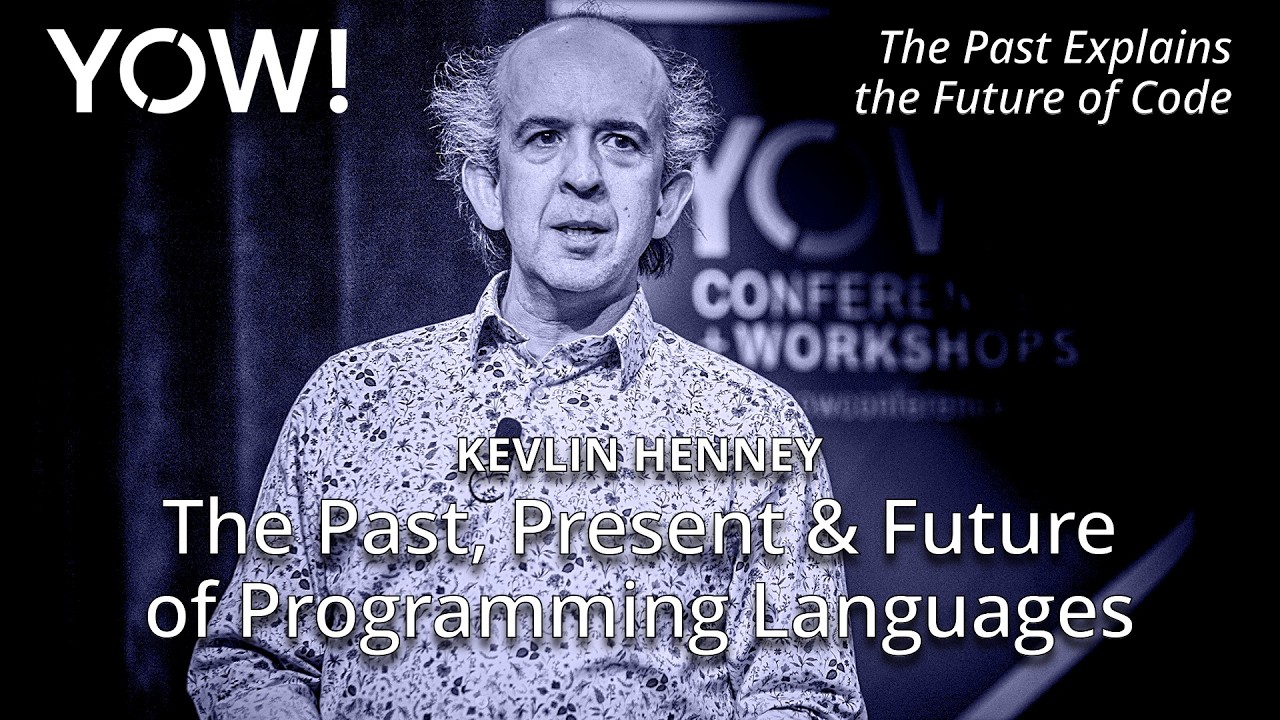
The Past, Present & Future of Programming Languages • Kevlin Henney • YOW! 2025
Keywords
Summary
165 words
Critical Evaluation
Kevlin Henney’s presentation is a masterful blend of historical insight and contemporary analysis. He provides a well-structured narrative that traces the lineage of programming languages from Fortran to modern languages like Python and Rust. His use of primary sources, such as Backus’s Turing Award paper and Floyd’s paradigm speech, adds scholarly weight. The talk is not merely a recitation of facts; Henney offers critical perspectives, such as his disdain for Fortran’s design while acknowledging its importance. He effectively uses data from TIOBE, IEEE Spectrum, and RedMonk to illustrate the stability of language popularity, challenging the common perception of rapid change in tech. The argument that programming languages evolve slowly is compelling and well-supported. However, some points are subjective, such as his dismissal of R’s syntax, which may not resonate with all data scientists. The talk’s strength lies in its synthesis of historical context and current trends, providing a nuanced view of the field. The inclusion of personal anecdotes and humor makes it engaging, but the technical depth is moderate, suitable for a general developer audience. The sources cited are credible and directly relevant, including links to Backus’s paper and the TIOBE index. The talk’s adéquation to its title is excellent, as it genuinely covers past, present, and future. Overall, it is a thought-provoking and informative talk that encourages reflection on the trajectory of programming languages.
225 words
Title / Content Match
The title accurately reflects the content, which covers the history, current state, and future of programming languages.
Quality & Reliability
8/10
The talk is based on historical sources (Backus, Floyd), current rankings (TIOBE, IEEE, RedMonk), and personal expertise. The speaker is a well-known consultant and author. The content is well-referenced and balanced, though it includes personal opinions and some humor.
Chapters
Cited Sources
- Can Programming Be Liberated from the von Neumann Style? — John Backus's 1977 Turing Award lecture, a foundational critique of imperative programming and a call for functional styles.
- The Paradigms of Programming — Robert Floyd's 1978 Turing Award lecture that introduced the term 'paradigm' to programming.
- TIOBE Index — Monthly ranking of programming language popularity, used to illustrate the stability of top languages.
- IEEE Spectrum Top Programming Languages 2025 — Another ranking source for programming language popularity.
- RedMonk Language Rankings — Ranking based on GitHub and Stack Overflow data, providing a different perspective on language popularity.
- Superplan and Groovy — Historical note on early programming languages, possibly referenced for context.
- if-then-else — Discussion on the history and significance of the if-then-else construct.
- The History of Simula — Article on Simula, the first object-oriented language, likely referenced for its historical impact.
- Lambda: The Ultimate Excel Worksheet Function — Microsoft Research blog on LAMBDA, bringing functional programming to Excel.
- Stack Overflow's Traffic Dropped 50% — Article discussing the decline in Stack Overflow traffic, possibly related to LLMs.
- TypeScript's Rise in the AI Era — GitHub blog on TypeScript's growth, possibly referenced for future trends.
Concurring Sources
- TIOBE Index — The ranking data used to show the stability of top languages.
- IEEE Spectrum Top Programming Languages 2025 — Another ranking that aligns with the talk's observations.
- RedMonk Language Rankings — Provides a different methodology but similar conclusions about language popularity.
Dissenting Sources
- Stack Overflow's Traffic Dropped 50%
External References
Contribution & Novelties
The talk provides a comprehensive historical perspective on programming languages, emphasizing that they evolve slowly and are deeply influenced by past ideas. It challenges the notion of rapid change in tech and offers a data-driven analysis of language popularity. The speaker’s personal insights and anecdotes add a unique flavor.
Pour aller plus loin :
- The History of Programming Languages — A broad overview of the evolution of programming languages.
- Von Neumann architecture — The computing model that Backus criticized.
- Functional programming — The paradigm advocated by Backus and others.
- TIOBE Index — The ranking used in the talk.
- IEEE Spectrum Top Programming Languages — Another ranking source.
107 words
Radar Profile
The radar chart shows a balanced profile with high scores in information quantity, quality, and reliability, and a slightly lower but still solid technical level. This indicates a well-rounded, informative talk that is accessible to a broad technical audience.
💬 No comments were provided for analysis.