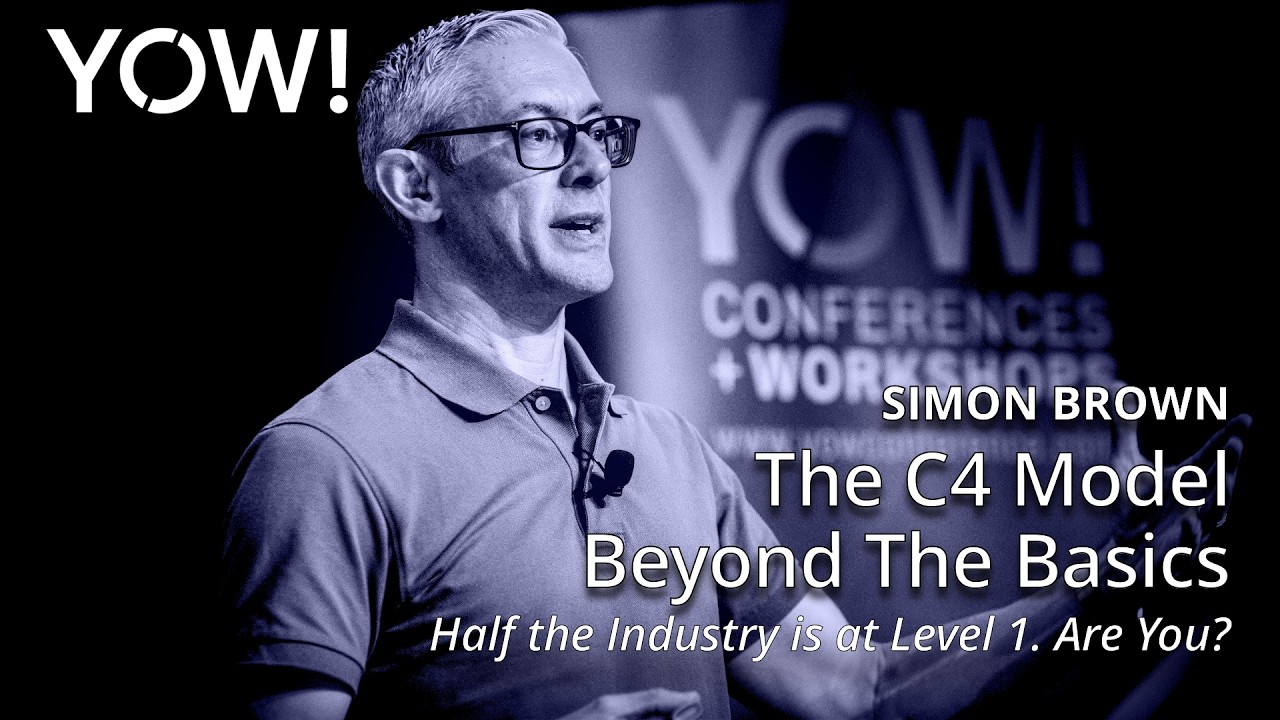
The C4 Model - Beyond The Basics
Keywords
Summary
253 words
Critical Evaluation
Simon Brown’s presentation is a valuable resource for software architects and developers seeking to improve their architecture documentation practices. As the creator of the C4 model, Brown speaks with authority, and his insights are grounded in years of experience and feedback from the community. The talk is well-structured, addressing seven common questions and misconceptions in a logical progression. Brown’s explanations are clear and practical, often using examples and analogies to illustrate his points. For instance, his comparison of C4 diagrams to Google Maps is effective in conveying the idea of zooming in and out to show different levels of detail. He also provides concrete advice, such as the importance of including technology choices on container diagrams to enable early evaluation of solutions. His clarification of the container concept, distinguishing it from Docker containers, is particularly useful, as this is a frequent source of confusion. He explains the rationale behind the term ‘container’ and its relationship to process boundaries and isolation boundaries, which helps to solidify the concept. The discussion on perspectives, drawn from the work of Rozanski and Woods, adds depth to the C4 model by suggesting additional views for non-functional concerns. Brown’s advice on modeling microservices is pragmatic, warning against over-decomposition and emphasizing the need to consider the system as a whole. The talk also addresses scaling the C4 model, both for large systems and entire system landscapes, which is a common challenge. Brown introduces the system landscape diagram as a solution for showing multiple systems. He also touches on the enterprise context, mentioning Structurizr as a tool for diagramming as code, which aligns with modern practices. The talk is not without limitations. As an expert opinion, it relies heavily on Brown’s personal views and experiences, which may not be universally applicable. Some topics, such as perspectives, are only briefly introduced and could benefit from more detailed examples. Additionally, the talk assumes a certain level of familiarity with software architecture concepts, which may make it less accessible to beginners. However, the target audience of a conference like YOW! is likely to be experienced practitioners. The title accurately reflects the content, and the talk delivers on its promise to go beyond the basics. Overall, this is a high-quality presentation that offers practical guidance and clarifies common misunderstandings. It is a valuable resource for anyone involved in software architecture documentation.
389 words
Title / Content Match
The title accurately reflects the content, which goes beyond the basics of the C4 model to address advanced topics and common questions.
Quality & Reliability
8/10
Simon Brown, creator of the C4 model, provides expert insights based on extensive experience. The talk is well-structured, addresses common misconceptions, and offers practical advice. While it is primarily opinion-based, it is grounded in real-world examples and the speaker's authority.
Chapters
Cited Sources
- C4 Model — Official website for the C4 model, referenced as the source of example diagrams and further information.
- Structurizr — Tool for diagramming as code, mentioned by Simon Brown in the context of scaling C4 in the enterprise.
- Simon Brown's Website — Personal website of Simon Brown, likely containing additional resources and contact information.
- Viewpoints and Perspectives — Reference for the concept of perspectives, as discussed in the talk.
- Microservices — Article by Martin Fowler on microservices, referenced in the context of microservices discussion.
- YOW! Conference Session — Link to the session page for downloading slides and reading the full abstract.
Concurring Sources
- C4 Model — The official C4 model website provides detailed documentation and examples that align with the talk's content.
- Structurizr — Structurizr is a tool that supports the C4 model, consistent with the talk's recommendations for scaling.
External References
Contribution & Novelties
This talk provides advanced insights into the C4 model, addressing common questions and misconceptions. It clarifies the container concept, distinguishes between abstraction and organisation, and offers guidance on modeling microservices and message-driven architectures. It also introduces the system landscape diagram for scaling and discusses the use of perspectives for non-functional concerns.
Pour aller plus loin :
- C4 Model — Official website with detailed documentation and examples.
- Structurizr — Tool for diagramming as code, enabling version control and automation.
- Viewpoints and Perspectives — Framework for considering multiple architectural perspectives.
- Microservices — Martin Fowler’s seminal article on microservices architecture.
97 words
Radar Profile
The radar profile shows high scores in quantity and quality of information, with a slightly lower but still solid score in technical level, reflecting the talk's balance between depth and accessibility. The overall reliability is high, consistent with the speaker's authority.