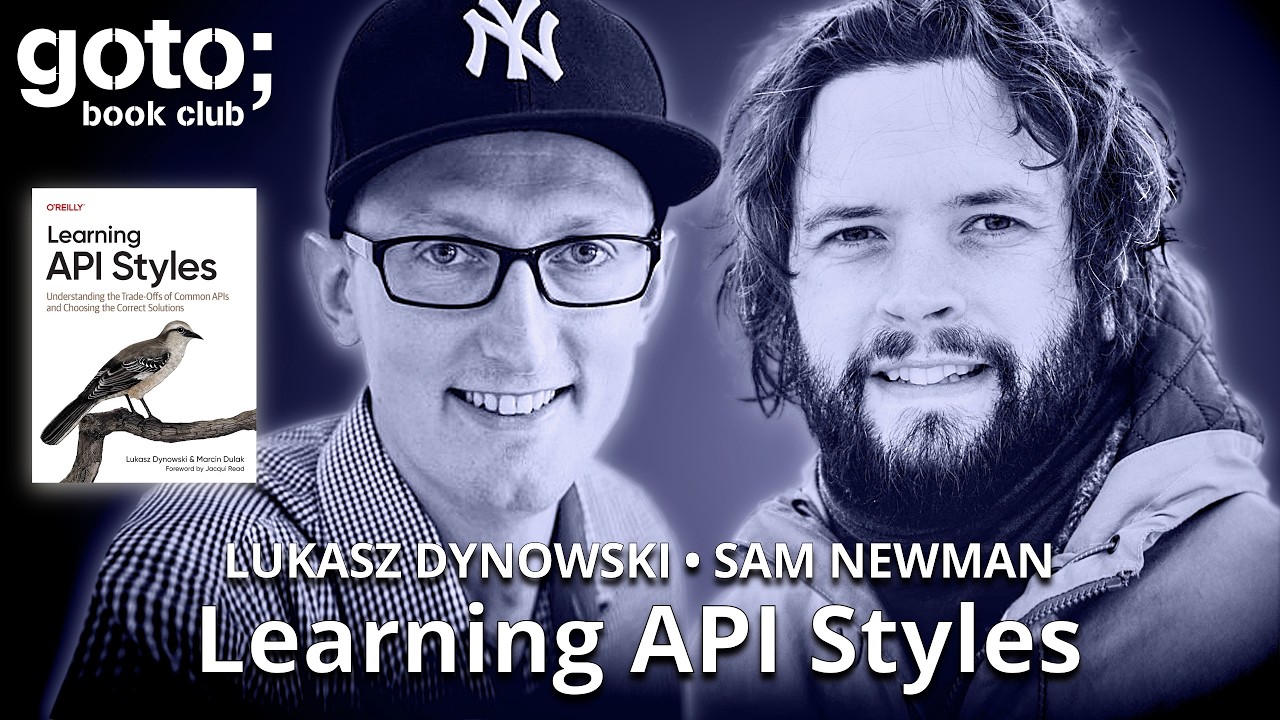
Learning API Styles • Lukasz Dynowski & Sam Newman • GOTO 2026
Keywords
Summary
176 words
Critical Evaluation
The interview provides valuable insights into the rationale behind the book ‘Learning API Styles’ and offers practical advice for API design and decision-making. Dynowski’s expertise is evident as he explains complex networking concepts in an accessible manner, linking them to real-world trade-offs. The discussion is grounded in the book’s content, which is published by O’Reilly, a reputable technical publisher, and includes references to specific RFCs and the Bezos API Mandate, adding credibility. The argumentation is coherent, with a clear emphasis on the importance of understanding the network layer and considering context when making API style choices. The conversation covers a range of topics, from security to protocol selection, and provides concrete examples such as RabbitMQ’s encryption limitations and RAID configurations. However, the format is an interview, so the depth is limited compared to a detailed technical presentation. The title accurately reflects the content, and the discussion stays on topic. The sources cited are primarily the book itself and related resources, which are appropriate. Overall, the information is reliable and useful for developers and architects seeking to deepen their understanding of API styles and trade-offs.
184 words
Title / Content Match
The title accurately reflects the content, which focuses on API styles and their trade-offs, as discussed by the book's co-author and an expert in microservices.
Quality & Reliability
8/10
The discussion is based on the co-author's expertise and practical experience, with references to specific RFCs and the Bezos API Mandate. The book is published by O'Reilly, a reputable technical publisher. The conversation is informal but technically accurate, with no obvious errors or unsupported claims.
Chapters
Cited Sources
- Learning API Styles — The book discussed in the interview, co-authored by Lukasz Dynowski.
- The Bezos API Mandate — Referenced as a key influence for treating APIs as products.
- RFC 6455 - The WebSocket Protocol — Mentioned as an example of a protocol RFC that the book covers.
- Sam Newman's Website — Sam Newman's personal site, mentioned as a resource.
- GOTO Book Club — The series this interview is part of.
Concurring Sources
- Building Microservices — Sam Newman's book, which aligns with the discussion on microservices and APIs.
External References
Contribution & Novelties
The interview highlights the book’s unique approach of starting from the network layer to explain API styles, emphasizing the importance of understanding underlying protocols for making informed trade-offs. It provides practical insights into security considerations, protocol selection, and the human-centric nature of API development.
Pour aller plus loin :
- OSI model — Foundational reference for understanding network layers.
- Bezos API Mandate — Key concept for treating APIs as products.
- gRPC — Modern RPC framework discussed as a future API style.
- WebTransport — Emerging protocol for low-latency communication.
87 words
Radar Profile
The radar profile shows high scores in quality and reliability, with moderate scores in quantity and technical depth. This indicates a focused, expert-driven discussion with valuable insights, though not exhaustive in coverage.