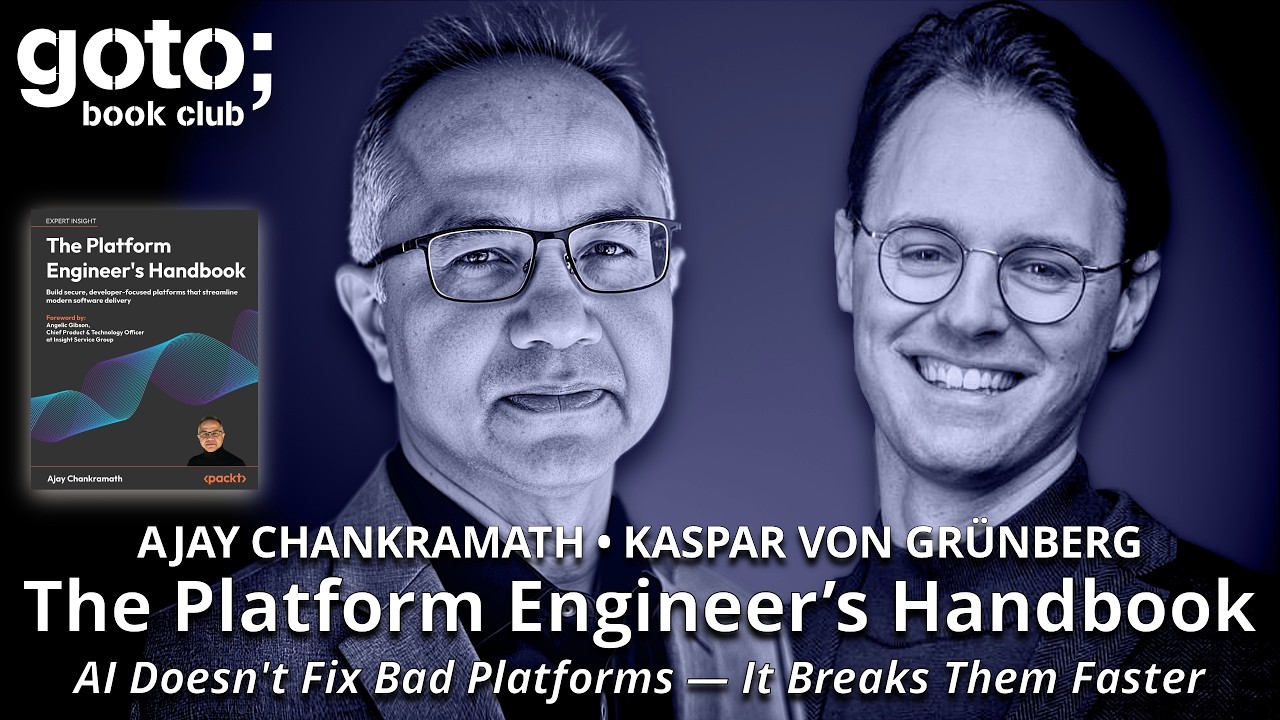
The Platform Engineer’s Handbook • Ajay Chankramath & Kaspar von Grünberg • GOTO 2026
Keywords
Summary
198 words
Critical Evaluation
The interview provides a compelling and insightful discussion on platform engineering, grounded in the authors’ extensive practical experience. Ajay Chankramath’s central thesis—that the gap in platform adoption is not technological but a product discipline gap—is a valuable and nuanced perspective. He argues that platforms fail when they are not treated as products with a clear feedback loop and a focus on developer experience as a first-class outcome. This is a crucial insight that resonates with common challenges in the industry. The conversation is well-structured, moving from the motivation behind the book to its content and then to the implications of AI. Chankramath’s emphasis on building platforms on 100% open-source, vendor-agnostic tooling is a strong stance, particularly in the context of geopolitical and licensing uncertainties. This aligns with broader industry trends towards sovereignty and avoiding vendor lock-in. The discussion on AI and platform engineering is particularly relevant. Citing a McKinsey finding that only 6% of AI initiatives show real productivity gains, Chankramath argues that agentic AI does not reduce the need for platform engineering but rather raises the stakes. This is a forward-looking perspective that acknowledges the growing role of AI agents in the software development lifecycle. The book’s approach of providing a code-first, hands-on guide is commendable, as it addresses a gap in existing literature that often remains at a conceptual level. The authors’ credibility is enhanced by their practical experience, including failures, which they openly discuss. However, the interview is relatively short and does not delve deeply into specific technical details, which may leave some practitioners wanting more. The claims are largely based on anecdotal experience rather than formal research, but this is typical for expert opinion content. The adéquation between the title and content is strong, as the conversation directly relates to the book’s themes. Overall, this is a valuable resource for those interested in platform engineering, offering both strategic insights and practical guidance.
316 words
Title / Content Match
The title accurately reflects the content, which focuses on the practical aspects of platform engineering as presented in the book 'The Platform Engineer’s Handbook'.
Quality & Reliability
8/10
The conversation is grounded in the authors' extensive practical experience in platform engineering, with concrete examples and references to industry practices. The claims are generally supported by experience rather than formal citations, but the expertise of the speakers adds credibility. The discussion on AI and platform engineering is forward-looking and aligns with current industry trends.
Chapters
- Intro
- Why this book exists
- From chip design to Platform Engineering
- Platform as a product, not a tool
- Inside the book: From foundations to enterprise-grade
- Built for any industry — Almost
- Sovereignty & going 100% vendor-agnostic
- What happens when agents enter the SDLC
- How to write a practical Platform Engineering book
- Outro
Cited Sources
- GOTO Book Club — The interview is part of the GOTO Book Club series.
- Episode page — The specific episode page for this interview.
- The Platform Engineer’s Handbook resources — Official resources for the book, including code and exercises.
- Ajay Chankramath's website — Personal website of Ajay Chankramath.
- Kaspar von Grünberg's website — Personal website of Kaspar von Grünberg.
- Thinking in Platforms book — Kaspar von Grünberg's book on platform thinking.
Concurring Sources
- GOTO Book Club — The interview is part of the GOTO Book Club series.
- Episode page — The specific episode page for this interview.
External References
Contribution & Novelties
The interview provides a fresh perspective on platform engineering by emphasizing the ‘product discipline gap’ as the root cause of platform adoption failures. It also highlights the importance of building platforms on open-source, vendor-agnostic tooling for sovereignty and resilience. The discussion on AI agents as new ‘users’ of platforms is particularly novel, suggesting that platforms must evolve to support agent context, memory, and guardrails.
Pour aller plus loin :
- Platform Engineering — Overview of the discipline.
- Internal Developer Platform — Community resource on IDPs.
- McKinsey on AI productivity — Reference to the finding on AI productivity gains.
- Kubernetes — Official documentation for Kubernetes, a key technology discussed.
- Backstage — An open-source developer portal platform, relevant to self-service portals.
118 words
Radar Profile
The radar chart shows a balanced profile with high scores in information quantity, quality, and reliability, and a slightly lower score in technical depth. This indicates that the content is rich and credible, but may not delve into highly technical details, making it accessible to a broader audience.
💬 No comments were provided for analysis.