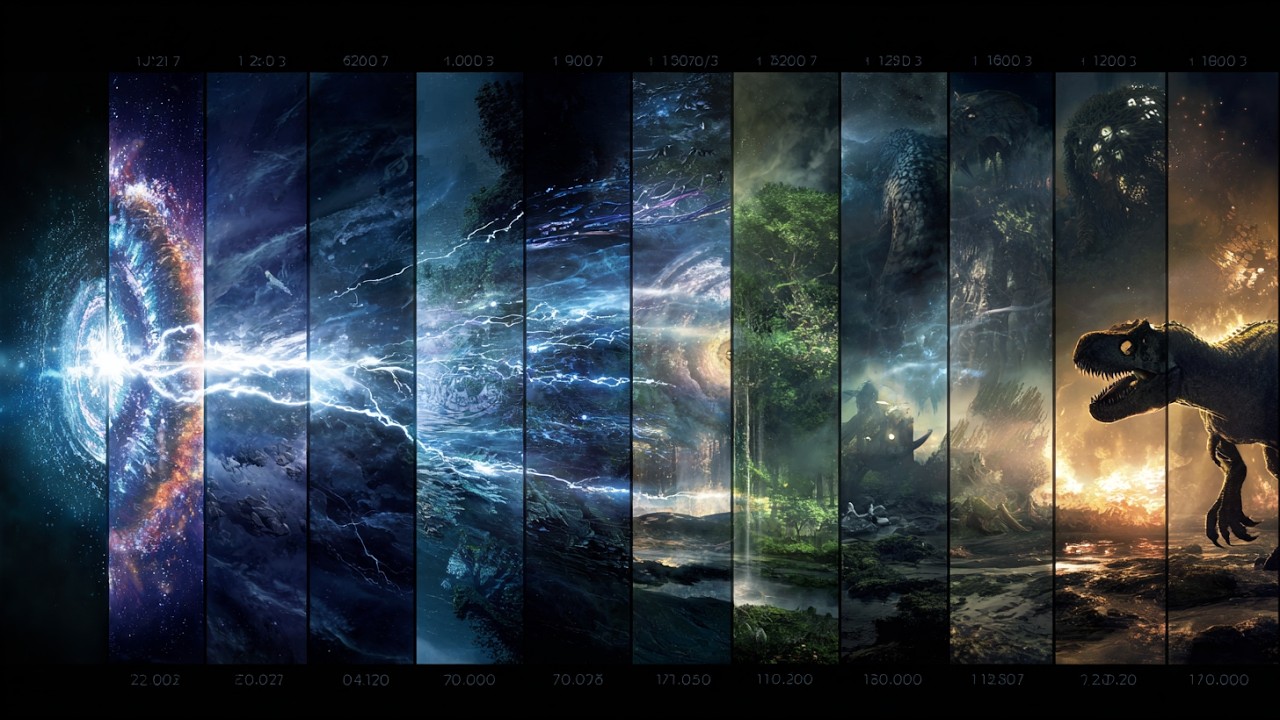
La folle histoire de l’Univers en 365 jours.
Keywords
Summary
202 words
Critical Evaluation
The video excels in its ability to convey the immense scale of cosmic time in an accessible and engaging manner. The cosmic calendar analogy, popularized by Carl Sagan, is effectively utilized, and the narration is clear and evocative. The scientific content is accurate, covering major milestones in cosmic and biological evolution with appropriate timescales. The video does not oversimplify to the point of misinformation; rather, it provides a coherent narrative that aligns with current scientific consensus. The use of visuals and sound enhances the emotional impact, making the vastness of time tangible. The argumentation is solid, as the video builds a logical sequence of events from the Big Bang to the far future, and it correctly places human history in the context of cosmic time. The sources are not explicitly cited within the video, but the content is consistent with established scientific knowledge. The title accurately reflects the content, and the video delivers on its promise. The only minor critique is that some events are simplified for brevity, but this is acceptable given the format. Overall, the video is a high-quality piece of science communication that effectively educates and inspires.
190 words
Title / Content Match
The title accurately reflects the content: a comprehensive narrative of the universe's history compressed into one year, as presented in the video.
Quality & Reliability
8/10
The video presents a scientifically accurate overview of cosmic history, using the cosmic calendar analogy. It covers major events from the Big Bang to the far future, with correct timescales and well-established scientific facts. The content is well-researched and aligns with current cosmological understanding. Minor simplifications are inherent to the format but do not compromise accuracy.
Chapters
- Le calendrier cosmique
- Merci Mammouth
- Janvier, les Ténèbres et les étoiles
- Naissance de la voie lactée
- Le système solaire
- Le Terre
- La formation de la Lune
- Les premiers océans
- L’apparition de la vie
- Photosynthèse et grande oxydation
- Les premières cellules complexes
- Les premiers mouvements
- Les neurones
- Le cryogénien
- L’explosion cambrienne
- Les arthropodes
- Les poissons à mâchoires
- La sortie de l’eau
- Premier amphibiens
- L’invention de la graine
- Le vol
- Les reptiles
- Les éruptions du permien
- Les dinosaures et les mammifères
- Les oiseaux
- Une planète tropicale
- La fin d’un règne
- Les ancêtres des grands singes
- La fermeture de la méditerranée
- Les hominidés
- Sapiens et la conquête du monde
- Le début de l’histoire
- La dernière seconde du calendrier
- Prédire le futur
- La fin de la vie sur Terre
- La transformation du ciel
- La mort du soleil
- L’histoire continue ailleurs ?
Cited Sources
- Mammouth.ai — Mentioned in the video as a sponsor and in the description as a tool for AI access.
- Videvo — Likely source for stock footage used in the video, as listed in the description.
Concurring Sources
- Cosmic Calendar - Wikipedia — The video's structure is based on the cosmic calendar analogy, which is well-documented.
- History of Earth - Wikipedia — The video's timeline of Earth's history aligns with scientific consensus.
Contribution & Novelties
The video provides a fresh and engaging retelling of the cosmic calendar concept, with high-quality production and a poetic narration. It effectively compresses 13.8 billion years into a year, making the vast timescales relatable. The video also extends the timeline into the future, offering a perspective on the eventual fate of Earth and the universe.
Pour aller plus loin :
- Cosmic Calendar - Wikipedia — The concept popularized by Carl Sagan, which this video adapts.
- History of the Universe - Wikipedia — A detailed overview of the universe’s evolution.
- Timeline of the far future - Wikipedia — Extrapolations of future events, as touched upon in the video.
107 words
Radar Profile
The radar profile shows high scores in quantity and quality of information, with a moderate technical level, indicating a well-balanced and accessible science communication piece. The reliability is high, reflecting the accuracy of the content.
💬 Très positif. Sur les 30 commentaires analysés, les spectateurs expriment une admiration unanime pour la qualité de la narration, la beauté visuelle et la capacité à rendre l'échelle cosmique tangible, avec plusieurs demandes pour que la vidéo soit montrée dans les écoles.