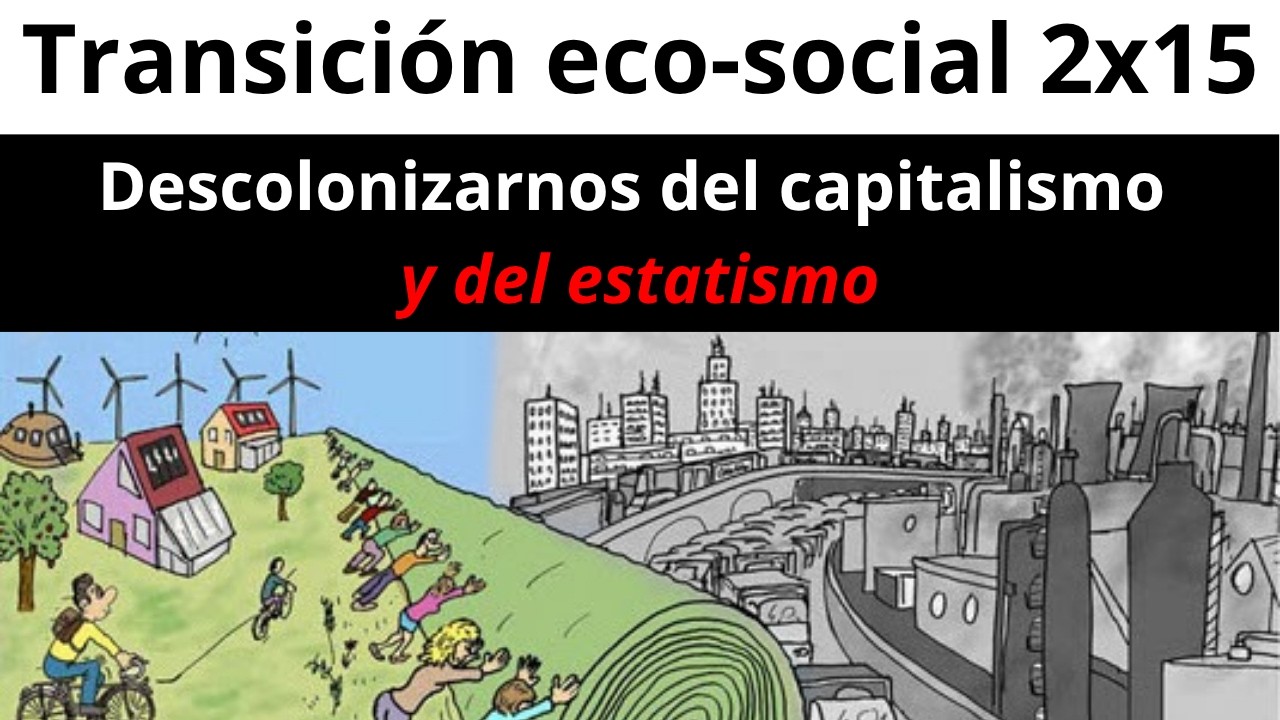
Podcast 2x15: Desafiando al estatismo en la transición ecosocial
Keywords
Summary
158 words
Critical Evaluation
Value of the Information & Strength of the Argument
The value of the information lies in its critical perspective on statist approaches to ecosocial transition, offering an alternative viewpoint that prioritizes social movements. The argumentation is coherent and grounded in ideological reasoning, but it lacks empirical evidence and detailed references. The hosts present a clear thesis and support it with historical examples and logical reasoning, though the discussion remains at a theoretical level without concrete proposals for implementation.
Scientific Rigor, Source Quality, Title Accuracy
The scientific rigor is moderate; the hosts reference concepts like Gramsci’s ‘war of position’ and the book ‘The Dawn of Everything’ by David Graeber, but without providing specific citations or data. The quality of sources is limited to anecdotal references and personal interpretations. The title accurately reflects the content, focusing on challenging statism in the ecosocial transition. No comments were provided for analysis.
147 words
Title / Content Match
The title accurately reflects the content, which focuses on challenging statism within the ecosocial transition.
Quality & Reliability
6/10
The discussion is based on personal opinions and ideological perspectives rather than empirical evidence. References to historical examples and concepts are made without detailed citations, limiting verifiability.
Key Moments
Markers derived by PSI from the transcript: the creator did not define chapters.
- Introduction to the topic of ecosocial transition and statism.
- Definition of ecosocial transition and critique of capitalist green transition.
- Critique of statist approaches and the role of the nation-state.
- Discussion on the co-optation of social movements by political parties.
- Historical examples of non-statist societies and the Spanish Revolution.
- Proposal for a dual strategy and the importance of movement independence.
- Call to decolonize the social imaginary and imagine politics beyond the state.
Cited Sources
- The Dawn of Everything — Referenced as a book that examines pre-state societies and non-centralized governance.
- Gramsci's concept of war of position — Mentioned in the context of critique of gaining positions within the state.
Concurring Sources
- The Dawn of Everything — Supports the idea that non-statist societies have existed and functioned.
Dissenting Sources
- Statist approaches to ecosocial transition — The hosts critique statist approaches, which are often advocated by ecosocialist thinkers.
Contribution & Novelties
The podcast offers a critical perspective on statist approaches to ecosocial transition, emphasizing the role of social movements and the need for independence from political parties. It contributes to the debate by highlighting the risks of co-optation and the importance of decolonizing the social imaginary.
Pour aller plus loin :
- Ecosocialism — Provides background on ecosocialist thought, which often involves state-led transitions.
- Social ecology — Murray Bookchin’s theory, which advocates for decentralized, non-statist forms of organization.
- Municipalism — Concept of local self-governance, relevant to the discussion of municipal-level transitions.
89 words
Radar Profile
The radar profile shows moderate scores across all dimensions, indicating a balanced but not highly rigorous discussion. The podcast is strong in argumentation but weaker in empirical grounding and source citation.