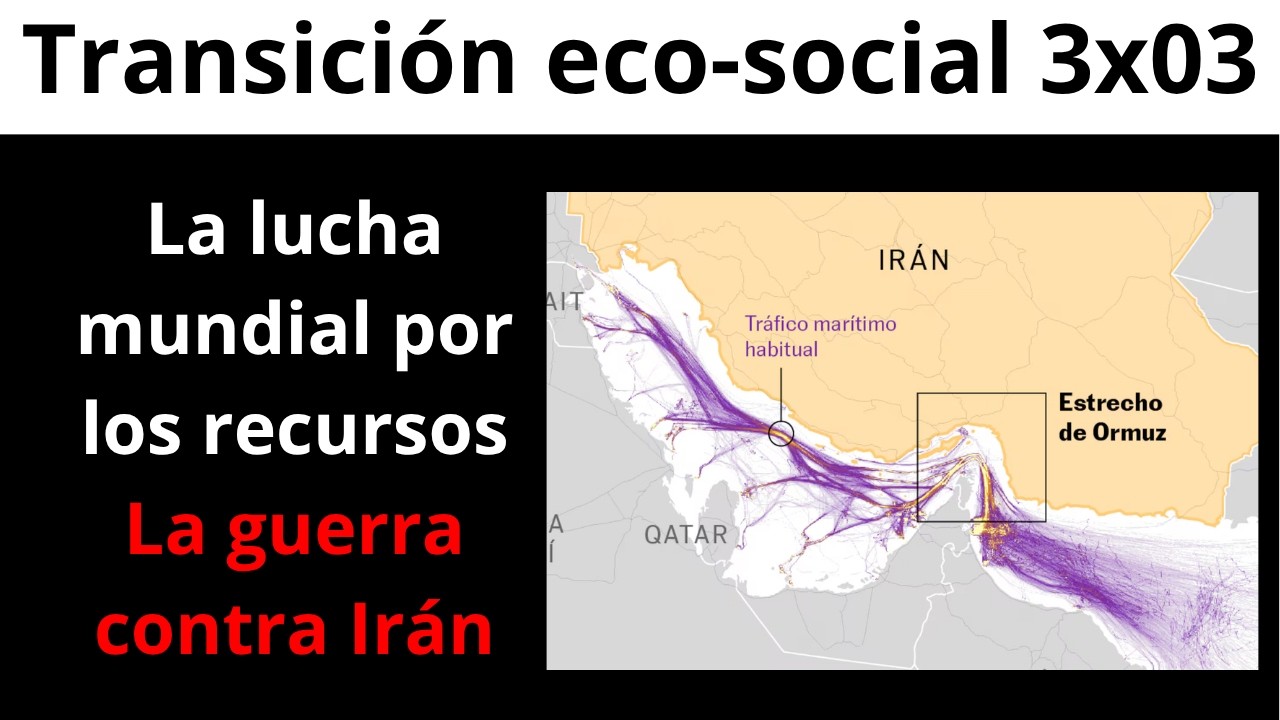
Podcast 3x03. La lucha mundial por los recursos: la guerra contra Irán
Keywords
Summary
190 words
Critical Evaluation
Value of the Information & Strength of the Argument
The value of the information lies in its contextualization of the Iran war within a broader narrative of resource scarcity and civilizational collapse, offering a perspective often absent from mainstream geopolitical analysis. The hosts make a compelling argument that the war is driven by the need to control resources, particularly oil, and to maintain US hegemony through the petrodollar system. They also highlight the often-overlooked link between the conflict and global food security via fertilizer exports. However, the argumentation is largely based on ideological assumptions and lacks empirical evidence or citations. The hosts present their views as self-evident, without engaging with alternative perspectives or addressing potential counterarguments. The discussion is more opinion-driven than rigorously analytical, which limits its scientific value.
Scientific Rigor, Source Quality, Title Accuracy
The scientific rigor is moderate: the hosts reference general concepts like the petrodollar system and the Strait of Hormuz but do not provide specific sources or data. The quality of sources is low, as no external references are cited, and the analysis relies on the hosts’ expertise and ideological framework. The title accurately reflects the content, which is a geopolitical commentary on the war against Iran. The hosts do not claim to present original research but rather offer their interpretation of events. The lack of citations and reliance on personal opinion reduce the overall reliability of the content.
233 words
Title / Content Match
The title accurately reflects the content, which focuses on the global resource struggle and the war against Iran.
Quality & Reliability
6/10
The hosts provide a coherent geopolitical analysis framed within a collapse theory perspective, but rely on personal opinions and ideological interpretations rather than verifiable data or citations. The discussion is informed but lacks rigorous sourcing.
Key Moments
Markers derived by PSI from the transcript: the creator did not define chapters.
- Introduction to the podcast and the series on global resource struggle.
- Discussion on the perspective of collapse and why it's important for analyzing the war.
- Explanation of the geopolitical context: US, China, Russia as imperial powers.
- Analysis of the role of the Strait of Hormuz and its importance for oil and fertilizer transit.
- Discussion on the impact of the war on global food security and fertilizer prices.
- Comparison between Iran's situation and Argentina's vulnerability to resource extraction.
- Critique of US military bases and the call for Latin American unity.
- Discussion on the need for an ecosocial transition and agroecology.
- Reflections on nationalism and the importance of anti-capitalist unity.
- Conclusion and summary of key points.
Contribution & Novelties
The podcast offers a unique perspective by framing the war against Iran within the broader context of civilizational collapse and resource depletion, which is not commonly addressed in mainstream media. It connects geopolitical events to ecological and economic crises, emphasizing the urgency of transitioning to sustainable practices. The hosts also draw parallels between Iran and Latin American countries, highlighting shared vulnerabilities and the need for regional solidarity.
Pour aller plus loin :
- Petrodollar system — Provides background on the role of the US dollar in oil trade.
- Strait of Hormuz — Details the strategic importance of this chokepoint for global oil transit.
- Urea fertilizer — Explains the chemical compound and its role in agriculture.
114 words
Radar Profile
The radar profile shows moderate scores across all dimensions, with slightly higher values for information quantity and quality, but lower for technical level and reliability. This indicates a balanced but not deeply rigorous analysis, suitable for a general audience interested in geopolitical commentary.