Photonics Frontiers Award 2025: Breakthroughs in Imaging & Optical Communications | Finalist Panel
Keywords
Summary
134 words
Critical Evaluation
Value of the Information & Strength of the Argument
The value of the information is high, as it provides direct insights from industry experts on cutting-edge photonics applications. Each presenter clearly articulates the problem they are solving, the technical approach, and the benefits of their solution. For instance, Jabil’s explanation of using SWIR wavelengths to avoid solar interference is well-argued and supported by the physics of atmospheric absorption. Similarly, IDA’s use of depolarization for defect detection is logically presented. The argumentation is solid, with presenters backing their claims with specific performance metrics (e.g., 180ms processing time, 100x laser power) and practical examples. However, the promotional nature of the presentations means that potential limitations or alternative approaches are not deeply explored. The Q&A sessions add value by addressing some technical questions, but they are brief and sometimes lack critical depth.
Scientific Rigor, Source Quality, Title Accuracy
The scientific rigor is moderate. The presenters are industry professionals with relevant expertise, and the technologies described are based on established principles (e.g., SWIR imaging, polarization). However, the content is largely self-reported, with no external citations or peer-reviewed references. The sources cited are limited to a registration link for Electro Optics, which is not directly related to the technical content. The title accurately reflects the content, as the video is indeed a panel discussion of finalists in imaging and optical communications. The adéquation between title and content is good, with no misleading elements. The lack of independent verification and the promotional context slightly reduce the overall reliability.
252 words
Title / Content Match
Title accurately reflects the content: a panel discussion of finalists in imaging and optical communications for the Photonics Frontiers Award 2025.
Quality & Reliability
7/10
Panel of industry experts presenting real-world photonics applications with technical depth, but limited independent verification and promotional context.
Key Moments
Markers derived by PSI from the transcript: the creator did not define chapters.
- Introduction by James Wormald, overview of the Photonics Frontiers Award and the panel structure.
- Presentation of IDA's brake disc inspection system using polarized light.
- Q&A on IDA's system, discussing adaptability and false positives.
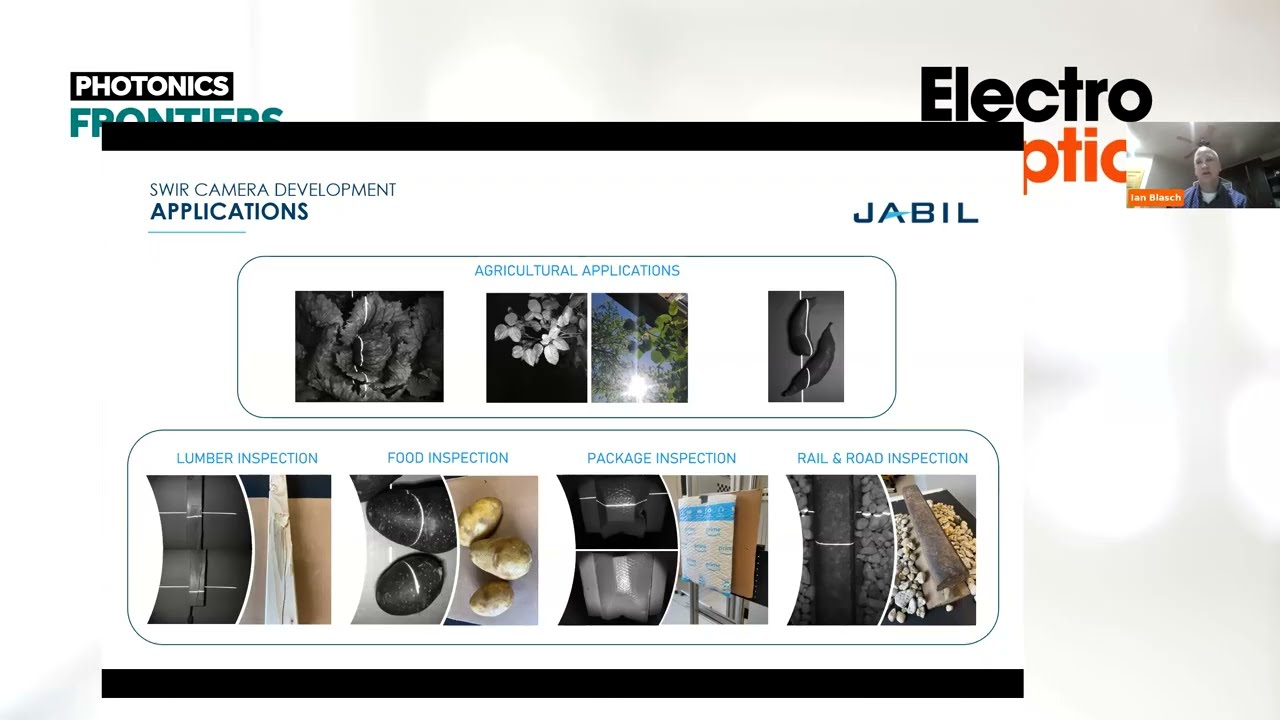
- Jabil's presentation on SWIR 3D laser line profile sensors for outdoor applications.
- Q&A with Ian Blasch on SWIR technology, laser safety, and AI integration.
- TriEye's presentation on lost cargo detection for autonomous driving.
- Q&A on TriEye's solution, discussing environmental conditions and perception.
- Kabs' presentation on optical ground stations for LEO laser communications.
- Q&A on Kabs' project, covering challenges and future plans.
- Closing remarks and summary of the panel.
Cited Sources
- Electro Optics registration — Mentioned in the description as a way to access more content from Electro Optics.
Concurring Sources
- Wikipedia: Short-wave infrared — Supports the technical basis of Jabil's SWIR sensors.
Contribution & Novelties
The video provides a unique overview of several cutting-edge photonics applications, particularly highlighting the use of SWIR technology to overcome environmental challenges. The presentations offer practical insights into how these technologies are being deployed in real-world settings, which is valuable for professionals in the field. The discussion also underscores the importance of cost reduction and reliability for widespread adoption.
Pour aller plus loin :
- Short-wave infrared — Provides background on SWIR technology and its applications.
- Laser communications — Relevant to Kabs’ optical ground stations for LEO laser communications.
- Autonomous vehicle — Context for TriEye’s lost cargo detection system.
98 words
Radar Profile
The radar profile shows a balanced performance across all dimensions, with slightly higher scores in information quantity and technical level, reflecting the detailed technical presentations. The lower score in reliability is due to the lack of independent sources and the promotional nature of the content.
💬 Sur les 0 commentaires analysés, aucune tendance n'est disponible.