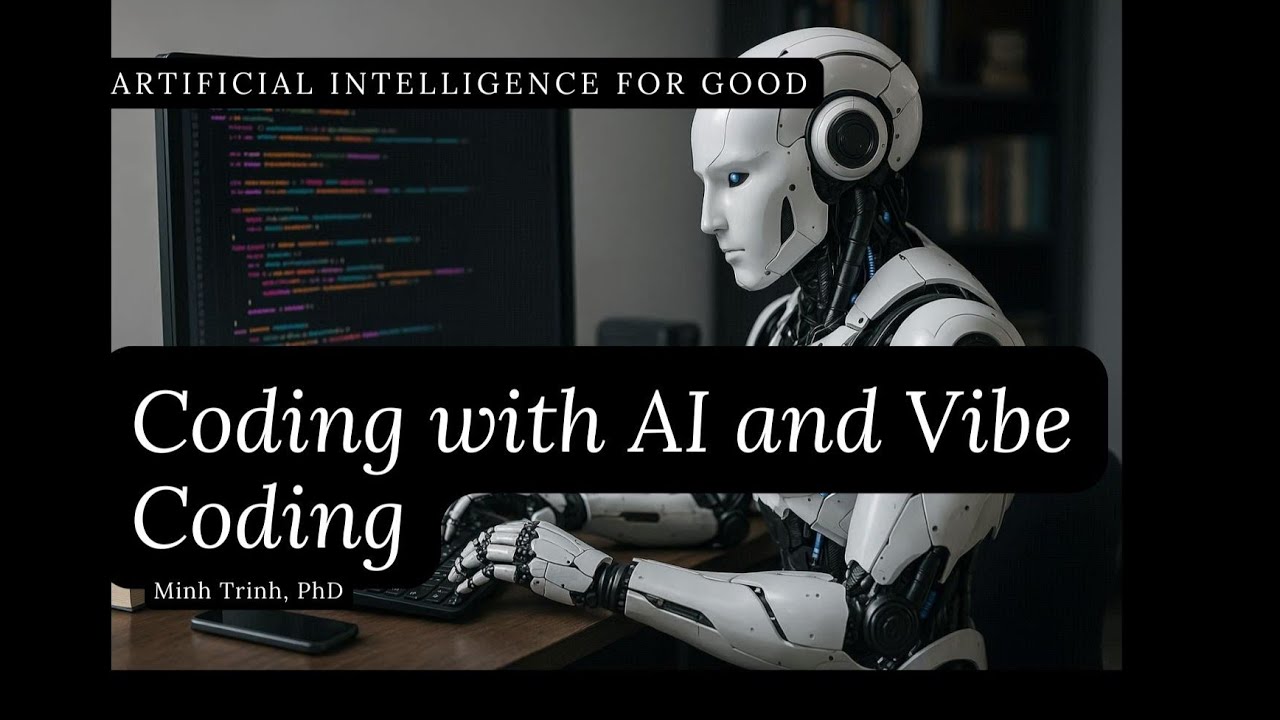
Coding with AI and Vibe Coding
Keywords
Summary
169 words
Critical Evaluation
Value of the Information & Strength of the Argument
The presentation offers valuable insights into the current state of AI coding tools and the practical aspects of vibe coding. It provides a comprehensive overview of benchmarks and models, which is useful for understanding the landscape. The argumentation is based on the author’s experience and observations, but lacks rigorous evidence or citations. The discussion of best practices and risks is practical and well-structured, though some claims could be better substantiated.
Scientific Rigor, Source Quality, Title Accuracy
The scientific rigor is moderate. The speaker references well-known benchmarks and models, but does not provide formal citations or links to specific papers. The quality of sources is acceptable for a general audience, but the lack of verifiable references weakens the overall reliability. The title accurately reflects the content, covering both AI coding and vibe coding. No comments were provided for analysis.
147 words
Title / Content Match
The title accurately reflects the content, covering both AI-assisted coding and the specific practice of vibe coding.
Quality & Reliability
7/10
The presentation is based on the author's expertise and includes references to well-known benchmarks and models, but lacks formal citations and verification of claims. It provides a broad overview with practical insights, but some information may be outdated or oversimplified.
Key Moments
Markers derived by PSI from the transcript: the creator did not define chapters.
- Introduction to the presentation on coding with AI and vibe coding.
- How LLMs learn to code from large corpora including GitHub and Stack Overflow.
- Overview of coding AI capabilities: generation, debugging, refactoring.
- Demo of OpenAI Codex CLI refactoring a component and running tests.
- Explanation of Pass@1 and Pass@K metrics for evaluating coding models.
- Introduction to coding benchmarks: MBPP, SWE-Bench, HumanEval, etc.
- Definition of vibe coding and its origin with Andrej Karpathy.
- Best practices for vibe coding: start with vision, iterate in small steps, use artifacts.
- When NOT to vibe code: security, payments, core logic.
- Security considerations and slop squatting risk.
- Demo: Building an app with Gemini 3.0.
- Future directions for coding AI and conclusions.
Cited Sources
- rodeo.ai — Mentioned in the video description as a resource for AI books and courses.
Concurring Sources
- SWE-bench — The benchmark is discussed in the video and its official website provides detailed information.
- HumanEval — The benchmark is mentioned in the video; the GitHub repository contains the dataset.
- LiveCodeBench — The benchmark is discussed in the video; the official website provides details.
Contribution & Novelties
The presentation provides a practical overview of AI coding tools and the emerging practice of vibe coding, highlighting both opportunities and risks. It synthesizes information from various benchmarks and models, offering a useful starting point for developers. The discussion of best practices and security concerns adds practical value.
Pour aller plus loin :
- SWE-bench — Official website for the SWE-bench benchmark, providing details and leaderboard.
- HumanEval — GitHub repository for the HumanEval benchmark, including code and data.
- LiveCodeBench — Official website for LiveCodeBench, a contamination-resistant benchmark.
- Andrej Karpathy’s tweet on vibe coding — Original tweet introducing the term ‘vibe coding’.
100 words
Radar Profile
The radar profile shows high scores in quantity of information and technical level, indicating a comprehensive and technical presentation. However, the lower score in reliability suggests that the content could benefit from more rigorous sourcing and verification.