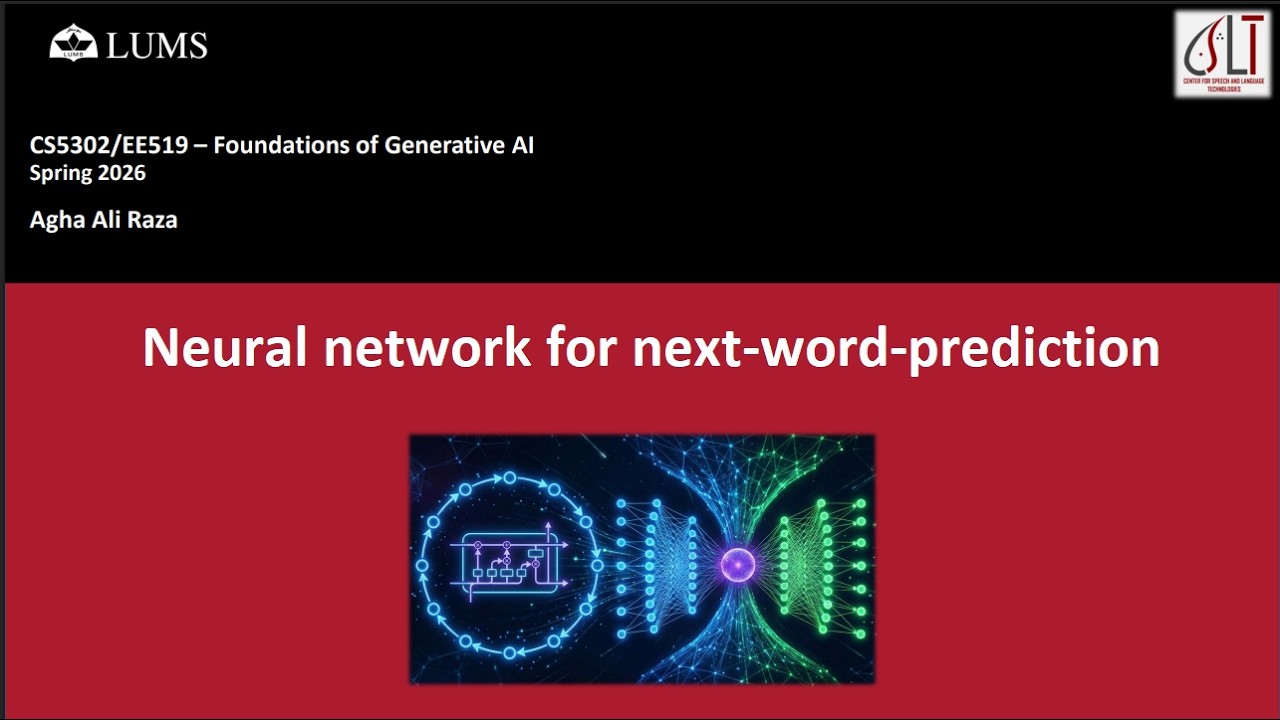
Generative AI L12: Neural network for next-word-prediction based on 3 context words, intro to RNN
Keywords
Summary
142 words
Critical Evaluation
Value of the Information & Strength of the Argument
The lecture provides valuable insights into the design choices and trade-offs in neural language models. The instructor’s argumentation is solid, building from concrete examples to general principles. He effectively explains the motivation behind RNNs by highlighting the shortcomings of feedforward networks, such as fixed input size and lack of parameter sharing. The discussion on freezing vs. fine-tuning embeddings is particularly useful, with a clear analogy to medical specialization. The reasoning is logical and well-structured, making complex concepts accessible.
Scientific Rigor, Source Quality, Title Accuracy
The scientific rigor is high for a pedagogical context. The instructor references established models (word2vec, GloVe, CBOW) and introduces standard terminology (pre-training, fine-tuning, catastrophic forgetting). However, no specific papers or external sources are cited in the video; the only links provided are to the course playlist and materials. The title accurately reflects the content, and the lecture is well-organized with clear chapter markers.
156 words
Title / Content Match
The title accurately describes the content: the lecture covers neural networks for next-word prediction based on three context words and introduces RNNs.
Quality & Reliability
8/10
Lecture from a graduate course at LUMS, with clear explanations and references to established concepts (word2vec, GloVe, etc.). The instructor demonstrates deep understanding and provides multiple perspectives. However, no external sources are cited beyond course materials, and the content is pedagogical rather than peer-reviewed.
Chapters
Cited Sources
- Course materials: Generative AI for Speech and Language Processing — Slides and assessments for the course, referenced as the source of lecture notes and exercises.
- Full playlist: Foundations of Generative AI — Playlist containing all lecture videos for the course.
Concurring Sources
- Course materials: Generative AI for Speech and Language Processing — The course materials align with the lecture content, providing slides and assessments.
Contribution & Novelties
The lecture offers a clear pedagogical explanation of neural language models, bridging the gap between word2vec and modern architectures. It emphasizes the importance of parameter sharing and memory, setting the stage for RNNs. The discussion on freezing vs. fine-tuning embeddings is particularly valuable for practitioners.
Pour aller plus loin :
- Recurrent Neural Networks (Wikipedia) — Overview of RNNs, their architecture, and applications.
- Word2Vec (Wikipedia) — Details on the word2vec model, including CBOW and skip-gram.
- Catastrophic forgetting (Wikipedia) — Explanation of catastrophic forgetting in neural networks.
85 words
Radar Profile
The radar profile shows high scores in quantity and quality of information, with a moderate technical level. The lecture is well-balanced, providing both theoretical foundations and practical considerations. The reliability is strong due to the instructor's expertise and clear explanations.