Diane O'Leary
Keywords
Summary
204 words
Critical Evaluation
Value of the Information & Strength of the Argument
The talk provides a valuable and original contribution by systematically dissecting the conceptual confusions in medical holism. O’Leary’s argument is well-structured, moving from historical context to specific terminological issues, and then to practical implications. She supports her claims with numerous citations from medical literature, demonstrating a thorough engagement with the field. The argumentation is solid, though it is a philosophical opinion rather than an empirical study, and some claims (e.g., the prevalence of MUS) are based on her own prior work. The distinction between non-reductive and reductive holism is a useful framework that clarifies the debate.
Scientific Rigor, Source Quality, Title Accuracy
O’Leary demonstrates high scientific rigor by grounding her analysis in historical and contemporary sources, including Engel, Sullivan, Paley, and DSM manuals. She carefully distinguishes between philosophical and medical uses of terms, showing a deep understanding of both fields. The title ‘Diane O’Leary’ is inadequate as it does not reflect the content, but this is likely a placeholder. The talk is well-referenced, though the lack of a formal bibliography in the description is a minor limitation. Overall, the sources are credible and appropriately used.
194 words
Title / Content Match
The title is minimal, but the content is a coherent philosophical lecture on medical holism and dualism.
Quality & Reliability
8/10
The talk is a well-structured philosophical analysis grounded in historical sources and contemporary medical literature, but it is an opinion piece rather than an empirical study.
Key Moments
Markers derived by PSI from the transcript: the creator did not define chapters.
- Introduction: thesis statement on medical holism and dualism.
- Historical background: biomedical model, humanism, and holism.
- George Engel's biopsychosocial model and its influence.
- The malady holism cures: reductionism and dualism in the biomedical model.
- Confusing quotes from medical literature on mind and body.
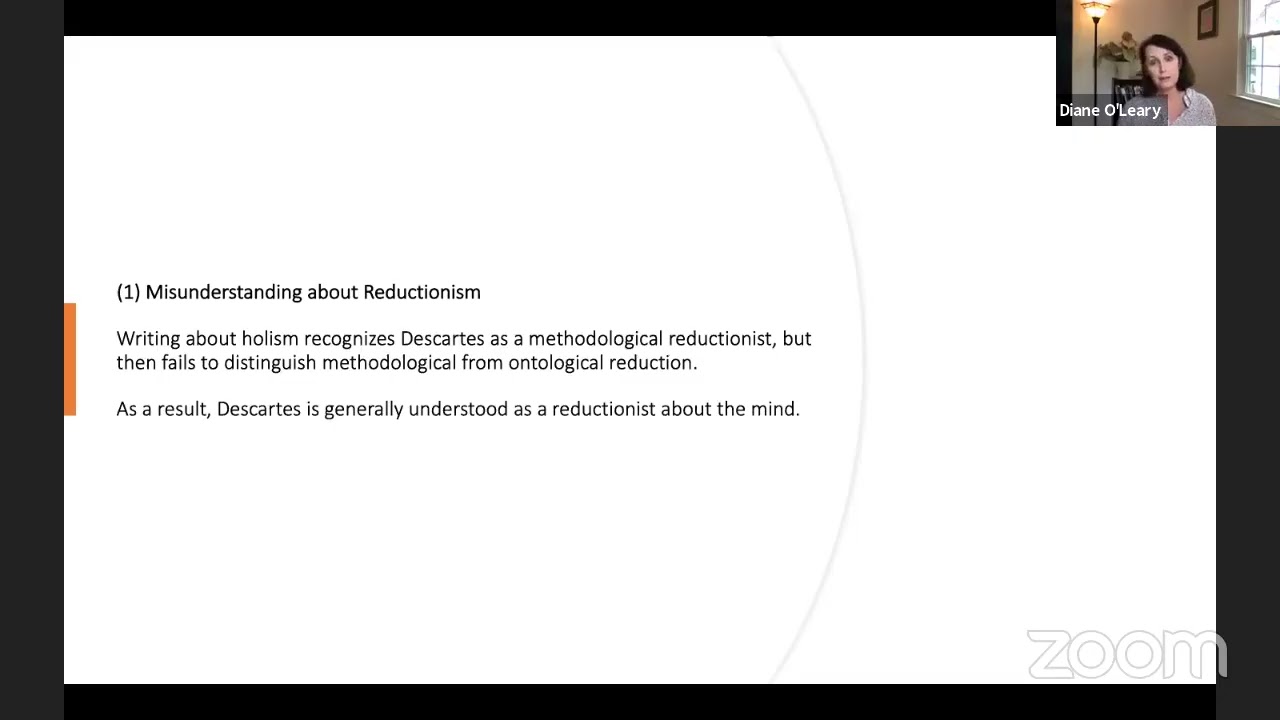
- First misunderstanding: conflation of methodological and ontological reductionism.
- Second misunderstanding: redefinition of dualism as epistemic separation.
- Two strands of holism: non-reductive and reductive.
- Reductive holism and the vagueness thesis in psychiatry.
- Medically unexplained symptoms and clinical implications.
Cited Sources
- Engel, G. (1977). The need for a new medical model: A challenge for biomedicine. — Cited as the primary source for the biopsychosocial model.
- Sullivan, M. (1986). In what sense is contemporary medicine dualistic? — Quoted to illustrate confusion about dualism in medical writing.
- Paley, J. (2000). The Cartesian dualism and the mind-body problem in medicine. — Quoted to show the rejection of dualism as a way to open to the mind.
- Gendo, K. (2016). Dualism discounts the significance of mental states. — Quoted as an example of medical writing on dualism.
- Miresco, M. J., & Kirmayer, L. J. (2006). The persistence of mind-brain dualism in psychiatric reasoning. — Cited as evidence of dualism persisting in psychiatry.
- DSM-IV and DSM-5 introductions — Cited to illustrate the vagueness thesis in psychiatry.
Concurring Sources
- Engel, G. (1977). The need for a new medical model. — Supports the historical account of holism.
- Miresco & Kirmayer (2006). Persistence of mind-brain dualism. — Supports the claim about dualism in psychiatry.
Dissenting Sources
- Critiques of the biopsychosocial model (e.g., Ghaemi, 2009) — Some argue the BPSM is too vague or not scientific, which contrasts with O'Leary's focus on conceptual clarity.
Contribution & Novelties
The talk offers a novel philosophical clarification of the conceptual confusions in medical holism, distinguishing between non-reductive and reductive holism and linking the latter to the vagueness thesis and clinical practice. This provides a framework for understanding ongoing debates in psychosomatic medicine.
Pour aller plus loin :
- Mind-body dualism — Overview of the philosophical concept.
- Biopsychosocial model — Background on the model proposed by Engel.
- Medically unexplained symptoms — Clinical relevance of the concept.
74 words
Radar Profile
The radar profile shows high scores in information quantity, quality, and technical level, with a slightly lower but still strong reliability score. This indicates a dense, well-argued philosophical talk with solid sourcing, though it remains an opinion piece rather than empirical research.