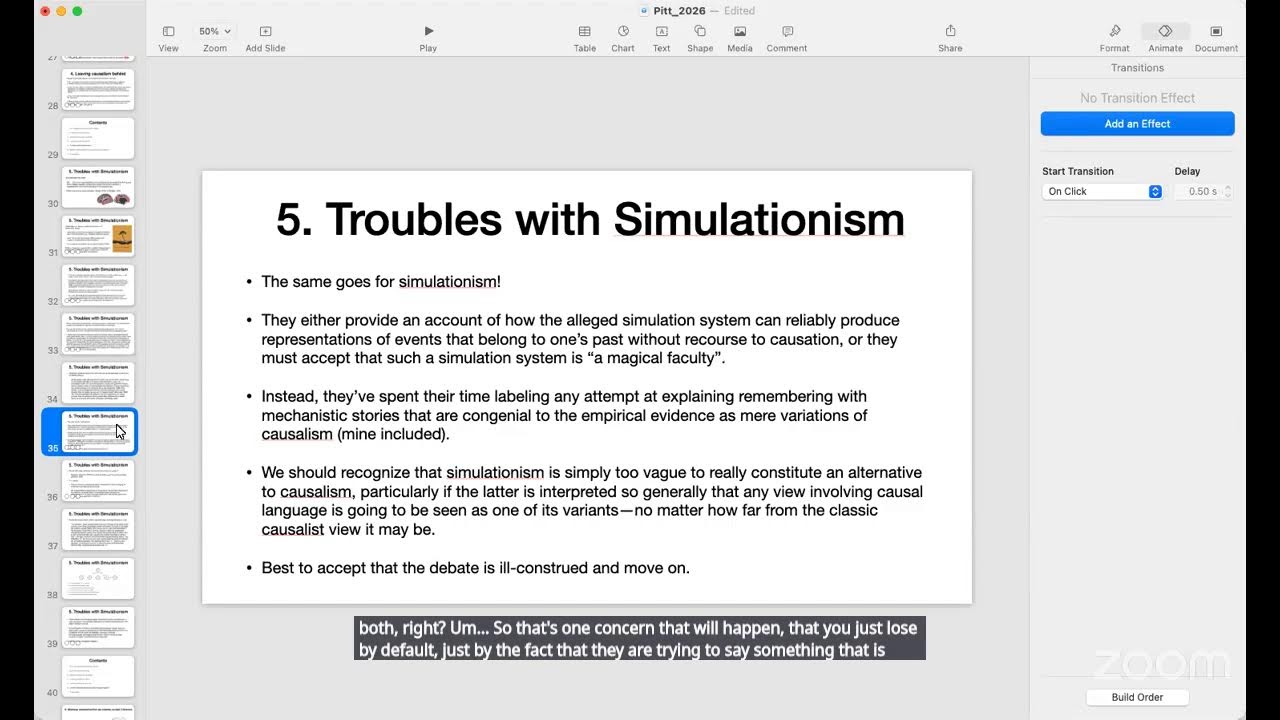
Remembering as Inverse Causal Inference
Keywords
Summary
141 words
Critical Evaluation
Value of the Information & Strength of the Argument
The talk provides a valuable contribution to the philosophy of memory by critically examining the foundations of the causalism/simulationism debate. De Brigard’s argumentation is rigorous and well-structured, systematically dismantling the causalist position through logical analysis and references to empirical findings. He effectively uses causal modeling and probability to reinterpret classic thought experiments, offering a novel perspective that reconciles competing views. The argument is persuasive and demonstrates deep expertise in both philosophy and cognitive science.
Scientific Rigor, Source Quality, Title Accuracy
De Brigard demonstrates high scientific rigor by engaging with key philosophical literature (Martin, Deutscher, Bernecker, Michaelian) and incorporating empirical research from cognitive psychology and neuroscience. He clearly cites sources and acknowledges the work of others, such as Peter Menzies. The title accurately reflects the content, and the talk is well-structured. The Q&A session further enhances credibility by addressing potential objections. Overall, the sources are appropriate and the title-content alignment is strong.
160 words
Title / Content Match
The title accurately reflects the central thesis of the talk, which proposes viewing remembering as a form of inverse causal inference.
Quality & Reliability
8/10
The talk presents a well-argued philosophical position by a leading expert, with references to empirical literature and logical analysis. However, it is primarily an opinion piece with limited empirical data, and the arguments are not peer-reviewed in this format.
Key Moments
Markers derived by PSI from the transcript: the creator did not define chapters.
- Introduction of Felipe De Brigard by the host.
- De Brigard introduces the causal question and the causalism/simulationism debate.
- Discussion of Martin and Deutscher's thought experiment and the notion of appropriate causation.
- Critique of Bernecker's five claims about the nature of causation.
- Introduction of causal modeling and probability to reinterpret thought experiments.
- Argument that intuitions about deviant causation are based on subjective probability, not spatiotemporal contiguity.
- Proposal of remembering as inverse causal inference and reconciliation of causalism and simulationism.
- Discussion of implications for memory reconstruction and counterfactual thinking.
- Q&A session begins, addressing questions about memory traces and empirical evidence.
- Concluding remarks and thanks.
Cited Sources
- De Brigard, F. (2023). Memory and Remembering. — Referenced as the author's own book where he first proposed reconciling causalism and simulationism.
- Martin, C.B. & Deutscher, M. (1966). Remembering. — Classic paper presenting the causal theory of memory.
- Bernecker, S. (2010). Memory: A Philosophical Study. — Key causalist work critiqued by De Brigard.
- Michaelian, K. (2016). Mental Time Travel: Episodic Memory and Our Knowledge of the Personal Past. — Representative of simulationism.
- Menzies, P. (2014). The Causal Structure of Mechanisms. — Referenced for arguments against causation as a natural relation.
Concurring Sources
- Michaelian, K. (2016). Mental Time Travel. — Supports the simulationist view that memory is constructive.
- Schacter, D.L. & Addis, D.R. (2007). The cognitive neuroscience of constructive memory. — Provides empirical evidence for the constructive nature of memory.
Dissenting Sources
- Bernecker, S. (2010). Memory: A Philosophical Study. — Defends causalism and the necessity of appropriate causation, which De Brigard critiques.
Contribution & Novelties
The talk offers a novel perspective by reframing the debate between causalism and simulationism, proposing that memory reconstruction can be understood as inverse causal inference. This reconciles the two views by emphasizing the constructive nature of memory while retaining a central role for causation. The use of causal modeling and probability to reinterpret thought experiments is an original contribution that challenges traditional intuitions.
Pour aller plus loin :
- Causal inference — Relevant for understanding the methodological framework used.
- Episodic memory — Core concept in the talk.
- Counterfactual thinking — Related to De Brigard’s earlier work on imagination and memory.
- Constructive memory — Relevant to the simulationist perspective.
107 words
Radar Profile
The profile shows high scores in information quantity, quality, and reliability, with a slightly lower technical level due to the philosophical nature of the talk. This indicates a well-balanced presentation that is both informative and credible.
💬 No comments were provided for analysis.