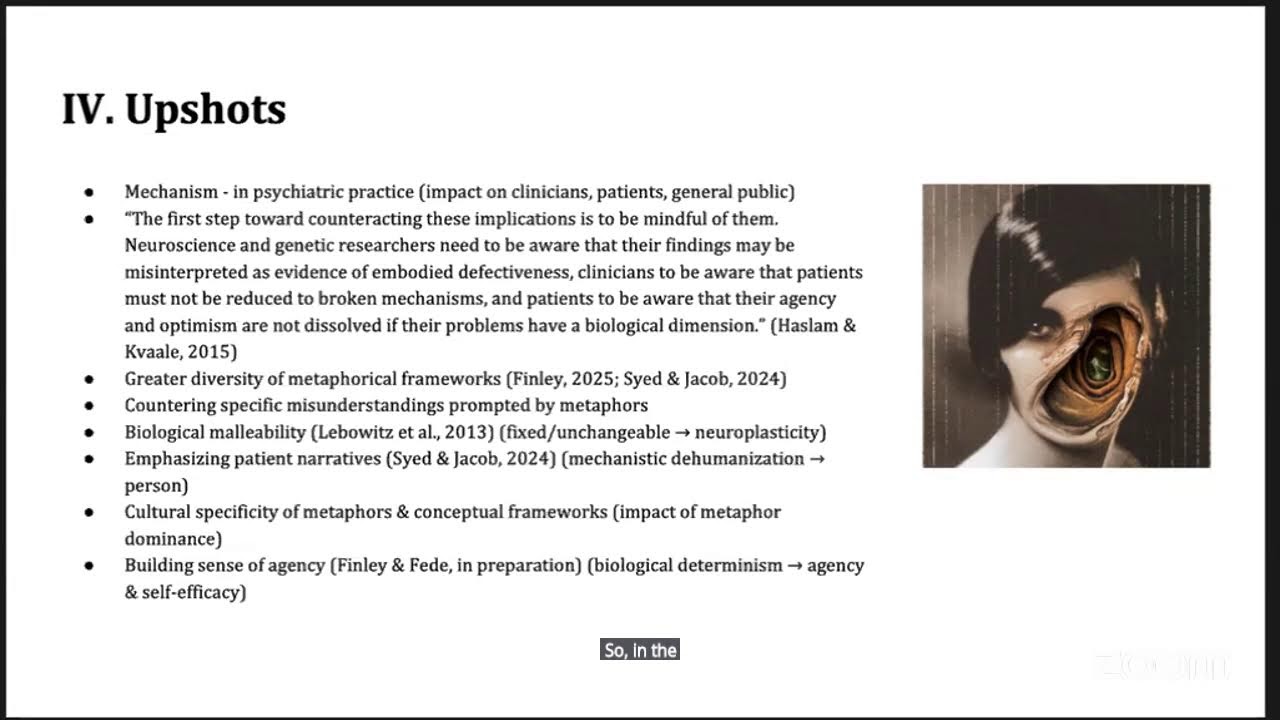
Mechanisms & Machine Metaphors in Psychiatry
Keywords
Summary
120 words
Critical Evaluation
Value of the Information & Strength of the Argument
The talk provides a valuable synthesis of philosophical and empirical literature, offering a novel explanation for the persistence of reductionistic interpretations in psychiatry. Finley’s argument is well-structured, moving from definitions to evidence to theoretical analysis. She effectively uses examples and quotes from key figures to support her claims. The argument is nuanced, acknowledging both positive and negative effects of biogenetic explanations. However, some parts are speculative, and the proposed alternative framework is not fully developed.
Scientific Rigor, Source Quality, Title Accuracy
Finley demonstrates scientific rigor by grounding her argument in established philosophical concepts (New Mechanist philosophy) and empirical studies. She cites specific researchers (e.g., Joseph Davis, Thomas Insel) and frameworks (RDoC, Kendler’s MPC model). The sources are credible and relevant. The title accurately reflects the content, and the talk is well-organized. The presentation is clear, though some sections are rushed due to time constraints.
153 words
Title / Content Match
The title accurately reflects the content, focusing on the role of mechanism concepts and machine metaphors in psychiatry.
Quality & Reliability
8/10
The talk is a well-structured philosophical analysis grounded in empirical literature and contemporary psychiatric frameworks. The speaker, an associate professor in philosophy, presents nuanced arguments with clear definitions and references to key works. However, as a single lecture, it lacks peer review and some claims are based on selected studies.
Key Moments
Markers derived by PSI from the transcript: the creator did not define chapters.
- Introduction and overview of the talk's structure.
- Definition of biogenetic explanations and contrast with biopsychosocial model.
- Empirical evidence of effects of biogenetic explanations on stigma and self-efficacy.
- Discussion of RDoC and its interpretation as reductionistic despite pluralistic intent.
- Introduction of machine metaphors and their role in creating explanatory vacuums.
- Analysis of minimal mechanism notions and their limitations in psychiatry.
- Kendler's mechanistic property cluster model and its promissory note.
- Implications for clinical practice and patient self-conception.
- Proposal of alternative framework and conclusion.
Cited Sources
- Joseph Davis's book on neurobiological imaginary — Mentioned as recent work on how young people conceptualize suffering in terms of brain states.
- Thomas Insel's reflection on NIMH — Quoted on the lack of progress in reducing suicide and hospitalizations despite neuroscience push.
- Kendler, Zachar, and Craver's mechanistic property cluster model — Discussed as an example of minimal mechanism notion in psychiatry.
- Lauren Ross and Bassett's taxonomy of mechanism usage — Referenced for categorizing uses of mechanism in neuroscience.
- American Psychiatric Association president's quote on biopsychosocial model — Quoted on the colonization of psychological and social by biological.
Concurring Sources
- Empirical studies on biogenetic explanations and stigma — Cited in the talk as evidence for negative effects.
- Philosophical literature on mechanisms in psychiatry — Referenced for the minimal mechanism notion.
Dissenting Sources
- Potential counterarguments from proponents of biogenetic explanations — Some may argue that biogenetic explanations reduce blame and increase legitimacy, which Finley acknowledges but argues are insufficient to explain the negative effects.
Contribution & Novelties
The talk offers a novel perspective on why biogenetic explanations in psychiatry often lead to reductionistic interpretations, attributing this to the influence of machine metaphors that fill conceptual gaps left by minimal mechanism accounts. This provides a new explanatory framework for empirical findings on stigma and pessimism. The proposal for an alternative framework, though not fully detailed, suggests a promising direction for future research.
Pour aller plus loin :
- New Mechanist Philosophy — Overview of mechanistic explanation in science.
- RDoC Framework — Official description of the Research Domain Criteria.
- Biopsychosocial Model — Background on the biopsychosocial approach in medicine.
99 words
Radar Profile
The radar profile shows high scores in information quantity, quality, and technical level, indicating a well-researched and detailed presentation. The fiabilite_globale is also high, reflecting the use of credible sources and rigorous argumentation. The overall balance suggests a strong academic talk.
💬 Sur les 0 commentaires analysés, aucune tendance n'est disponible.