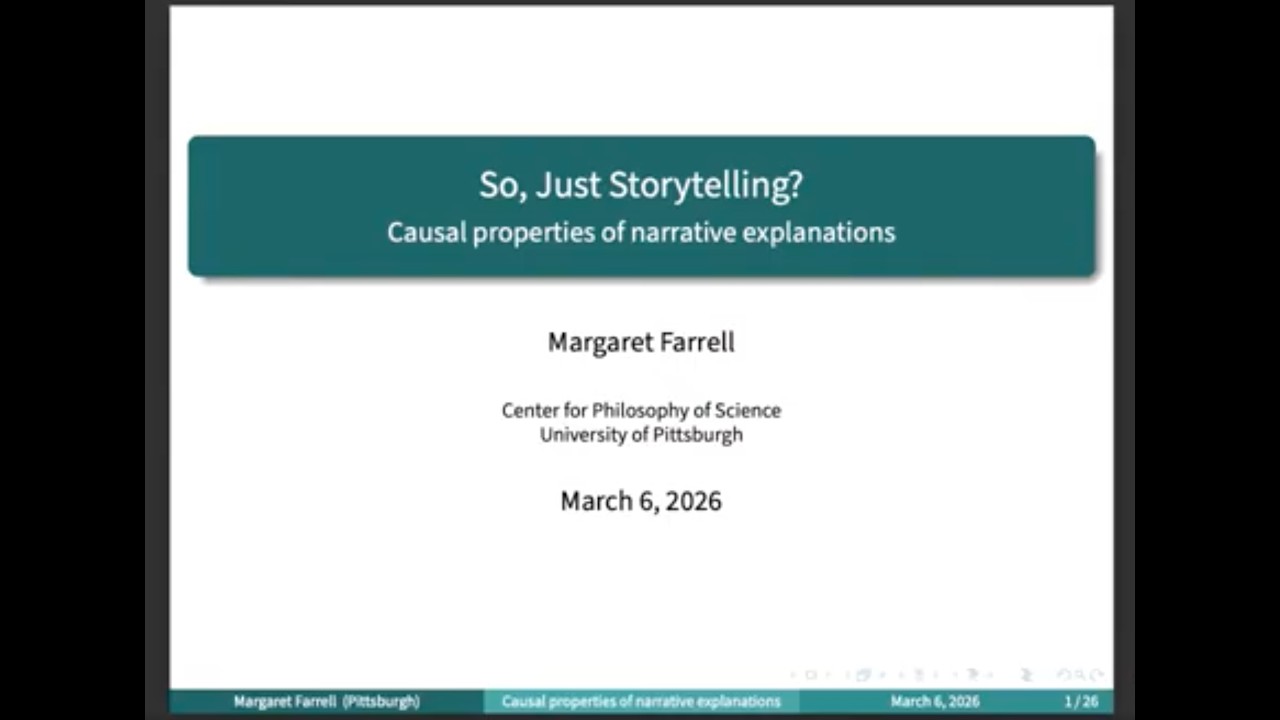
Causal Properties of Narrative Explanations
Keywords
Summary
152 words
Critical Evaluation
Value of the Information & Strength of the Argument
The talk offers a valuable contribution to the philosophy of science by proposing a novel account of narrative explanation that integrates with interventionist causal explanation. The argument is well-structured and builds on existing literature, providing a clear framework for understanding when narratives are used in science. Farrell’s critique of previous accounts is insightful, and her use of a concrete example from human evolution helps illustrate her points. The argumentation is solid, though it remains at a theoretical level and would benefit from further empirical or case-based support.
Scientific Rigor, Source Quality, Title Accuracy
The talk demonstrates high scientific rigor, with careful engagement with relevant philosophical literature, including works by Woodward, Beatty, Curry, and Sterelny. The sources are appropriately cited and discussed. The title accurately reflects the content, and the talk stays focused on its thesis. The presentation is well-organized and clear, making it accessible to a philosophical audience. No comments were provided, so no analysis of public reception is possible.
169 words
Title / Content Match
The title accurately reflects the content: the talk focuses on the causal properties of narrative explanations and proposes an interventionist account.
Quality & Reliability
8/10
The talk is a well-structured philosophical presentation by a postdoctoral researcher with relevant publications. It engages with established literature (Woodward, Beatty, Curry, Sterelny) and provides a clear argument. The reasoning is rigorous, though it is an expert opinion rather than empirical research.
Key Moments
Markers derived by PSI from the transcript: the creator did not define chapters.
- Introduction and overview of the talk's structure.
- Discussion of narrative properties using the 'Elephant's Child' story.
- Examples of narrative explanations in historical sciences.
- Options for accounts of narrative explanation.
- Introduction of the interventionist account and Woodward's framework.
- Application to Sarah Hrdy's cooperative breeding hypothesis.
- Critique of Beatty, Curry, and Sterelny's accounts.
- Proposal of narrative causal systems and their properties.
- Strategies for evaluating narrative explanations.
- Conclusion and Q&A.
Cited Sources
- Woodward, J. (2003). Making Things Happen: A Theory of Causal Explanation. — Cited as the basis for the interventionist account of causation and explanation.
- Beatty, J. (2016). What are narratives good for? — Discussed as an account of narrative explanation focusing on chancy choice points.
- Curry, A. (2014). Narrative and historical explanation. — Cited for his work on narrative explanation in historical sciences.
- Sterelny, K. (2016). Contingency and history. — Mentioned in relation to action sequence explanations.
- Hrdy, S. B. (2009). Mothers and Others: The Evolutionary Origins of Mutual Understanding. — Used as the main example of a narrative explanation in human evolution.
Concurring Sources
- Woodward, J. (2003). Making Things Happen: A Theory of Causal Explanation. — The interventionist framework is consistent with the proposed account.
- Beatty, J. (2016). What are narratives good for? — Shares the idea that narratives are suited for certain explanatory targets.
Dissenting Sources
- Curry, A. (2014). Narrative and historical explanation. — Curry's account may be more permissive about when narratives are explanatory, whereas Farrell's account is more restrictive.
Contribution & Novelties
The talk proposes a novel account of narrative explanation that integrates with interventionist causal explanation, arguing that narrative representations are well-suited for conveying information about causal systems with certain properties. This moves beyond previous accounts by focusing on the causal structure itself rather than the narrative form. The account offers a framework for evaluating narrative explanations in science.
Pour aller plus loin :
- Interventionism (philosophy) — Provides background on Woodward’s interventionist theory.
- Narrative explanation — Stanford Encyclopedia of Philosophy entry on narrative explanation.
- Cooperative breeding — Relevant to Hrdy’s hypothesis on human evolution.
93 words
Radar Profile
The radar profile shows high scores in all dimensions, indicating a well-rounded and rigorous presentation. The talk is technically detailed, provides substantial information, and demonstrates high reliability through engagement with established literature.