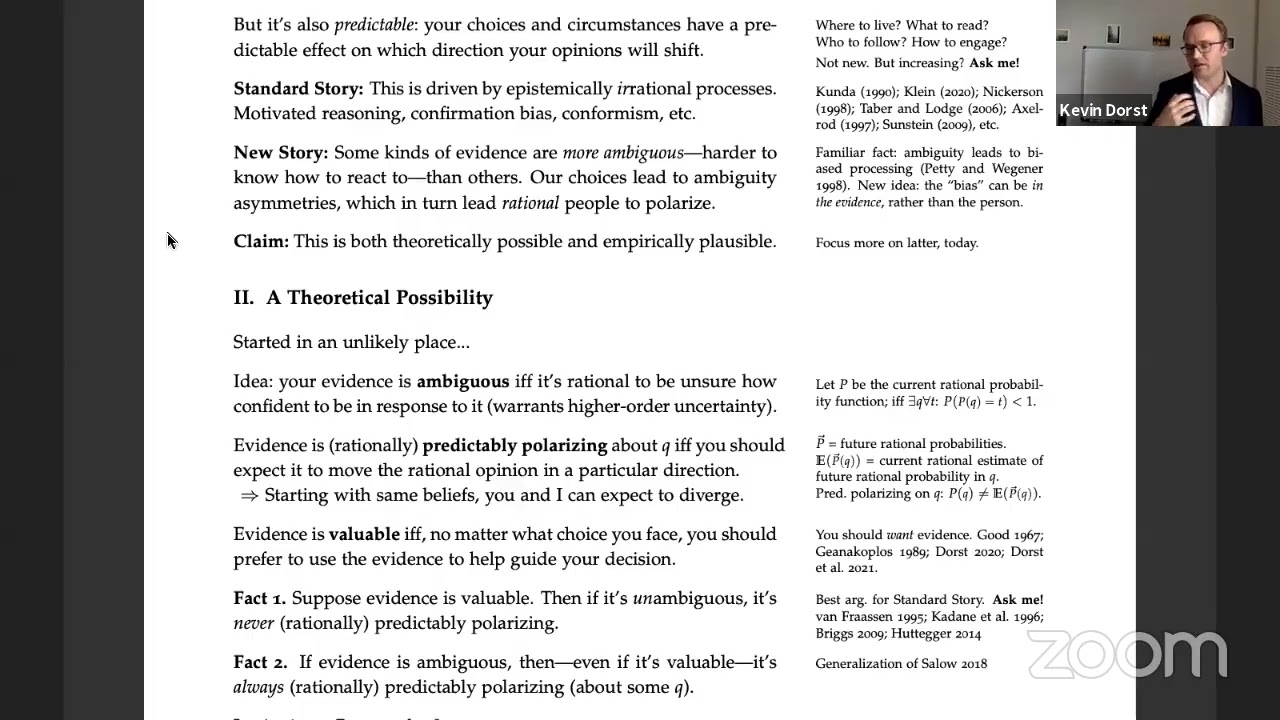
Kevin Dorst modeling rational polarization
Keywords
Summary
171 words
Critical Evaluation
Value of the Information & Strength of the Argument
The talk offers a novel and valuable perspective on polarization, challenging the common assumption that it is purely irrational. Dorst provides a clear theoretical framework, connecting formal epistemology with psychological findings. The argument is well-structured: he starts with a formal definition of ambiguity, then shows how it leads to predictable polarization in a Bayesian model, and finally illustrates with a concrete example. The word completion task is an effective intuitive illustration. However, the empirical evidence for the mechanism is not presented in detail, and the talk is more theoretical than empirical. The argumentation is solid within the formal framework, but the leap to real-world polarization is plausible rather than proven.
Scientific Rigor, Source Quality, Title Accuracy
The talk is scientifically rigorous in its formal modeling, drawing on established concepts in Bayesian epistemology and higher-order evidence. Dorst references psychological findings on ambiguity and polarization, though he does not cite specific studies in the talk. The title accurately reflects the content. The talk is given at a university center, suggesting academic credibility. However, as a single presentation, it lacks the scrutiny of peer review. The handout mentioned is not provided in the description, so the sources cited are not directly accessible. Overall, the scientific rigor is high, but the lack of explicit citations and empirical data limits the assessment.
226 words
Title / Content Match
The title accurately reflects the content: Kevin Dorst presents a model of rational polarization, focusing on how ambiguity in evidence can lead to predictable polarization.
Quality & Reliability
8/10
The talk is given by a professional philosopher (Kevin Dorst) at a university center, presenting a formal model and empirical plausibility for rational polarization. The argument is structured, references psychological findings and formal epistemology, and is delivered in an academic setting. However, it is a single presentation without peer review or published paper, and the empirical evidence is preliminary.
Key Moments
Markers derived by PSI from the transcript: the creator did not define chapters.
- Introduction and announcement of upcoming events.
- Kevin Dorst introduces the topic of polarization and the standard story.
- Dorst presents his alternative story: ambiguity in evidence leads to rational polarization.
- He explains the connection between higher-order evidence and ambiguous evidence.
- Formal definitions of ambiguous evidence and predictable polarization are introduced.
- He presents the theorem that ambiguous evidence is predictably polarizing.
- Introduction of the word completion task as an example.
- He explains why the word completion task is predictably polarizing.
- Formal model of the word completion task is presented.
- Discussion of why the evidence is valuable and the empirical plausibility.
Contribution & Novelties
The talk offers a novel theoretical framework for understanding polarization as potentially rational, by formalizing the concept of ambiguous evidence and showing its connection to predictable polarization. This challenges the dominant view that polarization is driven by irrational biases. The word completion task provides a concrete illustration. The talk also suggests that the bias may lie in the evidence itself, not the individual, which is a significant shift in perspective.
Pour aller plus loin :
- Bayesian epistemology — Relevant for the formal modeling of belief revision.
- Confirmation bias — Discussed as a potential alternative explanation.
- Higher-order evidence — The concept is central to the talk’s theoretical foundation.
107 words
Radar Profile
The radar profile shows high scores in quantity and quality of information, and moderate technical level, indicating a well-structured and informative talk. The reliability is also high, reflecting the academic context. The talk is strong in theoretical depth but may be less accessible to a general audience.