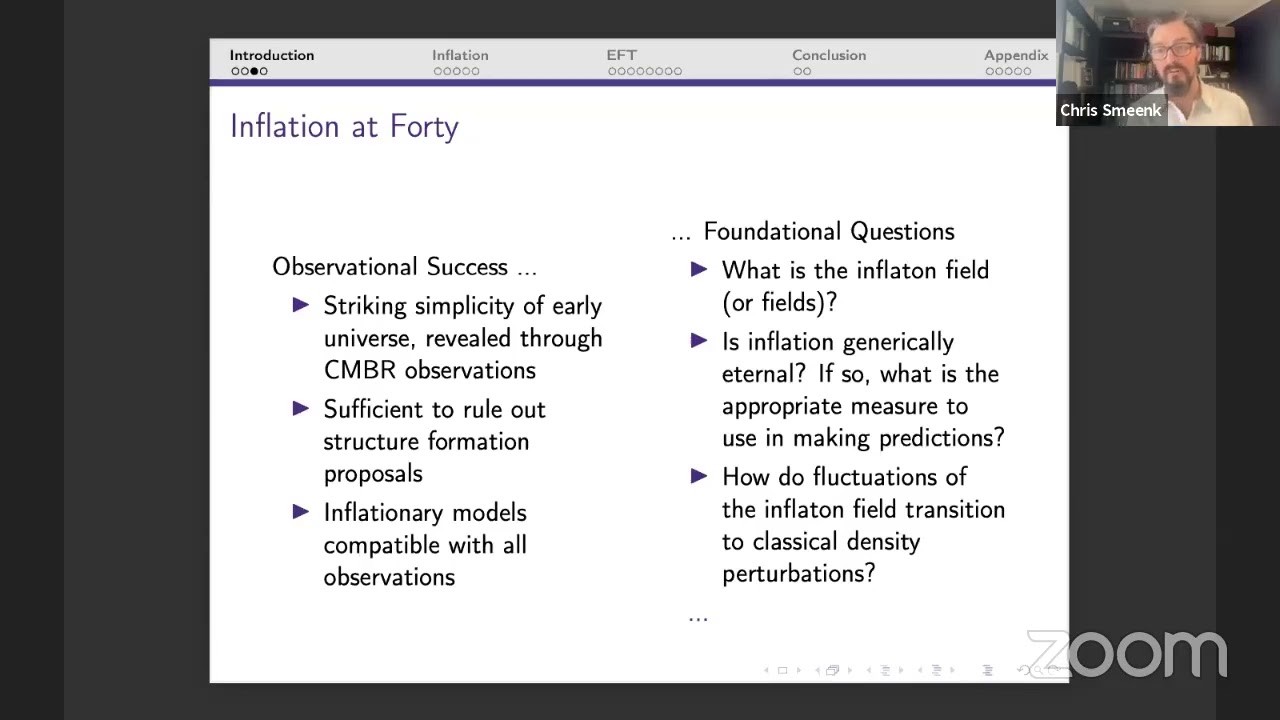
Chris Smeenk Decoupling from the Initial State Cosmology Beyond Spacetime
Keywords
Summary
120 words
Critical Evaluation
Value of the Information & Strength of the Argument
The talk provides a valuable critical perspective on inflationary cosmology, synthesizing observational successes with foundational challenges. Smeenk’s argument is well-structured, moving from the standard picture of inflation to the question of decoupling, and he supports his claims with references to key literature and historical context. He effectively uses the concept of effective field theory to frame the discussion, and his argument that inflation is sensitive to UV physics is compelling. However, the talk is largely a review of existing debates rather than presenting new empirical evidence, and some arguments rely on philosophical rather than empirical grounds.
Scientific Rigor, Source Quality, Title Accuracy
Smeenk demonstrates scientific rigor by referencing specific models (e.g., R^2 inflation), observational data (Planck), and key papers (e.g., Mukhanov-Sasaki equation). He clearly distinguishes between established results and open questions. The title accurately reflects the content, focusing on the decoupling issue. The talk is well-sourced, though it does not include a formal bibliography; the references are mentioned in passing. The adequacy between title and content is high, as the talk directly addresses the question of decoupling from the initial state.
190 words
Title / Content Match
The title accurately reflects the content, focusing on the decoupling of inflationary cosmology from initial state assumptions.
Quality & Reliability
8/10
The talk is a scholarly presentation by an expert in philosophy of physics, drawing on established literature and presenting a balanced view of inflationary cosmology. It is not peer-reviewed but reflects deep expertise and careful argumentation.
Key Moments
Markers derived by PSI from the transcript: the creator did not define chapters.
- Introduction to the talk and the question of decoupling from the initial state.
- Overview of inflationary cosmology and its observational success.
- Discussion of foundational questions in inflation, including the nature of the inflaton and eternal inflation.
- Introduction to effective field theory and the concept of decoupling.
- Analysis of whether inflation decouples from UV physics, with examples of sensitivity.
- Discussion of the robustness of inflationary predictions to pre-inflationary conditions.
- Comparison with historical cases of decoupling in physics and the role of underdetermination.
- Conclusion summarizing the challenges to decoupling and implications for cosmology.
Cited Sources
- Planck Collaboration results — Mentioned as providing observational constraints on inflationary parameters.
- Encyclopedia Inflationaris by Jerome Martin et al. — Referenced as a review of nearly 200 inflationary models.
- Mukhanov-Sasaki equation — Discussed as the equation governing the evolution of perturbations during inflation.
- R^2 inflation by Alexei Starobinsky — Cited as an example of a model that fits observational data well.
Concurring Sources
- Planck Collaboration results — Observational data supporting inflation's predictions.
- Starobinsky's R^2 inflation model — A model that fits the data and is discussed in the talk.
Dissenting Sources
- Steinhardt, EOS, and Turok criticisms — They question the plausibility of inflationary models and the likelihood of the initial state.
Contribution & Novelties
The talk offers a philosophical analysis of the decoupling problem in inflationary cosmology, synthesizing recent debates and emphasizing the sensitivity of inflation to UV physics. It provides a nuanced perspective on the observational success of inflation, arguing that it does not fully resolve foundational issues.
Pour aller plus loin :
- Effective field theory — Provides background on the EFT framework used in the talk.
- Inflationary cosmology — Overview of the inflationary paradigm and its observational status.
- Quantum gravity — Discusses the unresolved issues in quantum gravity that inflation is sensitive to.
91 words
Radar Profile
The radar profile shows high scores in information quality and technical level, reflecting the depth and rigor of the talk. The moderate scores in quantity and reliability indicate that while the talk is rich in content, it is based on expert opinion rather than new empirical data.
💬 No comments were provided for analysis.