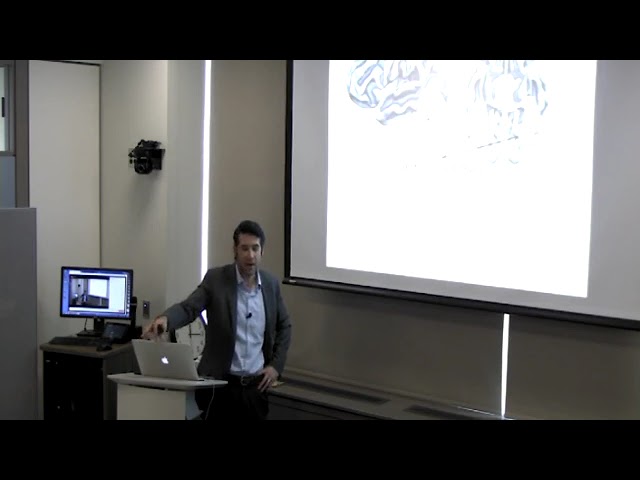
Live from the Center with Bradford Mahon
Keywords
Summary
156 words
Critical Evaluation
Value of the Information & Strength of the Argument
The talk provides a valuable synthesis of key findings in cognitive neuroscience, integrating patient studies and theoretical frameworks. Mahon’s argumentation is solid, building logically from established dissociations to his hypothesis about the interaction between ventral and dorsal streams. He carefully distinguishes facts from hypotheses, and his reasoning is transparent. The use of patient DF and other cases strengthens the argument, though the lecture format limits the depth of evidence presented.
Scientific Rigor, Source Quality, Title Accuracy
The scientific rigor is high; Mahon references classic studies (e.g., Goodale et al. 1991) and presents data from his own lab. The sources are credible, though not exhaustively cited in the talk. The title is generic but does not misrepresent the content; it accurately describes the format and speaker. The talk is appropriate for an academic audience, but the lack of detailed citations in the video description is a minor limitation.
156 words
Title / Content Match
The title accurately reflects the format (live talk) and the speaker, but does not indicate the specific topic; it is generic but not misleading.
Quality & Reliability
8/10
The talk is delivered by a recognized expert in cognitive neuroscience, presenting established findings and hypotheses with appropriate nuance. The content aligns with current scientific consensus, though it is a lecture rather than a peer-reviewed publication.
Key Moments
Markers derived by PSI from the transcript: the creator did not define chapters.
- Introduction of speaker and topic
- Definition of functional specialization and its implications
- Discussion of the dark side of functional specialization and diaschisis
- Overview of ventral and dorsal visual pathways
- Patient DF and the dissociation between perception and action
- End-state comfort and its implications for grasping
- Dissociations within object identification: form vs. texture
- Patient with impaired color knowledge and its neural basis
- Future directions and collaboration with neurosurgery
Cited Sources
- Goodale et al. (1991) - A neurological dissociation between perceiving objects and grasping them — Cited as the classic paper describing patient DF and the dissociation between visual perception and visuomotor control.
Concurring Sources
- Goodale & Milner (1992) - Separate visual pathways for perception and action — Foundational paper supporting the ventral/dorsal distinction.
Contribution & Novelties
The talk offers a coherent framework for understanding object concepts by integrating functional specialization, connectivity, and patient evidence. It highlights the often-overlooked interaction between ventral and dorsal streams in object grasping. The discussion of end-state comfort provides a behavioral link between perception and action. The future direction involving neurosurgery collaborations suggests potential for direct neural recordings.
Pour aller plus loin :
- Two visual systems hypothesis — Overview of the ventral and dorsal streams.
- Visual agnosia — Condition exemplified by patient DF.
- Diaschisis — Concept of remote effects of brain lesions.
90 words
Radar Profile
The radar profile shows high scores in quality and reliability, with slightly lower scores in quantity and technical level, reflecting a focused lecture rather than a comprehensive review.