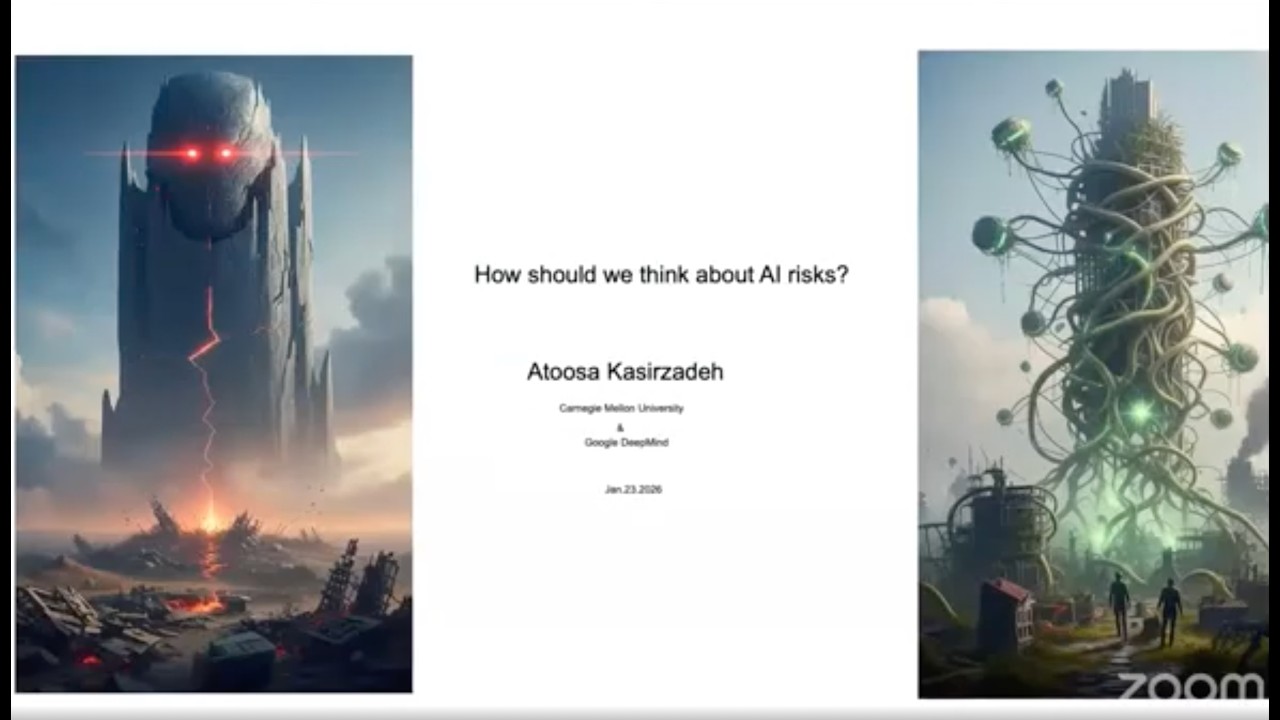
Lunchtime Talk – Atoosa Kasirzadeh 1/23/26
Keywords
Summary
194 words
Critical Evaluation
Value of the Information & Strength of the Argument
The talk provides valuable insights by challenging a prevalent dichotomy in AI risk discourse. Kasirzadeh’s argument is well-structured and draws on her extensive experience as a practitioner. She effectively illustrates the two camps with concrete examples (e.g., taxonomy of harms, Yudkowsky’s book) and introduces a novel ‘polycrisis’ model that integrates non-existential and existential risks. The argumentation is persuasive, though it relies heavily on her personal perspective and interpretation of the field. She acknowledges the limitations and the need for further research.
Scientific Rigor, Source Quality, Title Accuracy
The talk demonstrates scientific rigor by referencing specific papers (e.g., Kasirzadeh, 2025; Gyevnar & Kasirzadeh, 2025) and concepts (orthogonality thesis, instrumental convergence). However, the sources are not systematically cited with URLs, and the talk is primarily an opinion piece. The title accurately reflects the content, and the abstract aligns with the talk’s structure. The speaker’s credentials add to the credibility, but the lack of formal citations and the reliance on anecdotal evidence slightly reduce the overall rigor.
173 words
Title / Content Match
The title accurately reflects the content: a lunchtime talk by Atoosa Kasirzadeh, with the date specified. The abstract and talk focus on how to conceptualize AI risk.
Quality & Reliability
8/10
The speaker is an established AI researcher and philosopher with affiliations at Carnegie Mellon University, Google DeepMind, and the Center for the Governance of AI. The talk presents a well-structured argument based on her own research and collaborations, referencing specific papers and concepts. However, it is primarily an opinion piece based on personal experience and interpretation, not a systematic review or original study.
Key Moments
Markers derived by PSI from the transcript: the creator did not define chapters.
- Introduction of the speaker and her background.
- Kasirzadeh outlines the three main points of the talk.
- Discussion of four different meanings of 'risk from AI'.
- Description of the split between existential and non-existential risk in AI practitioners' conceptions.
- Overview of the taxonomy of harms from language models, including bias, misinformation, and malicious use.
- Introduction of the AI safety community and the extinction risk narrative, including the 2023 statement.
- Discussion of Yudkowsky's book 'If Anyone Builds It, Everyone Dies' and its policy implications.
- Presentation of the computational analysis of the literature, showing the dichotomy falls apart.
- Introduction and defense of the polycrisis model of AI existential risk.
- Discussion of implications for governance and mitigation, and concluding remarks.
Cited Sources
- Kasirzadeh, 2025 (paper on AI risk) — Referenced as recent work by the speaker on AI risk.
- Gyevnar & Kasirzadeh, 2025 (computational investigations) — Referenced as joint work with her postdoc on computational analysis of AI risk literature.
- If Anyone Builds It, Everyone Dies (book by Eliezer Yudkowsky and Nate Soares) — Discussed as a recent book advocating for a halt on advanced AI development.
Concurring Sources
- Statement on AI Extinction Risk (2023) — The statement quoted in the talk, signed by many AI researchers.
Dissenting Sources
- Yudkowsky and Soares' book 'If Anyone Builds It, Everyone Dies' — The book represents the AI safety perspective that the speaker argues against, focusing on extinction risk as the primary concern.
Contribution & Novelties
The talk offers a novel perspective by challenging the dichotomy between AI ethics and AI safety, proposing a ‘polycrisis’ model that integrates non-existential and existential risks. This is a significant contribution to the philosophical and practical discourse on AI risk. The computational analysis of the literature (with Gyimesi) provides empirical support for the argument.
Pour aller plus loin :
- AI Ethics — Overview of the field of AI ethics.
- Existential risk from artificial general intelligence — Background on existential risk from AI.
- Instrumental convergence — Concept discussed in the talk.
90 words
Radar Profile
The radar profile shows high scores in information quantity, quality, and reliability, with a slightly lower technical level. This indicates a talk that is rich in content and well-supported, but not overly technical, making it accessible to a broader audience.
💬 No comments were provided for analysis.