Functional Localization in Flux
Keywords
Summary
105 words
Critical Evaluation
Value of the Information & Strength of the Argument
The talk provides a valuable conceptual clarification of functional localization, offering a nuanced framework that can help structure debates. The argumentation is solid, drawing on historical and contemporary examples. However, it is primarily an expert opinion piece, and the empirical evidence for some claims is not fully detailed. The speaker acknowledges the complexity and avoids oversimplification, which strengthens the argument.
Scientific Rigor, Source Quality, Title Accuracy
The talk demonstrates scientific rigor by referencing key historical figures and contemporary researchers. However, specific citations are not always provided in the video, and the speaker relies on general knowledge. The title accurately reflects the content, and the talk is well-structured. The speaker’s expertise in philosophy of science and neuroscience lends credibility.
127 words
Title / Content Match
The title accurately reflects the content, which discusses the ongoing debates and conceptual analysis of functional localization.
Quality & Reliability
8/10
The talk is a well-structured conceptual analysis by a philosopher of science with expertise in cognitive neuroscience. It draws on historical and contemporary literature, presenting a clear framework. However, it is an opinion/expert talk, not a systematic review, and some claims are not fully referenced in the video.
Key Moments
Markers derived by PSI from the transcript: the creator did not define chapters.
- Introduction and overview of the talk's structure.
- Historical background: Gall, Flourens, Broca, and the 19th century debates.
- 20th century: Lashley's equipotentiality and mass action.
- Rise of neuroimaging and modern localizationist views.
- Contemporary anti-localizationist arguments and the need for conceptual analysis.
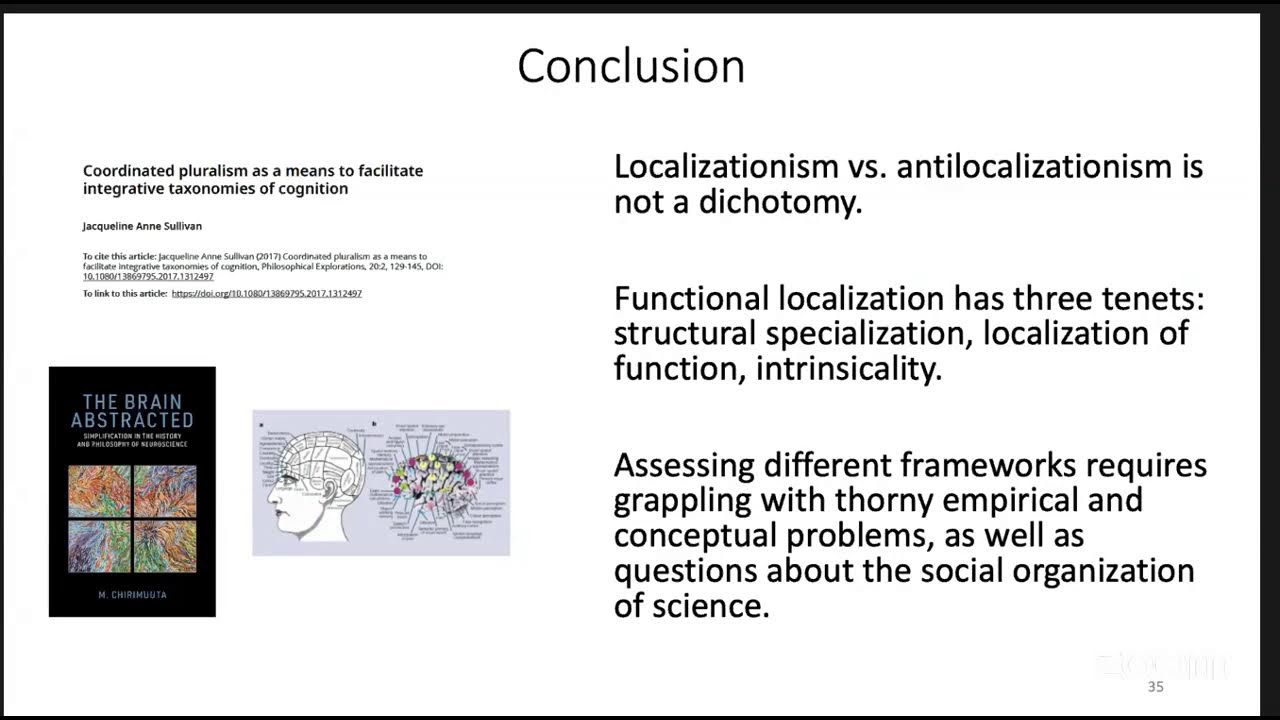
- Presentation of the three tenets: structural specialization, localization of function, intrinsicality.
- Discussion of neural reuse and its implications.
- Discussion of degeneracy and multiple realization.
- Discussion of context sensitivity and the role of networks.
- Application of the framework to current debates and the issue of bias.
Cited Sources
- Mundale, J. (2002). Concepts of localization — Referenced as a philosophical analysis of localization debates.
- Anderson, M. L. (2010). Neural reuse: A fundamental organizational principle of the brain — Referenced for the concept of neural reuse.
- Edelman, G. M., & Gally, J. A. (2001). Degeneracy and complexity in biological systems — Referenced for the concept of degeneracy.
- Seghier, M. L., et al. (2012). Reading and the left ventral occipitotemporal cortex — Referenced as an example of degeneracy in reading.
Concurring Sources
- Mundale, J. (2002). Concepts of localization — Provides a similar analysis of localization debates.
- Anderson, M. L. (2010). Neural reuse — Supports the idea that brain regions are multifunctional.
Dissenting Sources
- Kanwisher, N. (2010). Functional specificity in the human brain — Represents a strong localizationist view that may conflict with the anti-localizationist arguments discussed.
Contribution & Novelties
The talk offers a novel conceptual framework for understanding functional localization, breaking it down into three distinct tenets. This helps clarify debates and identify what exactly is being contested. The application to contemporary neuroscience and the discussion of bias are original contributions.
Pour aller plus loin :
- Neural reuse — Relevant to the concept of structural specialization violation.
- Degeneracy (biology) — Relevant to the concept of localization of function violation.
- Multiple realizability — Relevant to the philosophical implications of degeneracy.
- Functional magnetic resonance imaging — Relevant to the methods used in cognitive neuroscience.
93 words
Radar Profile
The radar profile shows high scores in quantity and quality of information, with moderate technical level and reliability. This indicates a well-informed talk that is accessible to a general academic audience but may lack deep technical detail.
💬 No comments were provided for analysis.