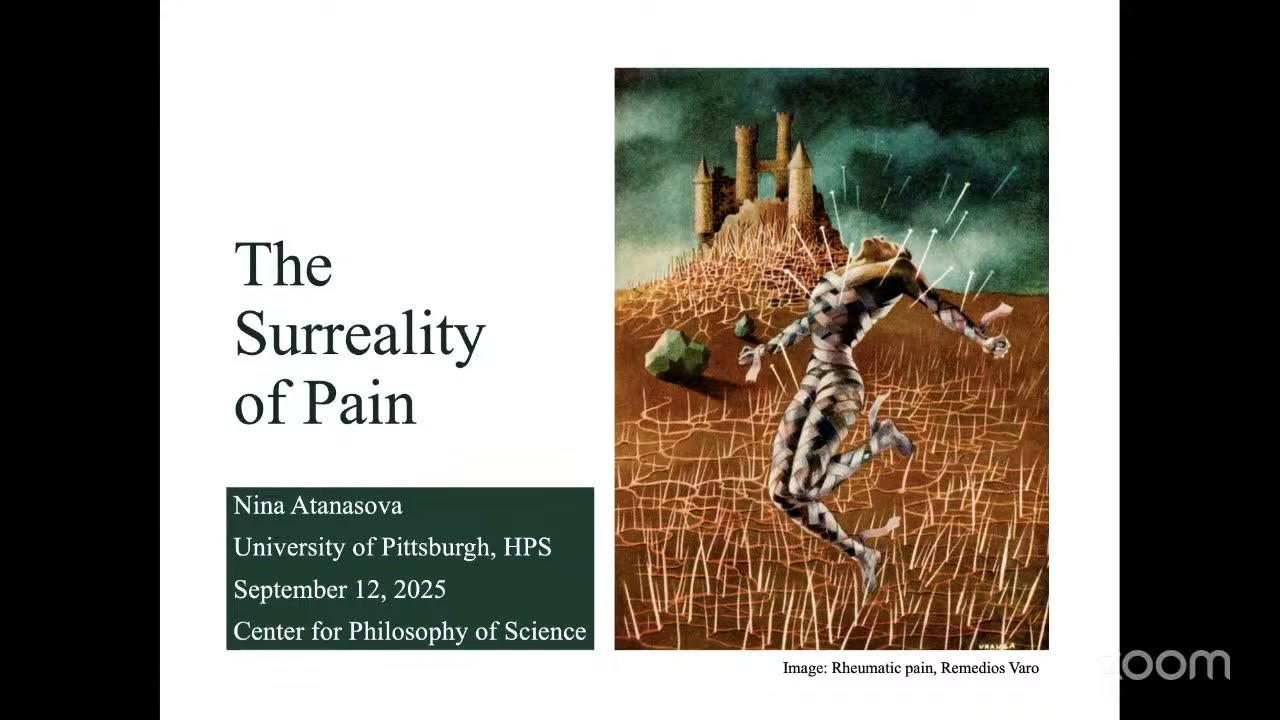
The Surreality of Pain
Keywords
Summary
160 words
Critical Evaluation
Value of the Information & Strength of the Argument
The talk offers a valuable contribution by clarifying the different senses of pain eliminativism and proposing a novel interpretation that reconciles eliminativism with the reality of pain. The argument is logically structured, moving from definitions to challenges to a case study. The use of the phlogiston analogy is effective in illustrating the distinction between eliminating a theoretical entity and eliminating the phenomenon it was meant to explain. However, the argument would benefit from more detailed engagement with the empirical literature on pain, particularly the acetaminophen studies, which are mentioned but not critically assessed. The speaker’s reliance on the biopsychosocial model as the ‘state-of-the-art’ is reasonable but could be challenged by other frameworks.
Scientific Rigor, Source Quality, Title Accuracy
The talk demonstrates scientific rigor by grounding the discussion in the works of Dennett, Hardcastle, Corns, Baetu, and others, and by referencing the International Association for the Study of Pain’s definition. The sources are relevant and up-to-date. The title is catchy and accurately reflects the content’s focus on the paradoxical nature of pain. The presentation is well-organized, though the lack of visual aids or detailed citations in the slides (if any) is a minor limitation. The speaker’s expertise is evident, and the argument is presented with appropriate nuance.
215 words
Title / Content Match
The title 'The Surreality of Pain' aptly captures the talk's central thesis: pain is real as an experience, but not as commonly conceived. The content aligns well with this provocative framing.
Quality & Reliability
7/10
The talk is a well-structured philosophical argument, grounded in contemporary literature on pain eliminativism. The speaker references key authors and the biopsychosocial model, but the presentation is an expert opinion rather than a systematic review, and some empirical claims (e.g., acetaminophen studies) are presented without detailed scrutiny.
Key Moments
Markers derived by PSI from the transcript: the creator did not define chapters.
- Introduction to the talk and the concept of pain eliminativism.
- Historical background: Dennett's 1978 paper and Hardcastle's 1997 book.
- Overview of four kinds of pain eliminativism: predictive/prescriptive and epistemic/ontological.
- Discussion of the biopsychosocial model and the IASP definition of pain.
- Critique of Baetu's challenge: eliminativism occurs at the level of theories, not phenomena.
- Critique of Corns' challenge: folk psychology may commit a splitting error, not a lumping error.
- Analogy with phlogiston and combustion to illustrate eliminativism of theories.
- Case study: neuroscience pain education (NPE) as a successful application.
- Conclusion: pain eliminativism is predictively successful and prescriptively justified.
Cited Sources
- Dennett, D. (1978). Why You Can't Make a Computer that Feels Pain — Cited as the origin of pain eliminativism discussion.
- Hardcastle, V. (1997). When a Pain is Not — Cited as an early defense of pain eliminativism.
- Corns, J. (2020). The Complex Reality of Pain — Cited as a contemporary challenge to pain eliminativism.
- Baetu, T. (2020). Pain, Reduction, and Eliminativism — Cited as a challenge based on the biopsychosocial model.
- International Association for the Study of Pain (IASP) definition of pain — Referenced as the state-of-the-art definition of pain.
Concurring Sources
- Hardcastle, V. (2024). The Myth of Pain — Recent work by Hardcastle that may align with the speaker's view on eliminativism.
- Gligorov, N. (2025). Pain and Eliminativism — Recent publication engaging with both scientific and traditional eliminativism.
Dissenting Sources
- Corns, J. (2020). The Complex Reality of Pain — Corns argues that pain terms exhibit family resemblance, thus avoiding elimination, which the speaker challenges.
- Baetu, T. (2020). Pain, Reduction, and Eliminativism — Baetu claims that the biopsychosocial model implies no reduction or elimination, which the speaker disputes.
Contribution & Novelties
The talk offers a novel interpretation of pain eliminativism by distinguishing between eliminating theories about pain and eliminating the phenomenon itself. This allows for a reconciliation of eliminativism with the reality of pain as an experience. The application to neuroscience pain education provides a concrete example of how eliminativism can be prescriptively justified in clinical practice.
Pour aller plus loin :
- Pain (Stanford Encyclopedia of Philosophy) — Overview of philosophical theories of pain.
- Eliminative Materialism (Internet Encyclopedia of Philosophy) — Background on eliminativism in philosophy of mind.
- Biopsychosocial Model (Wikipedia) — Explanation of the model referenced in the talk.
- Gate Control Theory of Pain (Wikipedia) — Relevant to the sensory, emotional, and cognitive dimensions of pain.
116 words
Radar Profile
The radar profile shows a balanced performance across all dimensions, with slightly higher scores in quality and technical level, indicating a well-argued and informative talk. The lower score in quantity suggests the talk could have been more comprehensive, but overall it is a solid contribution.
💬 Sur les 0 commentaires analysés, aucune tendance n'est disponible.