Lunchtime Talk – David Thorstad
Keywords
Summary
161 words
Critical Evaluation
Value of the Information & Strength of the Argument
The talk provides a valuable contribution by shifting the debate on framing effects from attitudes to processes, offering a novel defense of their rationality. The argument is well-structured, with clear definitions and case studies. The use of formal models (Rubenstein and Salant, Manzini and Mariotti) adds rigor, though the speaker acknowledges the need for further empirical work. The argument is persuasive in showing that framing effects can be a byproduct of rational cognitive strategies, but it does not fully address all objections, such as the possibility of alternative rational processes with fewer framing effects.
Scientific Rigor, Source Quality, Title Accuracy
The talk demonstrates scientific rigor by grounding the argument in established literature on bounded rationality (Herb Simon) and formal models of choice. The speaker provides a handout with references, though specific citations are not explicitly mentioned in the transcript. The title accurately reflects the content. The talk is a single presentation, so it lacks the scrutiny of peer review, but the speaker’s expertise and the logical structure lend credibility.
178 words
Title / Content Match
The title accurately reflects the content: a philosophical talk on procedural rationality and framing effects.
Quality & Reliability
8/10
The talk is by a philosopher with relevant expertise, presenting a novel argument with case studies and references to formal models. The argument is well-structured and the speaker acknowledges limitations. However, it is a single presentation without peer review, and the empirical evidence is illustrative rather than exhaustive.
Key Moments
Markers derived by PSI from the transcript: the creator did not define chapters.
- Introduction by the host, presenting David Thorstad and his work.
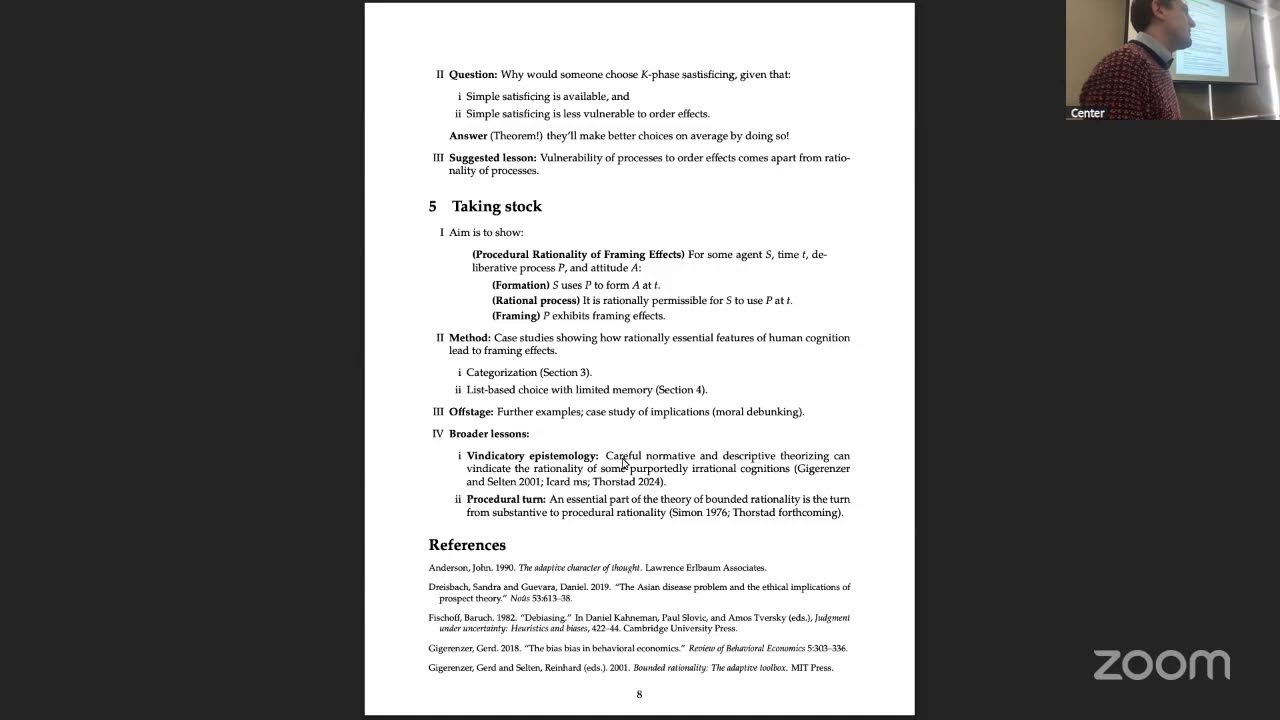
- David Thorstad begins his talk, introducing the topic of framing effects and their use in debunking arguments.
- Definition of framing effects and the distinction between substantive and procedural rationality.
- Presentation of the formal model of framing effects (Rubenstein and Salant) and the concept of procedural rationality.
- Case study 1: Category-based choice, using the Manzini and Mariotti model to show how categories can lead to framing effects but are rational.
- Discussion of the rationality of using categories despite framing effects, and the costs of trying to eliminate them.
- Case study 2: Choice from lists under memory constraints, arguing that ordering effects are unavoidable for memory-limited agents.
- Formal argument that rational memory management can introduce framing effects, and that minimizing them may be suboptimal.
- Conclusion: Implications for debunking arguments against moral intuitions, and the need to consider procedural rationality.
- Q&A session begins, with audience questions and discussion.
Cited Sources
- Slides/Handout — The speaker references a handout that contains the slides and additional material for the talk.
Concurring Sources
- Herbert Simon's work on bounded rationality — The talk builds on Simon's distinction between substantive and procedural rationality.
Dissenting Sources
- Standard debunking arguments (e.g., by Joshua Greene) — The talk challenges the use of framing effects in debunking arguments, which is a common position in moral psychology.
Contribution & Novelties
The talk offers a novel perspective on framing effects by focusing on procedural rationality rather than the rationality of attitudes. It argues that framing effects can be a rational byproduct of cognitive processes that are beneficial overall, such as categorization and memory management. This challenges the common view that framing effects are always irrational and provides a new way to resist debunking arguments against moral intuitions.
Pour aller plus loin :
- Bounded rationality — Foundational concept introduced by Herbert Simon, relevant to the talk’s framework.
- Framing effect (psychology) — Overview of framing effects in psychology, useful for background.
- Ecological rationality — Related concept emphasizing the role of the environment in rational decision-making.
- Manzini and Mariotti’s model of category-based choice — The formal model used in the first case study (note: URL is likely correct but not verified).
137 words
Radar Profile
The radar profile shows high scores in information quantity, quality, and technical level, with a slightly lower but still high reliability score. This indicates a well-informed and technically sophisticated talk, though it is a single presentation without peer review.