NoPE: The Counting Power of Transformers with No Positional Encodings
Keywords
Summary
130 words
Critical Evaluation
Value of the Information & Strength of the Argument
The talk provides a significant theoretical contribution by giving a complete characterization of the counting power of transformers without positional encodings. The argumentation is rigorous, with clear definitions and step-by-step proofs. The speaker carefully explains the constructions and the intuition behind them. The value lies in the precise characterization, which fills a gap in the understanding of transformer expressiveness. The argumentation is solid, with no apparent gaps or unsupported claims.
Scientific Rigor, Source Quality, Title Accuracy
The talk is based on original research, with a paper available on arXiv. The speaker cites the relevant literature and builds upon known results, such as the MRDP theorem. The title accurately reflects the content. The presentation is scientifically rigorous, with formal definitions and proofs. The sources are appropriate and credible. The talk does not rely on unverified claims; all statements are either proven or clearly motivated.
152 words
Title / Content Match
The title accurately reflects the content: the talk focuses on the counting power of transformers without positional encodings, presenting a characterization of the languages they recognize.
Quality & Reliability
8/10
The talk presents original research with formal proofs, published on arXiv. The presentation is rigorous, with clear definitions and step-by-step arguments. The speaker is a postdoc with relevant expertise. The content is technical and precise, though the video format and occasional screen-sharing issues slightly reduce clarity.
Key Moments
Markers derived by PSI from the transcript: the creator did not define chapters.
- Introduction and motivation: overview of known results on transformers and the goal to characterize NoPE.
- Definition of transformers, including word embeddings, positional encodings, attention layers, and position-wise layers.
- Explanation of attention mechanisms: unique, average-hard, and softmax attention.
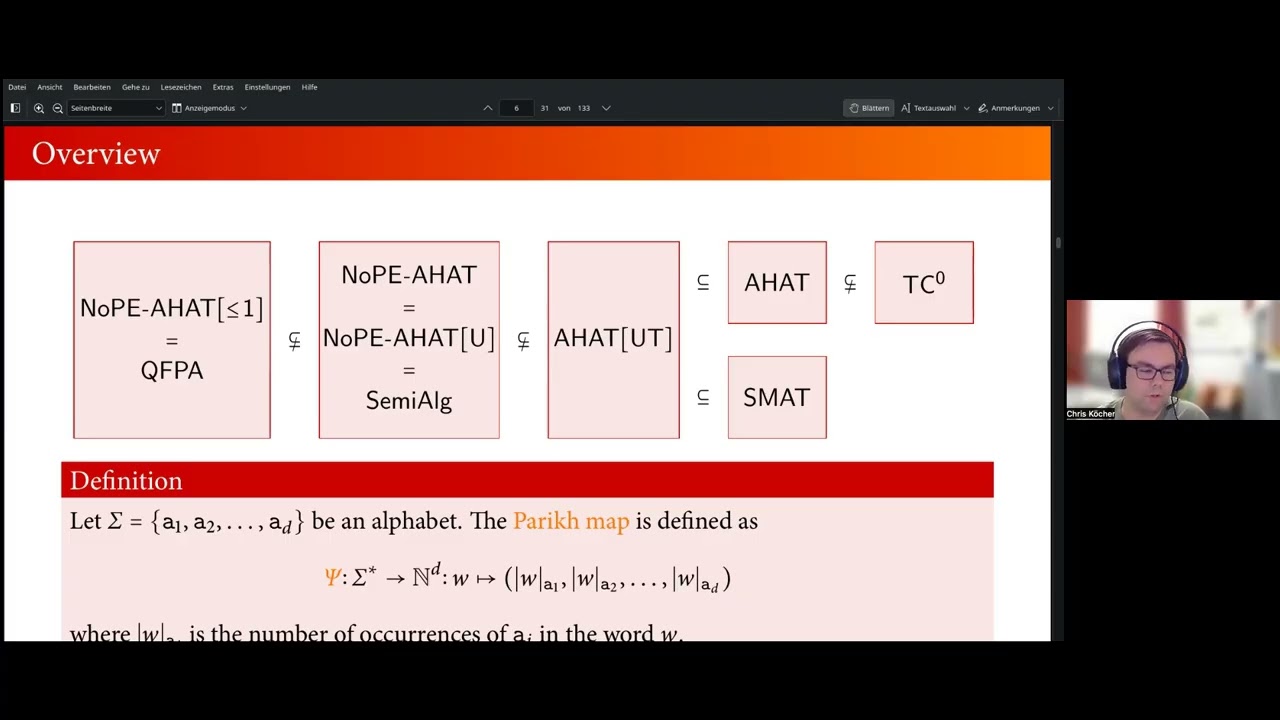
- Introduction of semialgebraic and QFPA languages, and the main characterization theorem.
- Proof that NoPE-AHead is contained in semialgebraic languages.
- Proof that semialgebraic languages are contained in NoPE-AHead with uniform layers.
- Discussion of related results: parity not in NoPE-AHead, and the projection result using MRDP theorem.
- Proof that NoPE-AHead with at most two uniform layers can express non-semilinear languages.
- Characterization of NoPE-AHead with at most one layer as QFPA.
- Conclusion and Q&A session.
Cited Sources
- NoPE: The Counting Power of Transformers with No Positional Encodings — The paper presenting the results discussed in the talk.
Concurring Sources
- NoPE: The Counting Power of Transformers with No Positional Encodings — The paper itself, which is the primary source for the results.
Contribution & Novelties
The talk provides a novel and complete characterization of the languages recognized by transformers without positional encodings, specifically for unique attention (NoPE-AHead). This fills a gap in the theoretical understanding of transformer expressiveness. The results also show that with two uniform layers, such transformers can recognize languages beyond semilinear sets, which is a surprising and significant finding.
Pour aller plus loin :
- Semialgebraic sets — Background on semialgebraic sets, which are central to the characterization.
- Presburger arithmetic — The logic underlying QFPA, relevant to the one-layer case.
- MRDP theorem — The theorem used to relate projections of NoPE-AHead languages to recursively enumerable sets.
103 words
Radar Profile
The radar profile shows high scores in quality of information, technical level, and reliability, with slightly lower but still high scores in quantity of information. This indicates a technically dense and reliable presentation, with a good amount of content.