Dhruv Rohatgi: Computational-Statistical Tradeoffs at the Next-Token Prediction Barrier
Keywords
Summary
160 words
Critical Evaluation
Value of the Information & Strength of the Argument
The talk provides valuable theoretical insights into the fundamental limits of next-token prediction under misspecification. The argumentation is rigorous, building from formal definitions to precise statements about approximation ratios and failure modes. The speaker carefully distinguishes between information-theoretic possibilities and computational constraints, and supports each claim with proof sketches or references. The discussion of practical modifications (boosting, density queries) and the identification of a ’next-token prediction barrier’ are particularly valuable, as they bridge theory and practice. The presentation is well-structured, with clear explanations of the problem setup and the implications of each result.
Scientific Rigor, Source Quality, Title Accuracy
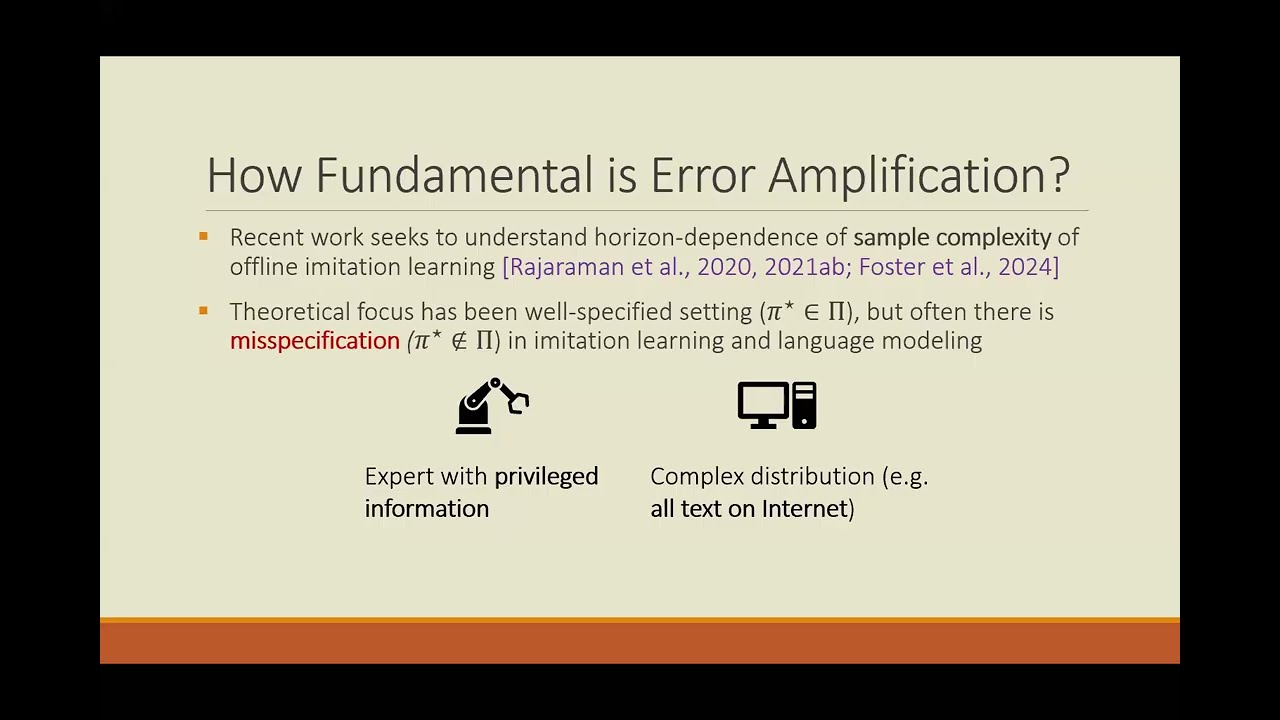
The talk is scientifically rigorous, with a clear formal framework and precise statements. The speaker references prior work (e.g., on sample complexity and error amplification) and builds on it, though specific citations are not enumerated in the talk. The title accurately reflects the content, focusing on computational-statistical tradeoffs at the next-token prediction barrier. The presentation is high-level but technically sound, with proof sketches that convey the key ideas without full detail. The talk does not include a public Q&A or comments, so no audience feedback is available.
195 words
Title / Content Match
The title accurately reflects the content: the talk focuses on computational-statistical tradeoffs in sequence modeling, centered on the 'next-token prediction barrier'.
Quality & Reliability
8/10
The talk presents rigorous theoretical results with clear formal definitions and proofs sketches, grounded in a well-defined statistical framework. The claims are supported by mathematical arguments and references to prior work, though the presentation is high-level and lacks full technical detail.
Key Moments
Markers derived by PSI from the transcript: the creator did not define chapters.
- Introduction and overview of the talk on learning under misspecification, focusing on autoregressive learning and the next-token prediction barrier.
- Definition of offline imitation learning and the goal of matching expert trajectory distribution under misspecification.
- Formalization of sequence modeling, autoregressive models, and next-token prediction as the standard algorithm.
- Discussion of failure modes of next-token prediction: dependence on failure probability, density ratios, and horizon.
- Introduction of the Le Cam estimator and its information-theoretic guarantee of constant approximation ratio.
- Practical modifications to avoid failure probability and density ratio dependencies, including boosting and density queries.
- Proof sketch that any iterative learner (including next-token prediction) incurs at least linear horizon dependence.
- Introduction of a concrete computational testbed and the cryptographic barrier to improving approximation ratio.
- Discussion of algorithmic hope: trading computation for better approximation factors in the testbed.
Cited Sources
- Talk description — The talk was given by Dhruv Rohatgi to the Formal Languages and Neural Networks Discord on August 17th, 2026.
Concurring Sources
- Talk description — The talk is based on joint work with Adam Block, Audrey Wong, A Krishna Mory, and Dylan Foster, as mentioned by the speaker.
Contribution & Novelties
The talk contributes a novel theoretical framework for understanding error amplification in autoregressive sequence modeling under misspecification. It identifies the ’next-token prediction barrier’ as a fundamental computational limit, while showing that information-theoretically, constant approximation is possible. The results provide a rigorous basis for understanding when and why practical interventions (e.g., scaling, sampling strategies) may or may not mitigate error amplification.
Pour aller plus loin :
- Le Cam estimator — The Le Cam estimator is a classical statistical method used to achieve minimax optimal rates, relevant to the information-theoretic results.
- Sample complexity in reinforcement learning — The talk discusses sample complexity in the context of imitation learning and sequence modeling.
- Cryptographic hardness assumptions — The computational barrier is based on cryptographic assumptions, a common tool in theoretical computer science.
128 words
Radar Profile
The radar profile shows high scores across all dimensions, indicating a technically rigorous and information-dense talk. The balance between quantity and quality of information, along with high technical level and reliability, suggests a strong theoretical contribution suitable for an expert audience.