Hanlin Zhu: Reasoning by Superposition: A Theoretical Perspective on Chain of Continuous Thought
Keywords
Summary
185 words
Critical Evaluation
Value of the Information & Strength of the Argument
The value of the information is high, as it provides a novel theoretical framework for understanding continuous reasoning in transformers, a topic of growing importance. The argumentation is solid: the speaker builds from motivation to formal theorem, explains the construction step-by-step, and supports it with experimental evidence. The proof is rigorous, and the explanation of the mechanism (superposition-based parallel BFS) is intuitive and well-illustrated. The comparison with discrete CoT highlights the advantages clearly. The experimental results showing alignment with the theoretical construction strengthen the claims.
Scientific Rigor, Source Quality, Title Accuracy
The talk is scientifically rigorous, with a clear theoretical framework and formal proofs. The speaker references prior work (including his own) and provides context, but does not cite specific external sources in the talk itself. The title accurately reflects the content, focusing on the theoretical perspective. The presentation is well-structured, and the technical details are handled with precision. The adéquation between title and content is excellent.
166 words
Title / Content Match
The title accurately reflects the content: the talk focuses on a theoretical perspective on chain of continuous thought, specifically the mechanism of reasoning by superposition.
Quality & Reliability
8/10
The talk presents a rigorous theoretical analysis with formal proofs and experimental validation, typical of academic research. The speaker is a PhD student at UC Berkeley, and the work is joint with others, indicating peer scrutiny. The presentation is clear and well-structured, with detailed explanations of the theoretical construction and empirical alignment.
Key Moments
Markers derived by PSI from the transcript: the creator did not define chapters.
- Introduction and motivation for test-time scaling and chain-of-thought.
- Discussion of overthinking and hallucination in long CoT, motivating latent reasoning.
- Introduction of chain of continuous thought (CCT) and its potential advantages.
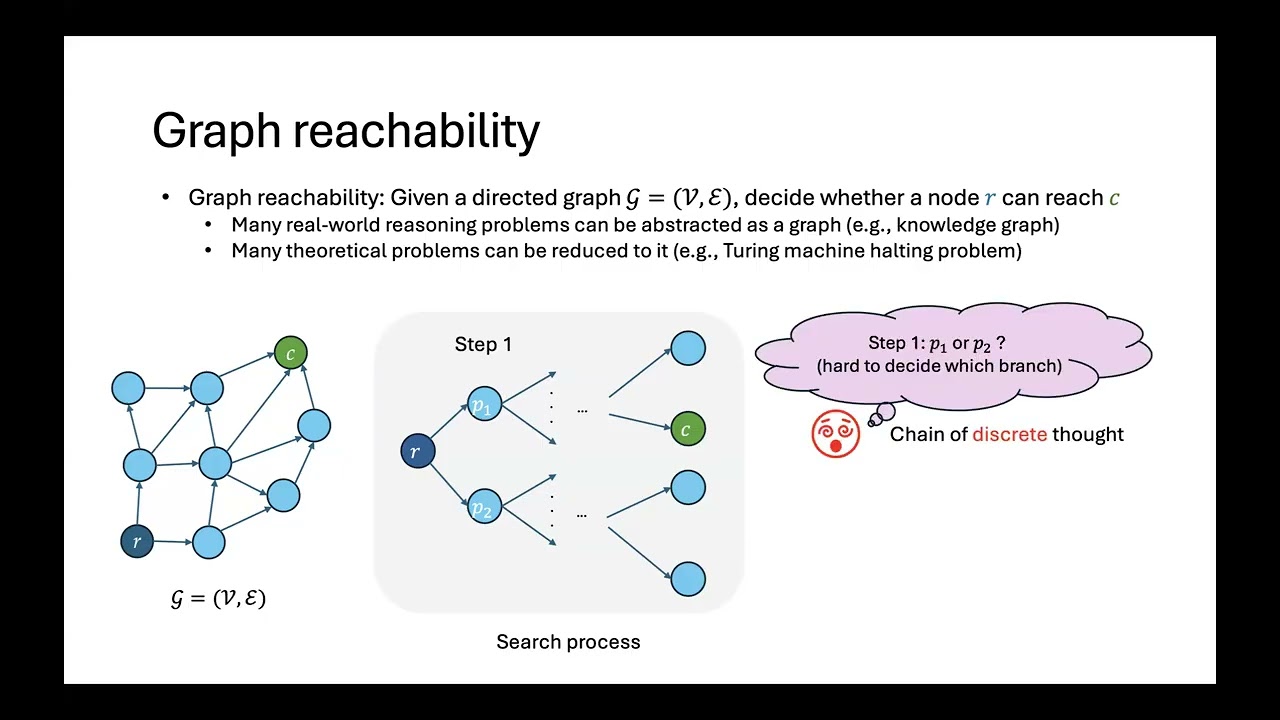
- Formal problem setup: directed graph reachability and prompt format.
- Main theorem: two-layer transformer with CCT solves graph reachability in O(D) steps.
- Explanation of the key mechanism: superposition of node embeddings enabling parallel BFS.
- Detailed construction of attention and MLP layers for the proof.
- Experimental results showing alignment with theoretical construction.
- Discussion of emergent superposition without explicit supervision.
- Conclusion and key takeaways.
Cited Sources
- Reasoning by Superposition: A Theoretical Perspective on Chain of Continuous Thought — The talk is based on this paper, which is not explicitly cited but is the underlying work.
Concurring Sources
- Chain-of-Thought Prompting Elicits Reasoning in Large Language Models — Foundational work on chain-of-thought prompting, which the talk builds upon.
- Let's Think Step by Step: A Large Language Models Approach — Related work on step-by-step reasoning.
Contribution & Novelties
The talk provides a novel theoretical framework for understanding continuous reasoning in transformers, specifically proving that a two-layer transformer with continuous chain-of-thought can solve graph reachability efficiently via superposition-based parallel BFS. This is a significant contribution as it offers a mechanistic explanation for the empirical success of continuous CoT and highlights the advantages over discrete CoT. The work also demonstrates that such superposition can emerge naturally during training, providing insights into how transformers might learn to reason in latent spaces.
Pour aller plus loin :
- Chain-of-thought prompting — Background on CoT and its variants.
- Transformer architecture — Overview of the transformer model.
- Graph reachability — Definition and complexity of the problem.
111 words
Radar Profile
The radar profile shows high scores in technical level and information quality, reflecting the advanced theoretical nature of the talk. The lower scores in quantity and reliability are due to the focused scope and lack of external citations, but overall the profile indicates a strong, specialized presentation.
💬 No comments were provided for analysis.