Ekdeep Lubana: In-context Learning of Formal Languages
Keywords
Summary
133 words
Critical Evaluation
Value of the Information & Strength of the Argument
The talk provides valuable insights into the mechanisms of in-context learning, particularly the emergence of structured representations and the phase transitions in algorithmic behavior. The argumentation is solid, building from empirical observations to controlled toy models, and finally to a behavioral explanation. The speaker clearly motivates each step and connects the results to broader implications for AI safety and reliability. The use of multiple papers and the progression from real models to toy models strengthens the overall argument.
Scientific Rigor, Source Quality, Title Accuracy
The talk is scientifically rigorous, with clear references to the papers discussed. The speaker is a researcher at Harvard, and the content is based on published work. The title accurately reflects the focus on in-context learning of formal languages, though the talk covers a broader scope. The sources cited are relevant and credible, including the paper link provided in the description. The talk does not include any promotional content.
162 words
Title / Content Match
The title accurately reflects the content, focusing on in-context learning of formal languages, though the talk covers broader aspects of in-context learning.
Quality & Reliability
8/10
The talk presents a coherent research narrative based on three peer-reviewed papers, with clear methodology and results. The speaker is a research fellow at Harvard, and the content is technically rigorous. However, the talk is a seminar presentation, not a formal publication, and some claims are presented without full experimental details.
Key Moments
Markers derived by PSI from the transcript: the creator did not define chapters.
- Introduction to in-context learning and its significance.
- Discussion of many-shot jailbreaking and its implications.
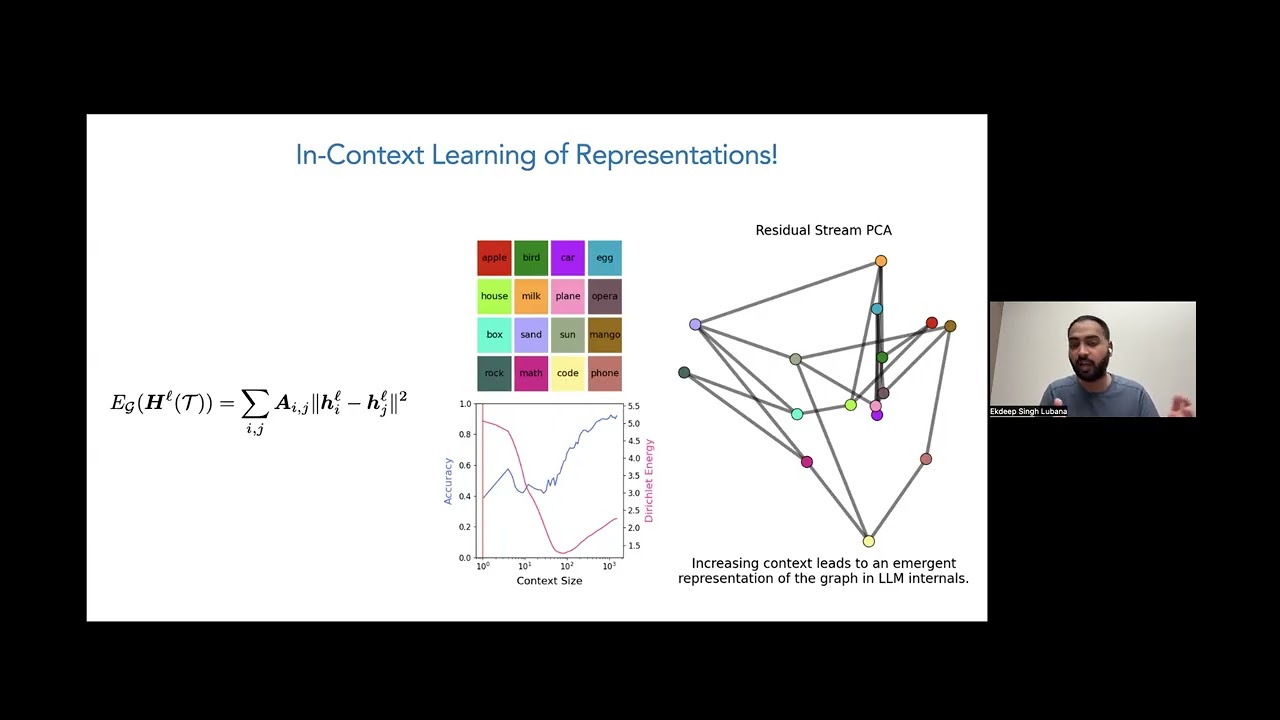
- First paper: In-context learning of representations using random walks on graphs.
- Second paper: Algorithmic phases of in-context learning with toy Markov chains.
- Third paper: Behavioral explanation for many-shot jailbreaking.
- Discussion of implications and future directions.
Cited Sources
- In-Context Learning of Representations — Paper link provided in the video description, likely the first paper discussed.
Concurring Sources
- In-Context Learning and Induction Heads — Discusses the role of induction heads in in-context learning, supporting the claims about higher-order statistics.
Contribution & Novelties
The talk synthesizes three papers that collectively advance the understanding of in-context learning. The key novelty is the demonstration that in-context learning can lead to the emergence of structured representations in pre-trained language models, and the identification of distinct algorithmic phases in a controlled toy setting. The behavioral explanation for many-shot jailbreaking provides a practical framework for assessing the reliability of in-context learning.
Pour aller plus loin :
- In-context Learning and Induction Heads — Relevant to the formation of induction heads and higher-order statistics.
- Many-shot Jailbreaking — The original paper on many-shot jailbreaking, directly related to the discussed phenomenon.
- Formal Languages and Neural Networks — A survey connecting formal languages and neural networks, relevant to the seminar series.
118 words
Radar Profile
The radar profile shows high scores across all dimensions, indicating a well-rounded and reliable presentation. The talk is technically deep, provides substantial information, and is based on credible sources.