Aleksandar Terzić: Structured Sparse Transition Matrices to Enable State Tracking in SSMs
Keywords
Summary
249 words
Critical Evaluation
Value of the Information & Strength of the Argument
The talk provides valuable insights into the expressivity of state space models, particularly the role of transition matrix structure. The argumentation is solid, building from theoretical foundations (FSA emulation) to practical design choices (PDSSM). The speaker clearly explains the trade-offs between different matrix structures and supports claims with experimental results on automata of varying complexity. The presentation of the PDSSM architecture is detailed, including the generation of column one-hot matrices and the efficient multiplication algorithm. The proof of optimal state size is a strong theoretical contribution. However, the talk is somewhat dense and assumes familiarity with SSMs and formal language theory, which may limit accessibility. The experimental results are limited to specific automata, and the speaker acknowledges that further work is needed to fully understand the trainability of complex diagonal SSMs on non-commutative groups.
Scientific Rigor, Source Quality, Title Accuracy
The talk demonstrates scientific rigor by referencing prior work (e.g., Mamba, DeltaNet, Delta product, work by Merrill) and presenting theoretical results with proofs. The sources cited are relevant and include recent papers. The title accurately reflects the content, focusing on structured sparse transition matrices and state tracking. The talk is well-structured, with clear definitions and motivations. The speaker also acknowledges collaborators and the venue (NeurIPS 2025), adding credibility. No public comments were provided, so no analysis of audience reception is possible.
230 words
Title / Content Match
The title accurately reflects the content, focusing on structured sparse transition matrices in state space models and their role in state tracking.
Quality & Reliability
8/10
The talk is given by a researcher from IBM and ETH Zurich, presenting work published at NeurIPS 2025. It includes theoretical results, experimental evidence, and references to prior work. The presentation is clear and well-structured, with a focus on formal language expressivity. However, it is a single talk without peer review in this context, and some claims are based on unpublished or recent results.
Key Moments
Markers derived by PSI from the transcript: the creator did not define chapters.
- Introduction and motivation for state space models
- Overview of expressivity results for SSMs in formal language framework
- Discussion of diagonal transition matrices and their limitations
- Introduction of dense unstructured SSMs and their cost
- Review of DeltaNet and Delta product as intermediate solutions
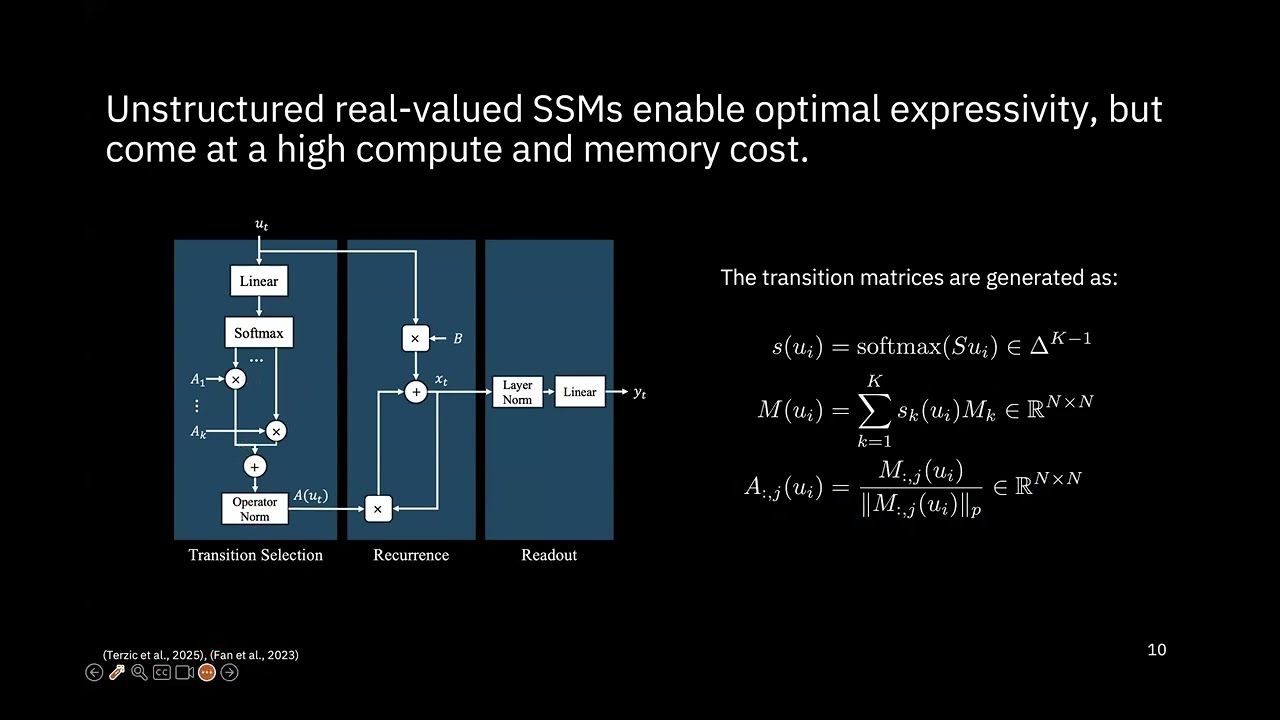
- Proposal of structured sparse matrices and PDSSM architecture
- Efficient multiplication algorithm for column one-hot matrices
- Theoretical properties of PDSSM: stability and optimality
- Experimental results on automata from algebraic groups
- Runtime measurements comparing PDSSM to dense and diagonal SSMs
Cited Sources
- NeurIPS 2025 paper on PDSSM — The talk is based on a paper presented at NeurIPS 2025.
- Mamba: Linear-Time Sequence Modeling with Selective State Spaces — Referenced as a popular diagonal SSM.
- DeltaNet: Change-of-State and Delta Rule for Efficient Memory — Referenced as a diagonal-plus-low-rank SSM.
- Delta Product: Improving State-Space Model for Sequence Modeling — Referenced as an extension of DeltaNet.
- The Illusion of State in State-Space Models — Referenced for the solvable vs non-solvable group distinction.
Concurring Sources
- Mamba: Linear-Time Sequence Modeling with Selective State Spaces — Confirms the popularity and efficiency of diagonal SSMs.
- The Illusion of State in State-Space Models — Supports the importance of solvable vs non-solvable groups for expressivity.
Dissenting Sources
- Wired Linear RNNs: Parallelizing Linear RNNs — The talk mentions that DPLR models are more expressive than structured sparse SSMs in general, which could be seen as a counterpoint to the claim that PDSSM is sufficient for all FSAs.
Contribution & Novelties
The talk introduces PDSSM, a novel state space model with structured sparse transition matrices that combine complex diagonal and column one-hot components. This design achieves expressivity comparable to dense models for finite state machine emulation while maintaining computational efficiency. The theoretical result that any N-state FSA can be emulated with state size N and that this is optimal is a significant contribution. The efficient multiplication algorithm for column one-hot matrices enables fast parallel scan, making the model practical. The talk also provides a clear comparison with existing approaches, highlighting the trade-offs.
Pour aller plus loin :
- State Space Models — Background on state space models.
- Finite-state machine — Formal definition and properties.
- Krohn–Rhodes theory — Decomposition of finite semigroups, relevant to automata complexity.
- Parallel prefix sum — Algorithm used in parallel scan for SSMs.
134 words
Radar Profile
The radar profile shows high scores in quantitative information, qualitative information, technical level, and global reliability, indicating a technically dense and reliable presentation. The talk is highly specialized, with a strong theoretical foundation and practical implications.