Eshaan Nichani: Learning Compositional Functions with Transformers from Easy-to-Hard Data
Keywords
Summary
156 words
Critical Evaluation
Value of the Information & Strength of the Argument
The talk provides a clear and rigorous theoretical framework for understanding compositional reasoning in transformers. The value lies in formalizing a complex cognitive task into a tractable mathematical problem, enabling precise analysis. The argumentation is solid: the expressivity construction is detailed and intuitive, and the SQ lower bound is well-motivated with a clear proof sketch. The speaker effectively connects the theoretical results to practical implications, such as the necessity of curriculum learning. The presentation is logically structured, building from definitions to results, and addresses potential questions from the audience, strengthening the overall argument.
Scientific Rigor, Source Quality, Title Accuracy
The talk is based on a specific research paper, which is cited in the description and linked to arXiv. The speaker does not reference external sources beyond the paper, but the content is presented with mathematical rigor. The title accurately reflects the content, focusing on learning compositional functions with transformers and the role of easy-to-hard data. The presentation is self-contained, with definitions and proofs sketched clearly. The audience questions are addressed, indicating a thorough understanding. Overall, the scientific rigor is high, and the sources are appropriate for a research seminar.
198 words
Title / Content Match
The title accurately reflects the content, which focuses on learning compositional functions with transformers and the role of easy-to-hard data (curriculum learning).
Quality & Reliability
8/10
The talk presents a rigorous theoretical analysis with formal proofs for expressivity and learning, backed by a peer-reviewed paper on arXiv. The claims are precise and well-motivated, though the presentation is concise and assumes familiarity with the topic.
Key Moments
Markers derived by PSI from the transcript: the creator did not define chapters.
- Introduction and motivation for compositional reasoning in LLMs
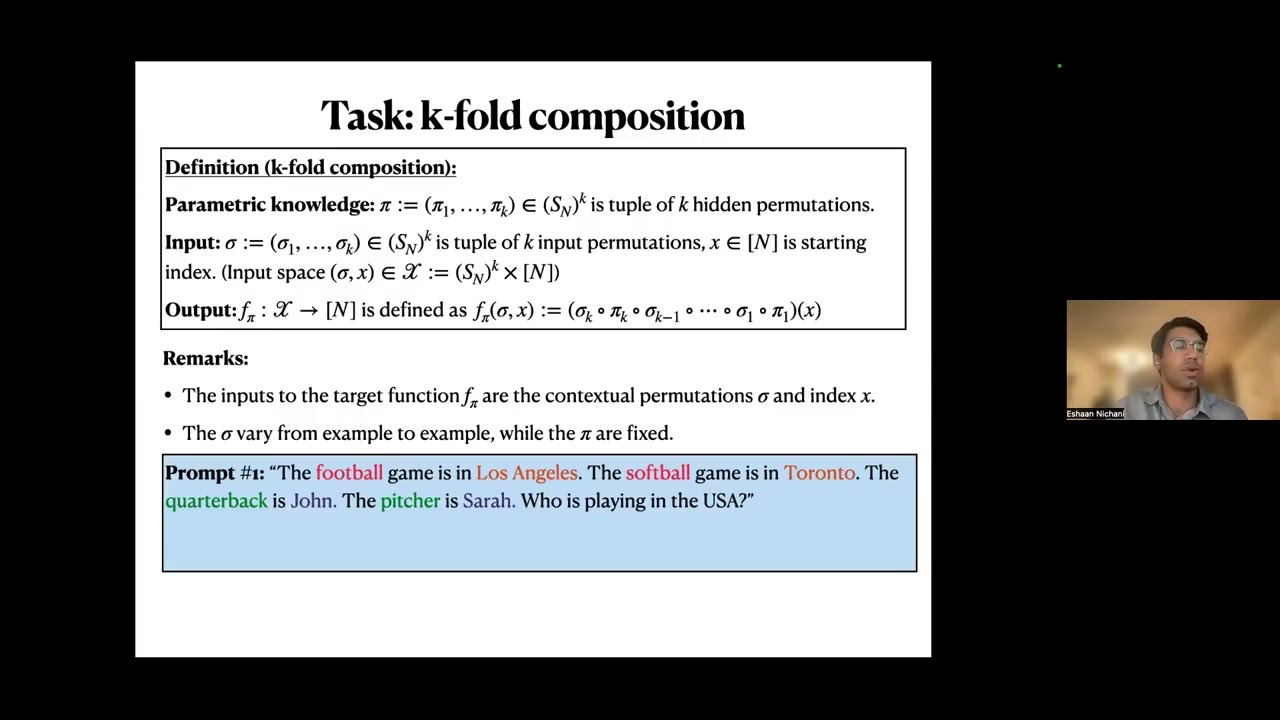
- Definition of k-fold composition task with example
- Formal definition and remarks on k-fold composition
- Transformer architecture and residual stream perspective
- Expressivity result: log k + 1 layers suffice
- Construction details: first layer computes sigma_i ∘ pi_i
- Second layer composes adjacent permutations to get hop-2
- Generalization to log k layers via binary tree
- Learning lower bound: SQ hardness for gradient descent
- Proof sketch of SQ lower bound and curriculum learning necessity
Cited Sources
- Learning Compositional Functions with Transformers from Easy-to-Hard Data — The paper presented in the talk, providing the theoretical results on expressivity and learning.
Concurring Sources
- Learning Compositional Functions with Transformers from Easy-to-Hard Data — The paper itself, which the talk is based on, provides the detailed proofs and results.
Contribution & Novelties
The talk introduces a novel formal task (k-fold composition) to model compositional reasoning in transformers, bridging contextual and parametric knowledge. It provides a constructive proof that transformers can express this task with logarithmic depth, and establishes a statistical query lower bound showing that learning without curriculum is computationally hard. The key insight is that curriculum learning (easy-to-hard data) is both necessary and sufficient for efficient gradient-based training, offering a theoretical justification for a common practice in training LLMs.
Pour aller plus loin :
- Statistical query learning — The SQ model is central to the lower bound argument.
- Transformer architecture — The original transformer paper, foundational to the model used.
- Curriculum learning — The concept of training on easy examples first, shown to be necessary here.
125 words
Radar Profile
The radar profile shows high scores in information quality, technical level, and reliability, with slightly lower scores in information quantity and overall reliability, reflecting the focused and rigorous nature of the talk. The presentation is dense and technical, appealing to a specialized audience.
💬 No comments were provided for analysis.