Jiaoda Li: Characterizing the Expressivity of Transformer Language Models
Keywords
Summary
127 words
Critical Evaluation
Value of the Information & Strength of the Argument
The talk provides a significant theoretical contribution by precisely characterizing the expressivity of transformers in terms of a well-understood logical fragment. The argumentation is rigorous, building on prior work and addressing technical challenges such as simulating summation with threshold counting. The proof sketches are clear and the experimental validation strengthens the claims. The discussion of limitations, such as the fixed precision assumption, adds to the credibility.
Scientific Rigor, Source Quality, Title Accuracy
The talk is scientifically rigorous, with a clear theoretical framework and proofs. The main source is the paper on arXiv (2505.23623), which is appropriately referenced. The title accurately reflects the content. The presentation is self-contained, providing necessary background on formal languages and logic. The experimental methodology is sound, using a length generalization setting. The talk does not overstate its findings and acknowledges assumptions.
144 words
Title / Content Match
The title accurately reflects the content: the talk characterizes the expressivity of transformer language models in terms of a fragment of temporal logic.
Quality & Reliability
8/10
The talk presents a formal theoretical result with a rigorous proof sketch, supported by experimental validation. The methodology is clearly explained, and the claims are grounded in established formal language theory. The presentation is technical and precise, with appropriate caveats about assumptions.
Key Moments
Markers derived by PSI from the transcript: the creator did not define chapters.
- Introduction and motivation: characterizing transformer expressivity.
- Background on formal languages, regular expressions, and star-free languages.
- Introduction to temporal logic (LTL) and its fragments.
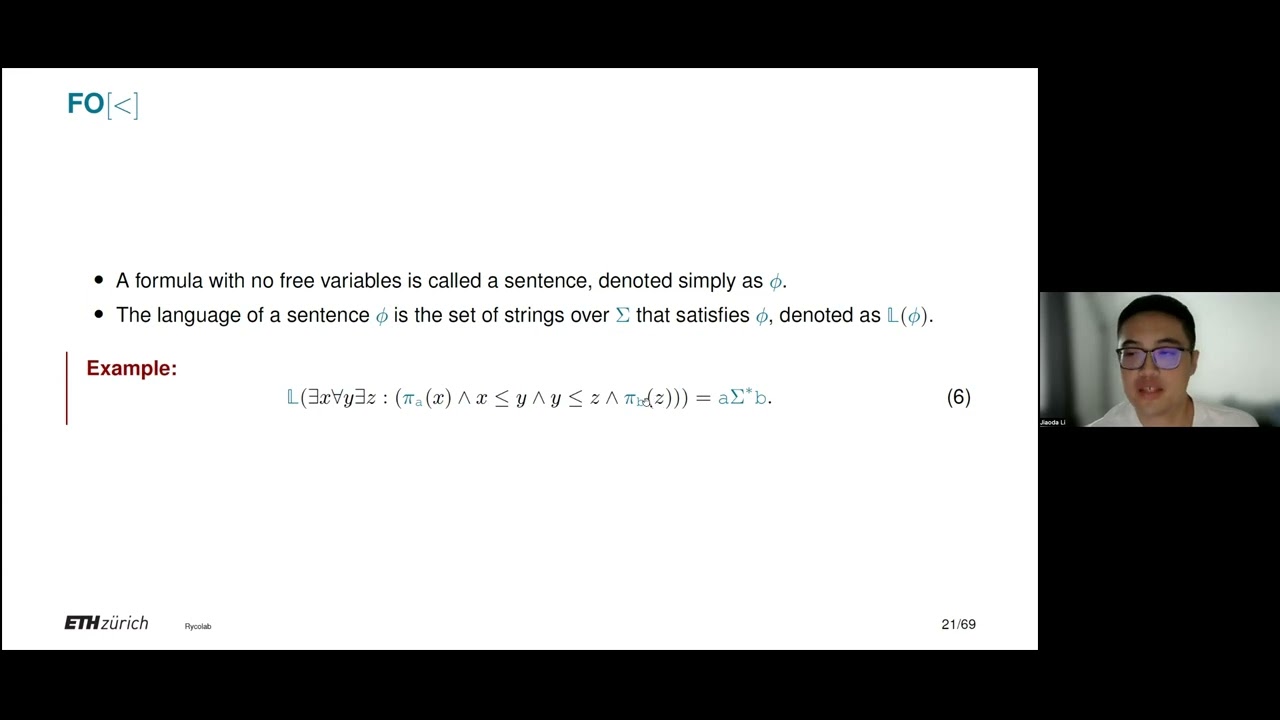
- First-order logic and its connection to LTL; introduction of PFO2.
- Main result: transformers can be translated into PFO2.
- Simulating attention summation with threshold counting.
- Second direction: LTL_past can be simulated by transformers.
- Handling fixed precision by using two attention layers.
- Equivalence to left-deterministic polynomials and partially ordered DFAs.
- Experimental validation on learnable and non-learnable languages.
Cited Sources
- Characterizing the Expressivity of Transformer Language Models — Paper presented in the talk, containing the main theoretical and experimental results.
Concurring Sources
- On the Expressive Power of Transformers — Related work showing transformers are equivalent to linear temporal logic under similar assumptions.
Contribution & Novelties
The talk provides an exact characterization of the expressive power of transformers under fixed precision and softmax attention, which was previously unknown. It introduces a new logical fragment (PFO2) and shows its equivalence to LTL_past, and then to left-deterministic polynomials. This bridges formal language theory and neural network expressivity, offering a precise boundary for what transformers can and cannot learn. The experimental validation on a range of languages confirms the theoretical predictions.
Pour aller plus loin :
- Linear Temporal Logic — Foundational logic used in the talk.
- First-order logic — Basis for PFO2.
- Regular language — Context for the languages discussed.
101 words
Radar Profile
The radar profile shows high scores in information quality, technical depth, and reliability, with slightly lower scores in information quantity and global reliability due to the narrow focus and reliance on a single source. This indicates a specialized, rigorous talk suitable for an expert audience.