Aditya Varre: Learning In-context n-grams with Transformers: Sub-n-grams Are Near-stationary Points
Keywords
Summary
186 words
Critical Evaluation
Value of the Information & Strength of the Argument
The talk provides a valuable contribution by offering a theoretical explanation for the plateau phenomenon in transformer training, a topic that has been empirically observed but not fully understood. The argumentation is rigorous: the authors define a clear mathematical framework, derive conditions for stationary points, and validate their theory with experiments. The use of a simplified transformer architecture is justified as a tractable model that retains essential features. The presentation is well-structured, building from motivation to formal results and empirical validation. The claims are supported by a proof sketch and references to a peer-reviewed paper, enhancing credibility. The discussion of partial solutions and their role in stage-wise learning is insightful and adds depth to the understanding of in-context learning.
Scientific Rigor, Source Quality, Title Accuracy
The scientific rigor is high: the talk is based on a paper published at ICML 2025, a top-tier conference, and the presenter provides a clear mathematical exposition. The sources cited include the paper itself (arXiv link) and references to prior work on n-gram estimation and transformer training dynamics. The title accurately reflects the content, focusing on the specific finding that sub-n-grams are near-stationary points. The talk does not overstate its claims and acknowledges the limitations of the simplified architecture. The use of orthogonal embeddings and concatenation is a deliberate simplification, and the presenter notes that similar results can be observed empirically with learned embeddings. Overall, the sources are appropriate and the title is well-aligned with the content.
251 words
Title / Content Match
The title accurately reflects the content: the talk focuses on learning in-context n-grams with transformers and demonstrates that sub-n-grams are near-stationary points.
Quality & Reliability
8/10
The talk presents a rigorous theoretical analysis of transformer training dynamics on a synthetic n-gram task, with a clear mathematical framework and empirical validation. The claims are supported by a formal proof sketch and references to a peer-reviewed ICML paper. The presentation is coherent and the methodology is sound, though the simplified architecture and assumptions (orthogonal embeddings, concatenation) may limit direct applicability to full-scale transformers.
Key Moments
Markers derived by PSI from the transcript: the creator did not define chapters.
- Introduction and motivation: in-context learning and plateaus in training.
- Definition of n-gram language model and data generation.
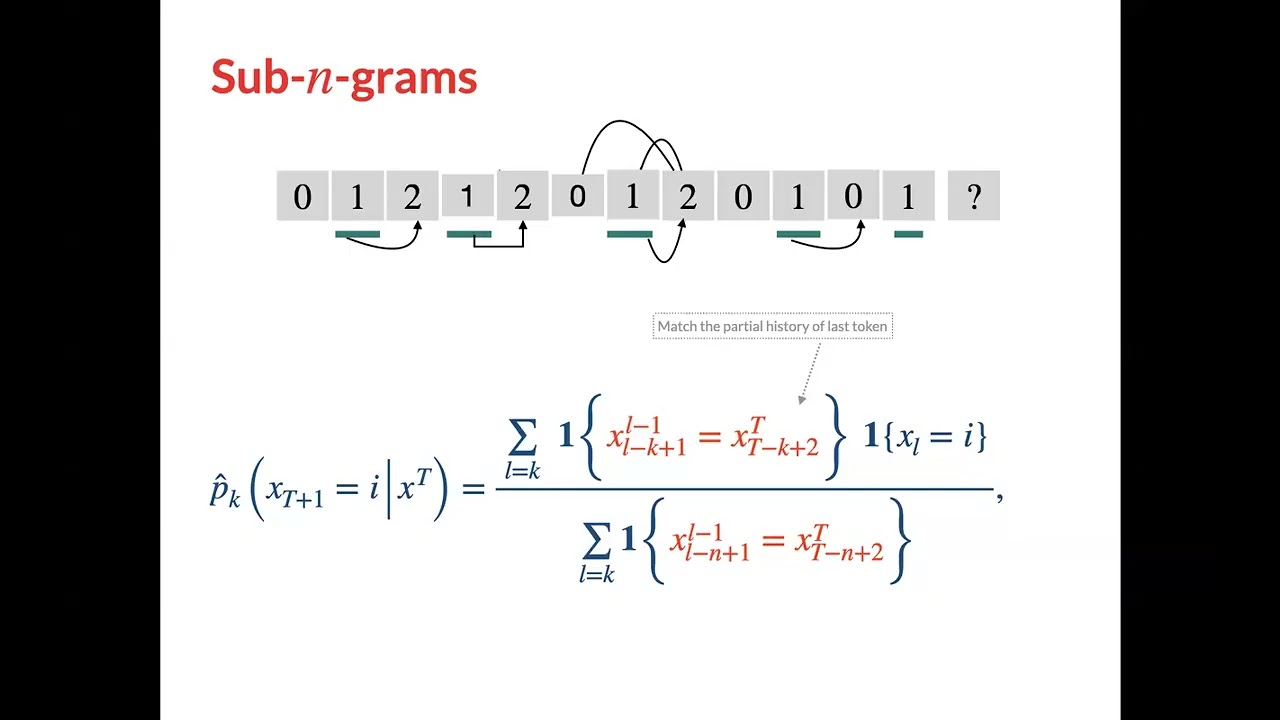
- Illustration of partial solutions and stage-wise learning.
- Formal problem setup: loss function and gradient of cross-entropy.
- Conditions for gradient vanishing: score depends on partial history.
- Simplified transformer architecture with concatenated heads.
- How the transformer represents n-gram solutions and sub-solutions.
- Empirical validation and discussion of results.
Cited Sources
- Learning In-context n-grams with Transformers: Sub-n-grams Are Near-stationary Points — The paper this talk is based on, providing the theoretical and empirical results.
Concurring Sources
- What Language Model Memories and Why — Related work on how transformers learn n-gram-like patterns, supporting the stage-wise learning hypothesis.
- Induction Heads as a Mechanism for In-Context Learning — Discusses induction heads, which are related to the attention patterns that emerge during training.
Dissenting Sources
- Attention is All You Need — The original transformer architecture uses residual connections and layer normalization, which are simplified in this work. The concatenation of heads and skip connections is non-standard, potentially limiting direct applicability.
Contribution & Novelties
The talk offers a novel theoretical framework to explain the plateau phenomenon in transformer training by identifying sub-n-gram solutions as near-stationary points. This provides a mechanistic understanding of stage-wise learning, where the model gradually adds syntactic structures. The simplified architecture allows for a rigorous analysis of the loss landscape, which is a significant contribution to the theoretical understanding of in-context learning.
Pour aller plus loin :
- In-context learning — Provides background on the phenomenon and its significance.
- Transformer architecture — Essential for understanding the model components discussed.
- Markov chain — The n-gram model is a higher-order Markov chain; this reference explains the basics.
- Cross-entropy loss — The loss function used in the analysis.
- Gradient descent — The optimization method relevant to the training dynamics.
124 words
Radar Profile
The radar profile shows high scores in information quantity, quality, and technical level, indicating a dense and rigorous presentation. The fiabilite_globale is also high, reflecting the solid theoretical foundation. The profile suggests a talk that is highly informative and technically deep, suitable for an expert audience.