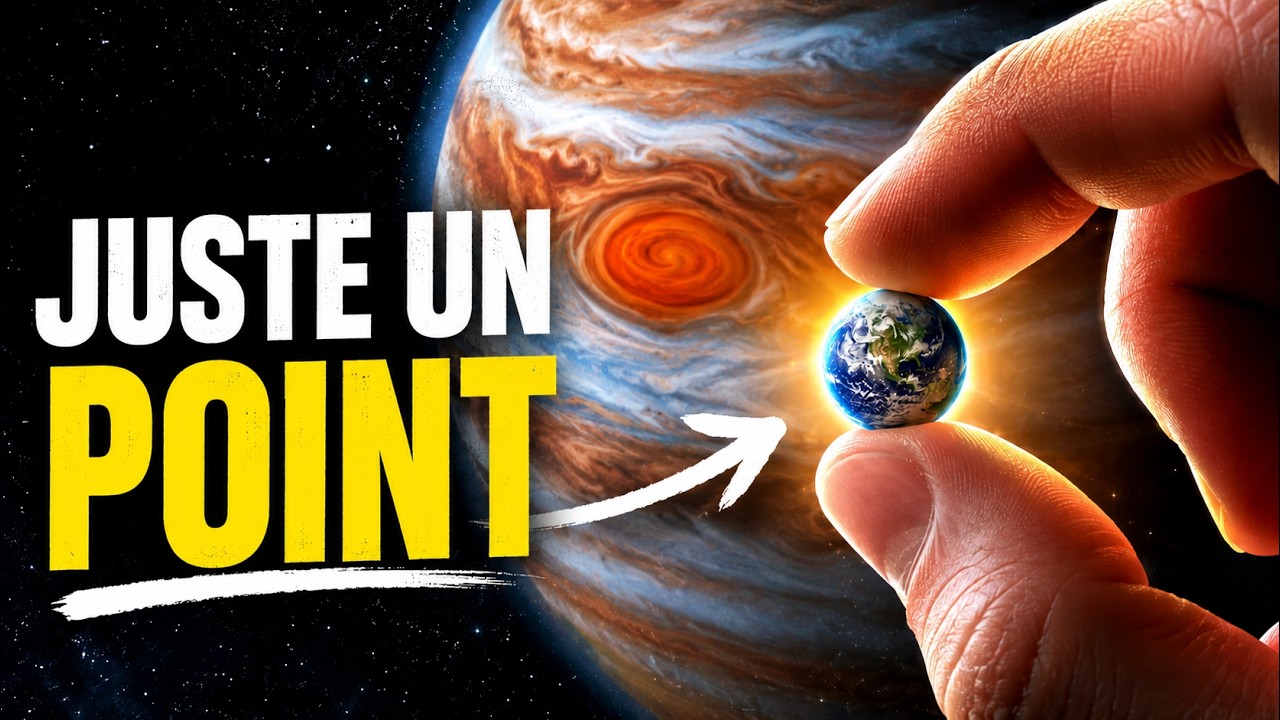
La véritable échelle de l'univers : La Terre est-elle vraiment si petite ?
Keywords
Summary
132 words
Critical Evaluation
Value of the Information & Strength of the Argument
The video provides a compelling and accessible narrative that effectively conveys the immense scale of the universe through vivid analogies and comparisons. It presents a logical progression from the solar system to larger cosmic structures, building a sense of awe. The argumentation is primarily descriptive, relying on established astronomical facts and figures, though it occasionally uses imprecise language (e.g., ‘10x billion suns’) that could confuse. The strength lies in its ability to make abstract concepts tangible, but it lacks critical analysis or discussion of uncertainties in measurements.
Scientific Rigor, Source Quality, Title Accuracy
The video does not cite specific scientific sources or studies, which limits its scientific rigor. The information presented is generally consistent with current astronomical knowledge, but the lack of references makes it difficult to verify specific claims. The title accurately reflects the content, which systematically compares Earth’s size to larger structures. The video’s strength is its clear and engaging presentation, but it would benefit from citing sources for its more extraordinary claims, such as the volume of Stephenson 2-18.
181 words
Title / Content Match
The title accurately reflects the content, which systematically compares Earth's size to increasingly larger cosmic structures.
Quality & Reliability
6/10
The video presents a broad overview of cosmic scales with generally accurate figures (e.g., Jupiter's diameter, Sun's mass fraction, distances to nearby stars), but lacks citations to primary sources and contains minor imprecisions (e.g., '10x billion suns' for Stephenson 2-18 volume). The narrative is engaging but relies on approximations and analogies rather than rigorous data presentation.
Chapters
- L'illusion de la grandeur terrestre
- Les géantes gazeuses et le Soleil
- Les hypergéantes et les planètes errantes
- La Voie lactée et le trou noir central
- La collision inéluctable avec Andromède
- Le superamas Laniakea et le Grand Attracteur
- La toile cosmique et le vide du Bouvier
- Le paradoxe de l'univers observable et l'énergie sombre
- Au-delà des limites : la théorie du multivers
Concurring Sources
- NASA - Jupiter Fact Sheet — Confirms Jupiter's diameter and mass relative to Earth.
- NASA - Sun Fact Sheet — Supports the claim that the Sun contains 99.6% of the solar system's mass.
Dissenting Sources
- Stephenson 2-18 size estimates — The video states Stephenson 2-18's diameter is 2150 times the Sun, but some sources suggest it may be smaller (around 2150 solar radii is an upper limit).
Contribution & Novelties
The video’s original contribution is its immersive, narrative-driven approach to visualizing cosmic scales, making complex astronomical concepts accessible to a general audience. It effectively uses analogies (e.g., Sun as a grapefruit, Earth as a pinhead) to convey relative sizes and distances.
Pour aller plus loin :
- Cosmic distance ladder — Essential for understanding how astronomers measure cosmic distances.
- Hertzsprung–Russell diagram — Classifies stars by luminosity and temperature, relevant to the discussion of stellar types.
- Observable universe — Provides context for the video’s discussion of the universe’s size and limits.
89 words
Radar Profile
The radar profile shows high scores in information quantity and quality, with moderate technical level and reliability. This indicates a content-rich video that is accessible but not deeply technical, and while generally accurate, it lacks rigorous sourcing.