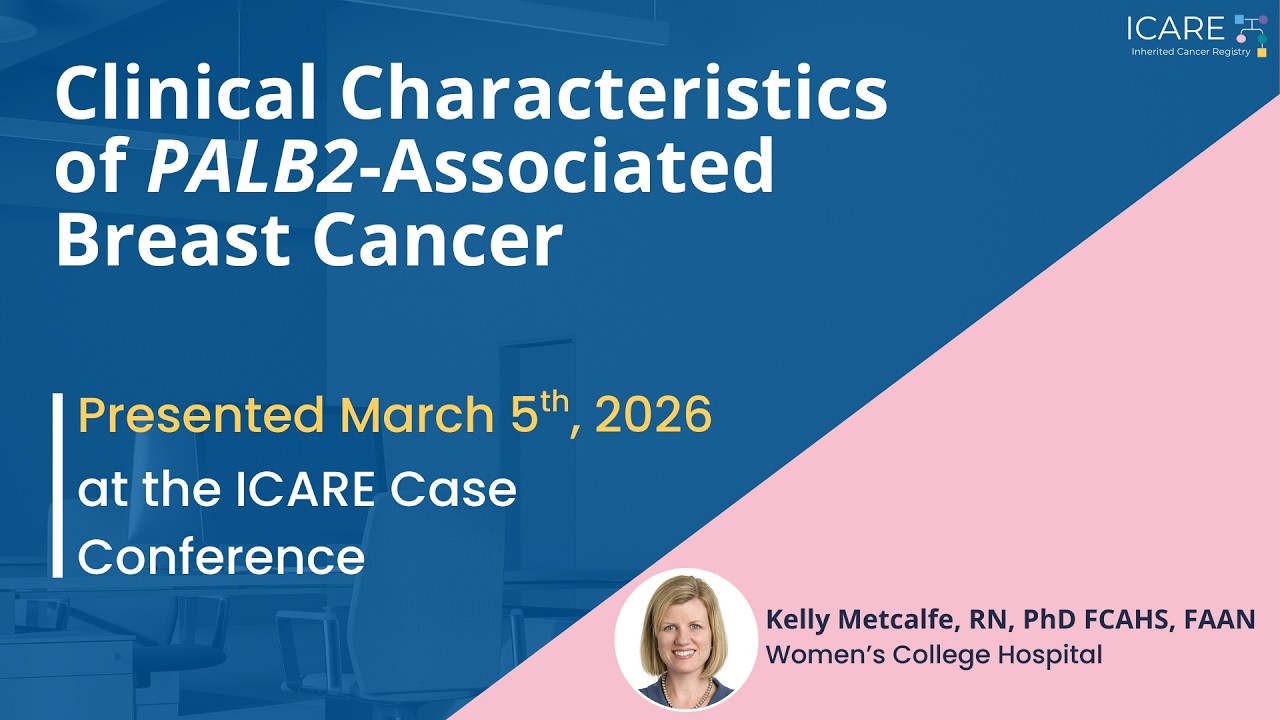
Full Recording of the March 2026 ICARE Genetics Case Conference
Keywords
Summary
157 words
Critical Evaluation
Value of the Information & Strength of the Argument
The video provides valuable preliminary data from the largest cohort of PALB2-associated breast cancer patients to date. The argumentation is well-structured, with clear presentation of clinical characteristics, risk estimates, and treatment associations. The speaker acknowledges limitations (preliminary, not yet published) and highlights the need for further analysis. The discussion with the host adds practical insights into clinical decision-making.
Scientific Rigor, Source Quality, Title Accuracy
The presentation is scientifically rigorous, with a clear methodology and transparent data collection. Sources cited include previous studies (e.g., Mayo Clinic study, Polish study) and the speaker’s own ongoing research. The title accurately reflects the content. No comments were provided for analysis.
115 words
Title / Content Match
The title accurately describes the content: a full recording of a genetics case conference.
Quality & Reliability
8/10
Presentation by a recognized expert (Dr. Kelly Metcalfe) with preliminary data from a large international cohort (888 patients, updated to ~1000). Data not yet peer-reviewed, but methodology is rigorous and transparent. No conflicts of interest disclosed.
Key Moments
Markers derived by PSI from the transcript: the creator did not define chapters.
- Introduction and housekeeping by Dr. Tuya Pal
- Case presentation: 37-year-old with homozygous PALB2 mutation
- Discussion of cascade testing and family communication
- Introduction of Dr. Kelly Metcalfe and start of her presentation
- Overview of PALB2 lifetime risks and previous studies
- Description of study methodology and cohort characteristics
- Presentation of contralateral breast cancer risk results
- Discussion of oophorectomy effect and clinical implications
- Conclusion and call for collaboration
Cited Sources
- ICARE LinkedIn — Mentioned as a way to follow ICARE for updates.
- ICARE Bluesky — Mentioned as a social media platform for ICARE.
Concurring Sources
- Mayo Clinic study on contralateral breast cancer risk in PALB2 carriers — Mentioned in the presentation as a previous study with smaller sample size.
Dissenting Sources
- Polish study on survival in PALB2 carriers — Reported poor survival in PALB2 carriers, which may contrast with the current study's focus on contralateral risk.
Contribution & Novelties
This video provides novel preliminary data on contralateral breast cancer risk in PALB2 carriers, which is higher than previously reported. It also highlights the potential benefit of oophorectomy in reducing this risk, particularly in ER-positive tumors. This information is crucial for clinical decision-making and genetic counseling.
Pour aller plus loin :
- PALB2 gene - Genetics Home Reference — Overview of PALB2 gene and associated cancer risks.
- Fanconi anemia - National Cancer Institute — Information on Fanconi anemia, which is associated with biallelic PALB2 mutations.
- Contralateral breast cancer risk in BRCA carriers - NCCN Guidelines — Guidelines for genetic/familial high-risk assessment, including management of contralateral breast cancer risk.
107 words
Radar Profile
The radar profile shows high scores in quantity and quality of information, reflecting the detailed data presented. The technical level is high, suitable for a specialized audience. Reliability is strong due to the expert presenter and large cohort, though preliminary nature slightly reduces the score.