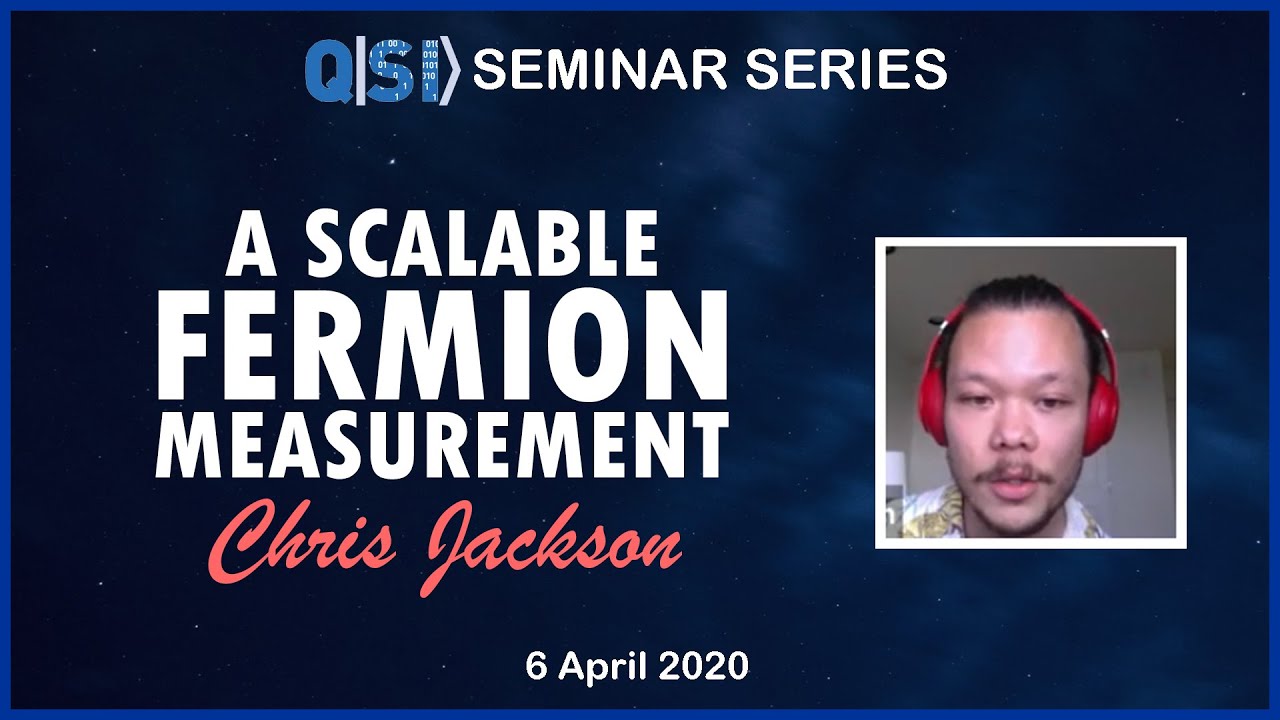
A Scalable Fermion Measurement
Keywords
Summary
168 words
Critical Evaluation
Value of the Information & Strength of the Argument
The talk provides a novel and insightful connection between differential geometry, Lie groups, and quantum measurement. The argumentation is rigorous, building from simple examples (spin coherent states) to the general case of semi-simple Lie groups, and then to the specific case of fermions. The presenter clearly explains the mathematical structures involved and how they lead to a scalable measurement scheme. The value lies in the potential to significantly reduce the resources needed for quantum state tomography of fermionic systems, which is crucial for quantum simulation and computing.
Scientific Rigor, Source Quality, Title Accuracy
The presentation is scientifically rigorous, with a clear logical flow and reliance on established mathematical and physical concepts. However, the talk does not cite specific papers or sources, except for a brief mention of a paper for the isotropic measurement. The title accurately reflects the content, focusing on a scalable measurement scheme for fermionic systems. The description provides links to the relevant research centers, but no direct references to the literature are given.
175 words
Title / Content Match
The title accurately reflects the content, focusing on a scalable measurement scheme for fermionic systems.
Quality & Reliability
8/10
Presentation by a researcher with a clear mathematical framework, based on established theories (Lie groups, coherent states, fermion systems). No direct citations to peer-reviewed papers, but the content is consistent with known results in quantum information and geometry.
Key Moments
Markers derived by PSI from the transcript: the creator did not define chapters.
- Introduction and historical overview of differential geometry.
- Definition of coherent states for the plane and sphere.
- Introduction to the isotropic measurement and its implementation.
- Generalization to semi-simple Lie groups and the role of the Killing form.
- Introduction to fermions and BCS coherent states.
- Discussion of the geometry of the BCS phase space and potential applications.
Cited Sources
- Centre for Quantum Information & Control — Affiliation of the speaker.
- UTS Centre for Quantum Software and Information — Hosting institution.
- Chris Ferrie — Host of the seminar.
Concurring Sources
- Centre for Quantum Information & Control — Affiliation of the speaker, supporting the credibility of the research.
- UTS Centre for Quantum Software and Information — Hosting institution, indicating a recognized research environment.
Contribution & Novelties
The talk presents a novel approach to fermionic quantum state tomography, showing that a scalable measurement is possible using isotropic measurements and BCS coherent states. This is a significant contribution to quantum information science, as it reduces the exponential resource overhead typically required for tomography. The connection between differential geometry and quantum measurement provides a unifying framework that could inspire further research.
Pour aller plus loin :
- BCS theory — Background on the Bardeen-Cooper-Schrieffer theory of superconductivity.
- Coherent states — General concept of coherent states in quantum mechanics.
- POVM — Positive operator-valued measures, the mathematical framework for generalized measurements.
99 words
Radar Profile
The radar profile shows high scores in technical level and information quality, with slightly lower but still strong scores in quantity and reliability. This indicates a technically dense presentation with solid content, though the lack of explicit citations slightly reduces the reliability score.
💬 No comments were provided for analysis.