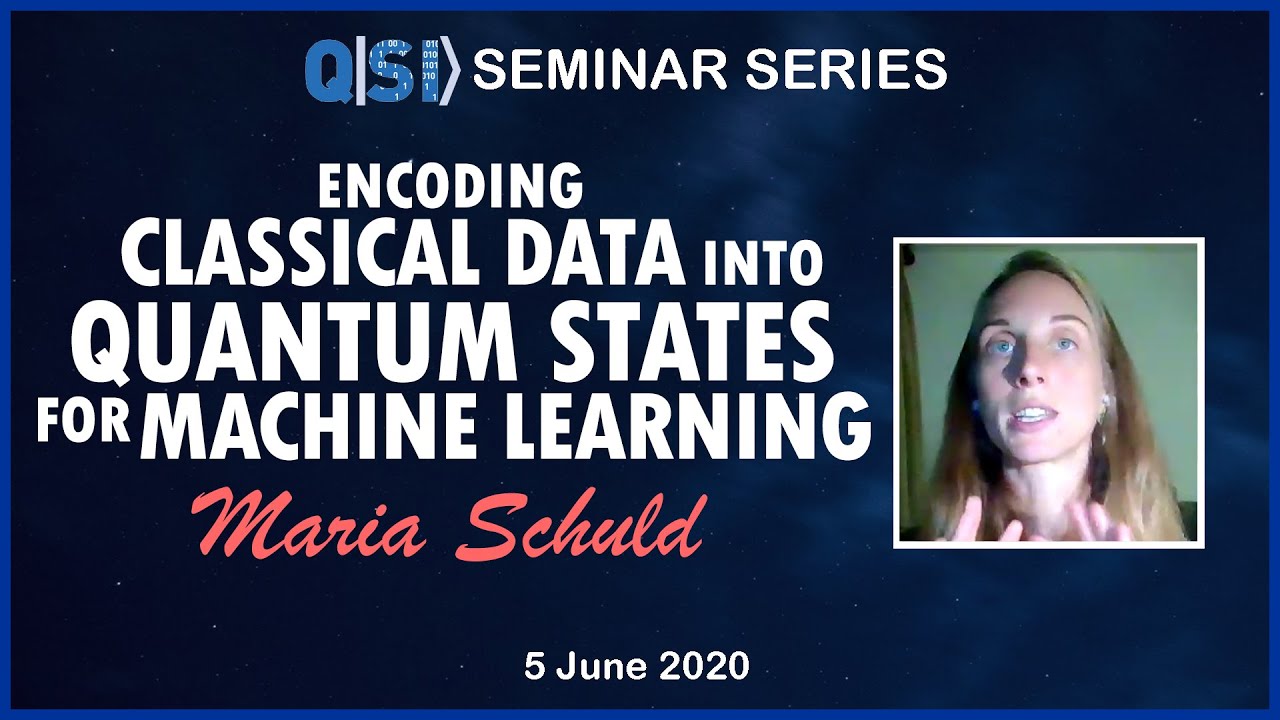
Encoding Classical Data into Quantum States for Machine Learning
Keywords
Summary
156 words
Critical Evaluation
Value of the Information & Strength of the Argument
The talk provides valuable insights into quantum machine learning, particularly emphasizing the often-overlooked importance of data encoding. Schuld’s argument is well-structured, building from basic ML concepts to the specific challenges of quantum encoding. She supports her claims with references to literature and logical reasoning, such as the limitations of basis encoding for generalization. The presentation is persuasive and offers a clear perspective on where the field should focus its efforts.
Scientific Rigor, Source Quality, Title Accuracy
The talk demonstrates scientific rigor by grounding its arguments in established ML theory and referencing a specific paper (arXiv:2001.03622) for the quantum embeddings framework. The speaker is a recognized expert, and the content aligns with current research directions. The title accurately reflects the content, and the talk does not overstate claims, acknowledging open questions and trade-offs. The description provides links to the related paper and institutional pages, which are relevant and credible.
157 words
Title / Content Match
The title accurately reflects the content, which focuses on the importance and methods of encoding classical data into quantum states for machine learning.
Quality & Reliability
8/10
The talk is given by a recognized expert in quantum machine learning, with clear technical depth and references to a peer-reviewed paper. The content is well-structured and grounded in established concepts, though it represents the speaker's perspective and does not include extensive external validation.
Key Moments
Markers derived by PSI from the transcript: the creator did not define chapters.
- Introduction to the talk's focus on data encoding in quantum machine learning.
- Overview of different approaches in quantum ML based on data type and device.
- Explanation of machine learning basics: models, loss functions, and generalization.
- Introduction to feature maps and kernel methods, linking to quantum Hilbert spaces.
- Discussion of variational circuits as quantum ML models and their parameterization.
- Comparison of basis encoding and amplitude encoding, highlighting trade-offs.
- Presentation of quantum embeddings framework for learning data encodings.
- Conclusion emphasizing that data encoding is 95% of the job in quantum ML.
Cited Sources
- Quantum embeddings for machine learning — Referenced as the related paper presenting the framework of quantum embeddings.
- Centre for Quantum Software and Information — Hosting institution of the seminar.
- Chris Ferrie — Host of the seminar and professor at UTS.
Concurring Sources
- Quantum embeddings for machine learning — The paper directly supports the talk's main thesis.
Contribution & Novelties
The talk offers a clear and compelling argument that data encoding is the most critical component in quantum machine learning, a perspective that is often underemphasized in the literature. It synthesizes existing concepts and introduces the quantum embeddings framework as a way to learn encodings adaptively. This provides a novel angle for researchers and practitioners.
Pour aller plus loin :
- Quantum machine learning — Overview of the field.
- Kernel methods — Background on classical kernel methods.
- Variational quantum eigensolver — Related variational quantum algorithms.
- Quantum embedding — General concept of embedding in quantum contexts.
94 words
Radar Profile
The radar profile shows high scores across all dimensions, indicating a well-balanced and technically rigorous presentation. The talk excels in providing substantial information and maintaining a high level of technical depth, with strong reliability due to the speaker's expertise and references.
💬 No comments were provided for analysis.