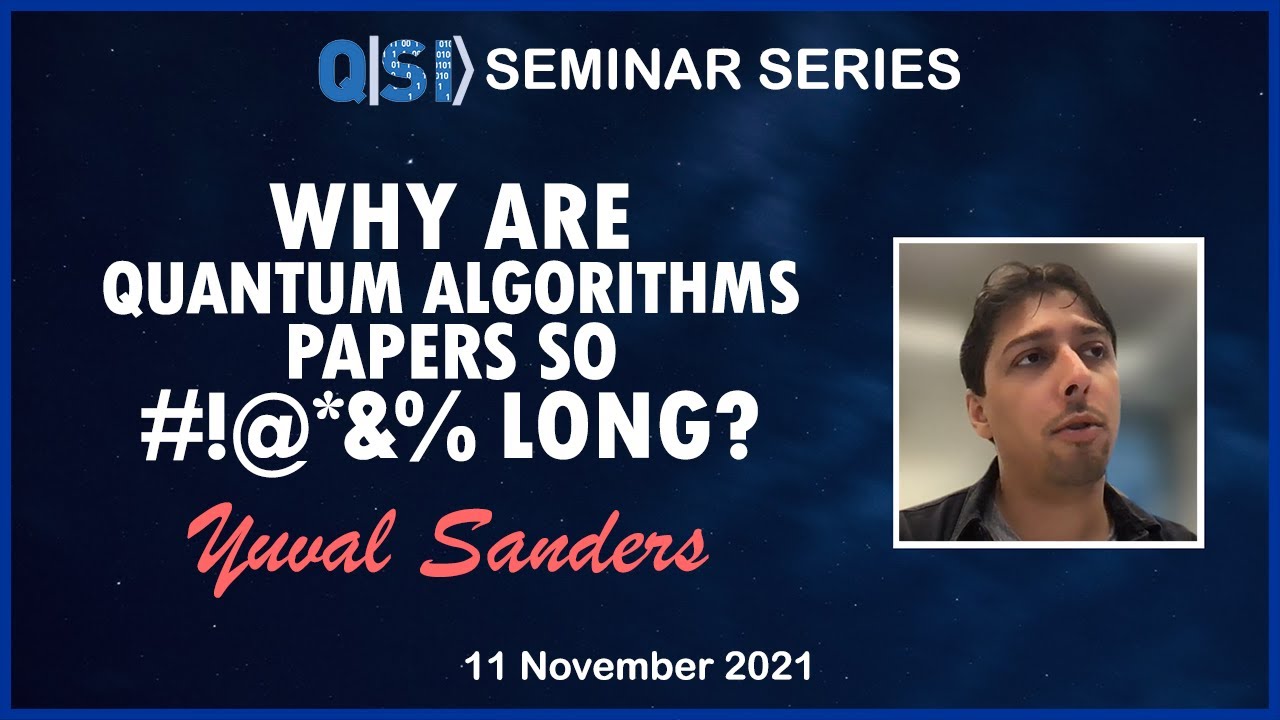
QSI Seminar Yuval Sanders, Centre for Quantum Software and Information, AUS
Keywords
Summary
158 words
Critical Evaluation
Value of the Information & Strength of the Argument
The talk provides valuable insights into the practical challenges of quantum algorithm research, based on the speaker’s direct experience. The argumentation is solid, supported by concrete examples from his papers. Sanders effectively demonstrates how the complexity of quantum algorithm compilation leads to lengthy papers, and he critically examines the reasons behind this trend. He distinguishes between good and bad reasons for paper length, offering a balanced perspective. The discussion of the ‘ugly’ aspects, such as undefined computational models and memory management, is particularly insightful and highlights a real gap in the field. The talk is well-structured and persuasive, though it is primarily an opinion piece rather than a systematic study.
Scientific Rigor, Source Quality, Title Accuracy
The talk is based on two peer-reviewed papers (arXiv:2007.07391 and arXiv:2110.05708), which are cited in the description. The speaker is a credible researcher affiliated with the Centre for Quantum Software and Information. The title accurately reflects the content, and the talk stays on topic. The sources are reliable and directly relevant. The talk does not cite external sources beyond his own papers, but that is appropriate for a seminar discussing his own work. The title is catchy but not misleading.
205 words
Title / Content Match
The title accurately reflects the content: the talk discusses why quantum algorithm papers are long, using the speaker's own papers as examples.
Quality & Reliability
8/10
The speaker is a recognized researcher in quantum algorithms, and the talk is based on two peer-reviewed papers (arXiv:2007.07391 and arXiv:2110.05708). The content is technical and well-argued, but it is an opinion piece about methodological challenges rather than a systematic review.
Key Moments
Markers derived by PSI from the transcript: the creator did not define chapters.
- Introduction by host Troy Lee, introducing Yuval Sanders.
- Sanders begins his talk, outlining the two papers he will discuss.
- Overview of the combinatorial optimization paper, including the problem domains and the headline results.
- Discussion of the quantum field theory paper, focusing on the Gaussian state preparation and the use of Fourier and wavelet transforms.
- Explanation of the classical and quantum components of the algorithms, and the concept of sparse matrix-vector multiplication.
- Introduction of the 'good, bad, and ugly' framework for analyzing paper length.
- Discussion of good reasons for long papers, including novel mathematics and new applications.
- Discussion of bad reasons, such as non-standard cost models and the use of Toffoli counts.
- The 'ugly' part: presentation of pseudocode from the paper, highlighting undefined concepts like quantum arrays and memory management.
- Conclusion: the methodological problem and its impact on media reporting, followed by Q&A.
Cited Sources
- arXiv:2007.07391 — Paper on combinatorial optimization, discussed in the talk.
- arXiv:2110.05708 — Paper on quantum field theory simulation, discussed in the talk.
- Troy Lee profile — Host of the seminar.
- Yuval Sanders profile — Speaker's profile.
- Centre for Quantum Software and Information — Affiliation of the speaker and host.
Concurring Sources
- arXiv:2007.07391 — The paper itself supports the claims about the length and content.
- arXiv:2110.05708 — The paper itself supports the claims about the length and content.
Contribution & Novelties
The talk offers a unique insider perspective on the methodological challenges in quantum algorithms research, particularly the issue of paper length and the lack of standardized computational models. It highlights the need for better tools and frameworks to streamline the compilation of quantum algorithms. The speaker’s candid discussion of the ‘ugly’ aspects, such as undefined concepts and handwaving, is a valuable contribution to the field.
Pour aller plus loin :
- Quantum Random Access Machine (QRAM) — Relevant to the discussion of computational models.
- Quantum circuit compilation — Background on the compilation process.
- Surface code — Mentioned in the context of error correction and Toffoli counts.
105 words
Radar Profile
The radar profile shows high scores in technical level and information quality, indicating a dense and reliable presentation. The lower score in 'quantite_information' relative to others suggests that while the talk is rich in detail, it is focused on a specific topic. Overall, the talk is well-balanced and authoritative.
💬 No comments were provided for analysis.