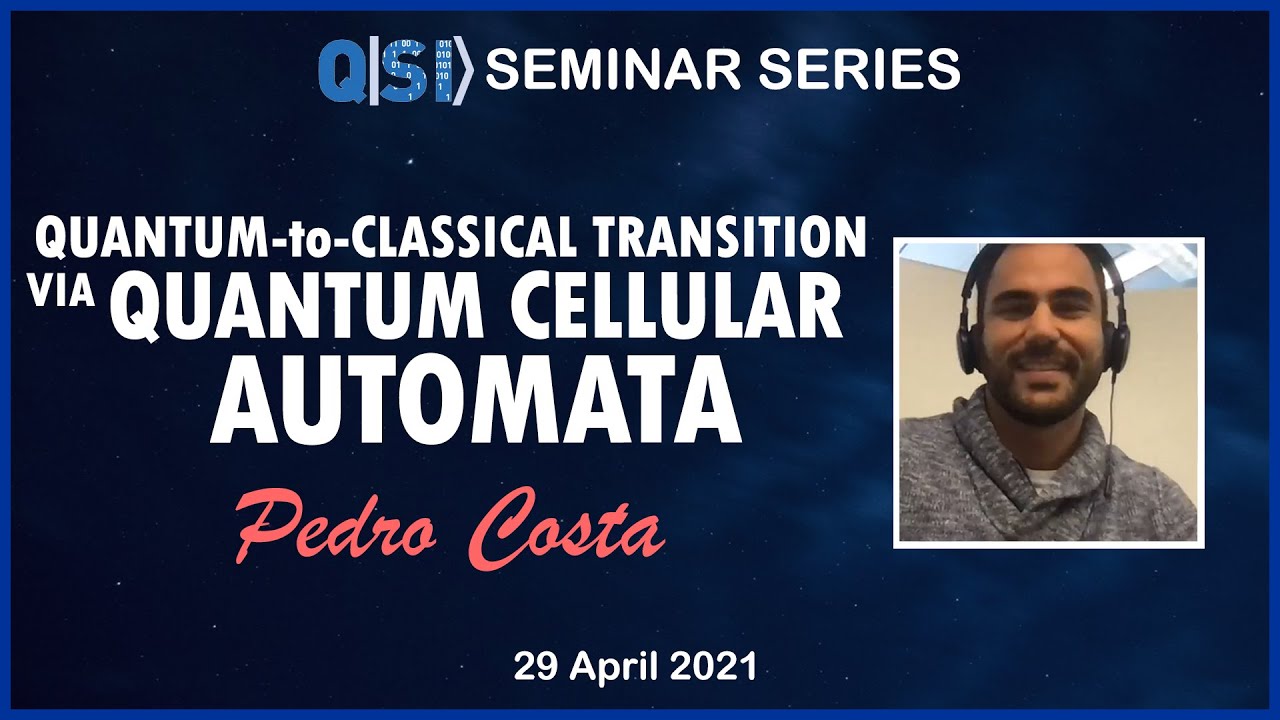
Quantum-to-Classical transition via Quantum Cellular Automata
Keywords
Summary
149 words
Critical Evaluation
Value of the Information & Strength of the Argument
The presentation provides a clear and structured argument for using QCA to study the quantum-to-classical transition. The speaker builds on established concepts (CA, PCA, QCA) and introduces a novel coarse-graining method. The argumentation is logical, with definitions and derivations presented step-by-step. The value lies in proposing a concrete model that bridges quantum and classical regimes, supported by mathematical derivations and simulations. The speaker also acknowledges limitations and future directions, enhancing the credibility of the work.
Scientific Rigor, Source Quality, Title Accuracy
The scientific rigor is high, as the work is based on a preprint (arXiv:2012.04237) and builds on prior publications in peer-reviewed journals. The speaker cites relevant literature and explains the theoretical foundations. The title accurately reflects the content, focusing on the quantum-to-classical transition via QCA. The presentation is well-structured, but the video quality is typical of a seminar recording, with occasional interruptions and informal language. No comments were provided for analysis.
161 words
Title / Content Match
The title accurately reflects the content, which focuses on the quantum-to-classical transition via quantum cellular automata.
Quality & Reliability
8/10
The presentation is based on a peer-reviewed preprint (arXiv:2012.04237) and the speaker is a postdoc at Macquarie University. The content is technical and rigorous, with clear definitions and derivations. However, the video is a seminar recording with limited production quality and no external verification of the claims.
Key Moments
Markers derived by PSI from the transcript: the creator did not define chapters.
- Introduction by host and speaker's background
- Definition of classical cellular automata (CA) and their properties
- Introduction to partitioned cellular automata (PCA) and their reversibility
- Coarse-graining procedure for classical CA
- Definition of quantum cellular automata (QCA) and translation from quantum walks
- Simulation of Dirac equation using QCA
- Application of coarse-graining to QCA and derivation of emergent classical dynamics
- Results: convergence to diffusion and transport equations
- Discussion and conclusions
Cited Sources
- Quantum-to-Classical transition via Quantum Cellular Automata — The main paper presenting the results discussed in the seminar.
Concurring Sources
- Quantum-to-Classical transition via Quantum Cellular Automata — The paper itself, which the seminar is based on.
Contribution & Novelties
The seminar presents a novel approach to studying the quantum-to-classical transition using quantum cellular automata. The key contribution is the development of a coarse-graining procedure for QCA that allows deriving emergent classical dynamics from quantum microscopic rules. This provides a concrete model to validate the transition, with potential implications for understanding decoherence and the emergence of classicality.
Pour aller plus loin :
- Quantum cellular automaton — Provides an overview of QCA and their applications.
- Dirac equation — The relativistic wave equation simulated by the QCA.
- Quantum walk — The quantum walk model used as a basis for the QCA construction.
100 words
Radar Profile
The radar profile shows high scores in technical level and information quality, indicating a specialized and rigorous presentation. The fiabilite_globale is also high, reflecting the use of a preprint and the speaker's expertise. The quantite_information is slightly lower, as the talk is focused on a specific topic.