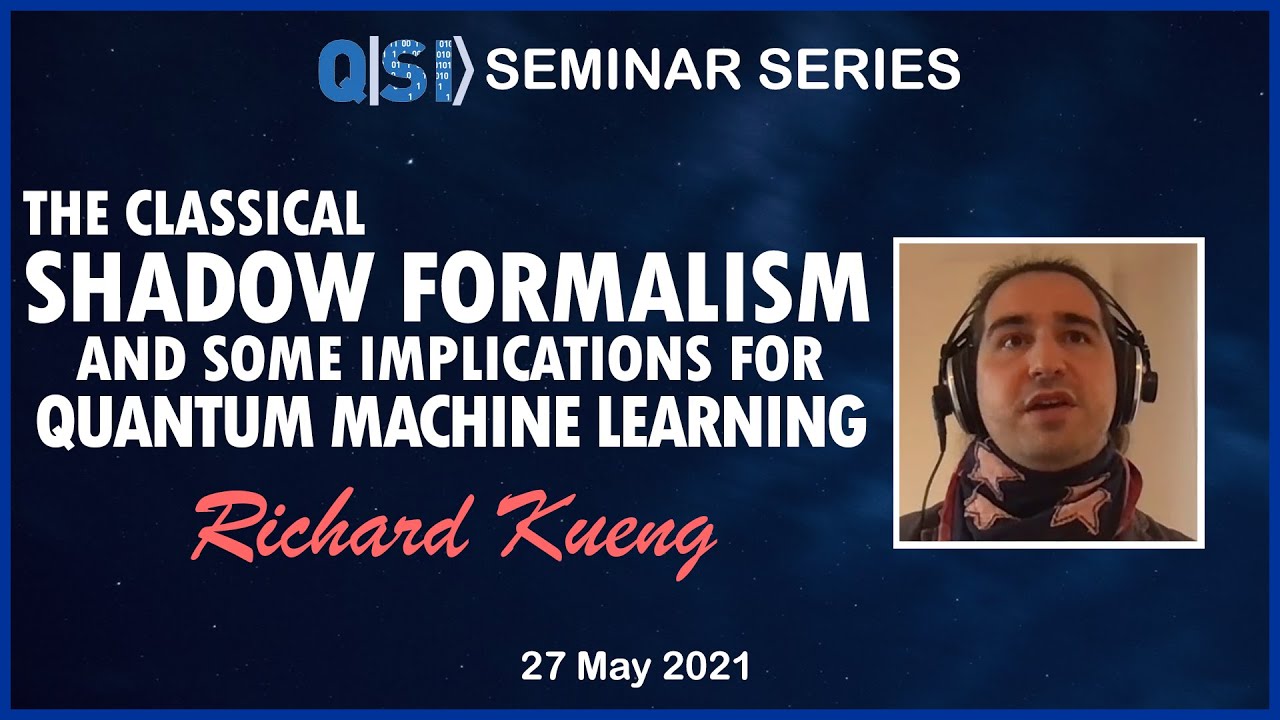
The classical shadow formalism and (some) implications for quantum machine learning
Keywords
Summary
127 words
Critical Evaluation
Value of the Information & Strength of the Argument
The talk provides a clear and rigorous introduction to the classical shadow formalism, with a strong emphasis on the theoretical guarantees and practical advantages. The argumentation is well-structured: starting from the VQE readout problem, Kueng motivates the need for efficient measurement strategies, then presents the formalism and its properties, and finally touches on applications to quantum machine learning. The value lies in the presentation of a novel and powerful technique that addresses a critical bottleneck in near-term quantum computing. The argumentation is solid, backed by mathematical derivations and references to prior work.
Scientific Rigor, Source Quality, Title Accuracy
The talk is scientifically rigorous, with clear definitions and derivations. The speaker cites relevant prior work, including the paper by Huang, Kueng, and Preskill (2020) on predicting many properties of a quantum system from very few measurements. The title accurately reflects the content. The talk is based on original research and is presented by an expert in the field. The sources mentioned are credible and directly related to the topic.
177 words
Title / Content Match
The title accurately reflects the content: the talk focuses on the classical shadow formalism and its implications for quantum machine learning.
Quality & Reliability
8/10
The talk presents a rigorous mathematical framework with performance guarantees, based on peer-reviewed research (joint work with Huang and Preskill). The speaker is an expert in the field, and the content is technically sound. However, as a seminar talk, it lacks the full detail of a published paper, and some claims are presented without full derivation.
Key Moments
Markers derived by PSI from the transcript: the creator did not define chapters.
- Introduction and motivation: VQE readout problem
- Example of VQE with 20 ions, readout bottleneck
- Intuition for random measurements: infinite monkey theorem
- Formalization of classical shadows: quantum-to-classical channel
- Derivation of the average channel and inverse
- Example with single-qubit Pauli measurements
- Sample complexity results and comparison with other methods
- Implications for quantum machine learning
- Ongoing work and future directions
- Conclusion and Q&A
Cited Sources
- Institute for Integrated Circuits - Quantum Research — Speaker's affiliation and research group
- Centre for Quantum Software and Information — Hosting institution
Concurring Sources
- Predicting many properties of a quantum system from very few measurements — The paper presenting the classical shadow formalism, co-authored by the speaker.
Contribution & Novelties
The talk presents the classical shadow formalism, a novel and efficient method for predicting many properties of a quantum state from few measurements. The key innovation is the use of randomized measurements and classical post-processing to construct a classical description that can predict many observables with rigorous guarantees. This has significant implications for quantum machine learning, as it enables the extraction of useful information from quantum systems for classical ML algorithms.
Pour aller plus loin :
- Predicting many properties of a quantum system from very few measurements — The original paper by Huang, Kueng, and Preskill.
- Quantum machine learning — Overview of the field.
- Variational quantum eigensolver — The algorithm motivating the readout problem.
114 words
Radar Profile
The radar profile shows high scores in information quality and technical level, indicating a technically rigorous and informative talk. The quantity of information is also high, but the overall score is slightly lower due to the lack of detailed derivations and the focus on a specific topic.
💬 Sur les 0 commentaires analysés, aucune tendance n'est disponible.