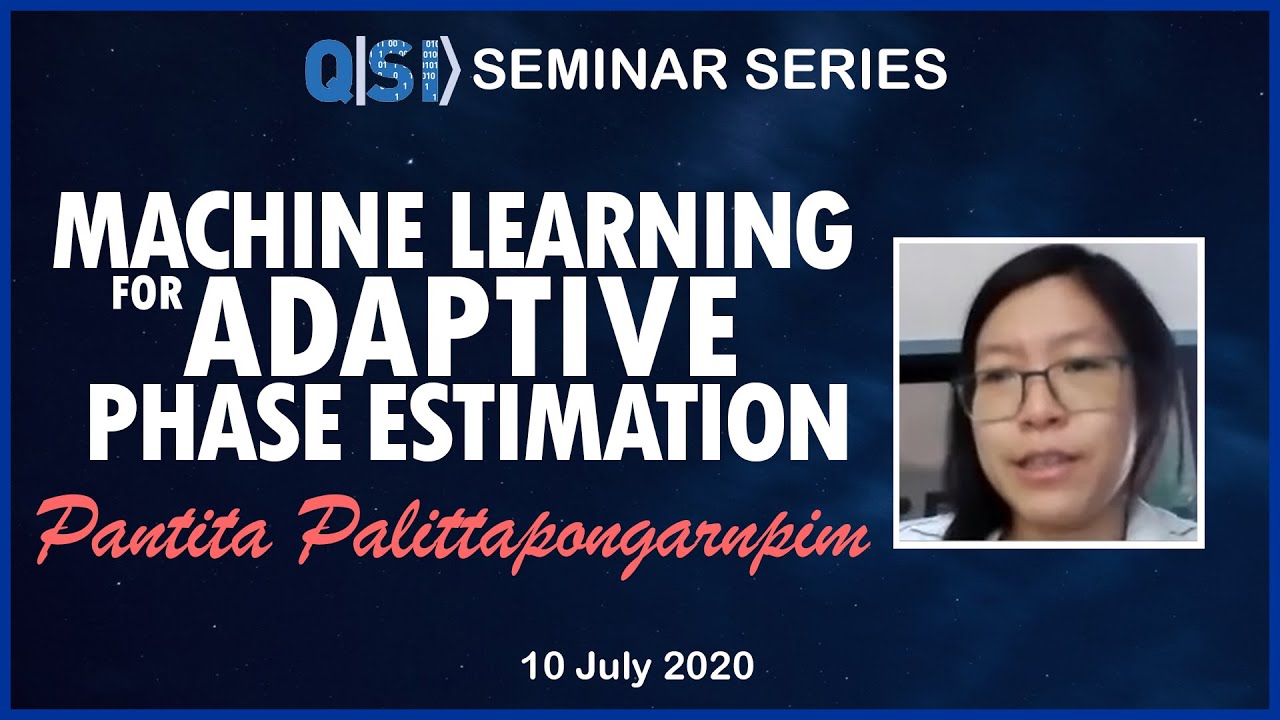
Machine Learning for Adaptive Phase Estimation
Keywords
Summary
178 words
Critical Evaluation
Value of the Information & Strength of the Argument
The talk provides valuable insights into the application of machine learning to quantum control, specifically addressing the challenge of incomplete knowledge of quantum dynamics. The speaker clearly explains the motivation, methodology, and results, making a strong case for the use of data-driven control. The argumentation is solid, with references to prior work and a clear comparison of different optimization algorithms. The presentation is well-structured, guiding the audience from the abstract framework to a concrete example.
Scientific Rigor, Source Quality, Title Accuracy
The talk demonstrates scientific rigor by referencing published work and providing a clear methodology. The sources cited include the speaker’s own publications and related work by others. The title accurately reflects the content, and the presentation is consistent with the abstract. The speaker acknowledges the limitations of the study, such as the simulation-based approach and the assumption of no prior knowledge of the phase shift.
155 words
Title / Content Match
The title accurately reflects the content, focusing on machine learning techniques applied to adaptive phase estimation.
Quality & Reliability
8/10
The talk presents original research from a PhD, with clear methodology and references to published work. The speaker is an expert in the field, and the content is well-structured. However, it is a seminar presentation, not a peer-reviewed publication, and some details are simplified for a general audience.
Key Moments
Markers derived by PSI from the transcript: the creator did not define chapters.
- Introduction to quantum metrology and the goal of improving phase estimation precision.
- Explanation of adaptive quantum metrology and the feedback loop.
- Overview of data-driven control framework and its advantages over model-based control.
- Description of the Mach-Zehnder interferometer and the Wiseman-Killip state.
- Discussion of policy search and the challenges of learning with 50/50 detection probabilities.
- Comparison of optimization algorithms: particle swarm optimization, differential evolution, and stochastic hill climbing.
- Evaluation criteria for comparing model-free and model-based methods.
- Results showing Heisenberg-limited scaling despite unknown noise.
- Discussion of robustness and resource efficiency.
- Conclusion and future directions.
Cited Sources
- Chulalongkorn University — Speaker's affiliation.
- UTS Centre for Quantum Software and Information — Hosting institution.
- Márika Kieferová — Host of the seminar.
Concurring Sources
- Wiseman and Killip, 'Adaptive single-shot phase measurements: The full quantum theory' — Reference for the Wiseman-Killip state.
- Hentschel and Sanders, 'Machine learning for precise quantum measurement' — Prior work on policy search for adaptive phase estimation.
Contribution & Novelties
The talk presents a novel application of data-driven control to quantum metrology, specifically adaptive phase estimation. The key contribution is the demonstration that machine learning techniques can design control policies without a complete model of the quantum system, even in the presence of unknown noise. The speaker also introduces a noise-resistant differential evolution algorithm that improves scalability to larger particle numbers.
Pour aller plus loin :
- Quantum metrology — Provides background on the field and the Heisenberg limit.
- Particle swarm optimization — A key algorithm used in the talk.
- Differential evolution — Another optimization algorithm discussed.
- Machine learning — General overview of the field.
104 words
Radar Profile
The radar profile shows high scores in information quantity, quality, and technical level, indicating a dense and well-presented talk. The global reliability is also high, reflecting the speaker's expertise and the use of published work. The overall note of 4 stars is justified by the strong content and clear presentation.
💬 Sur les 0 commentaires analysés, aucune tendance n'est disponible.