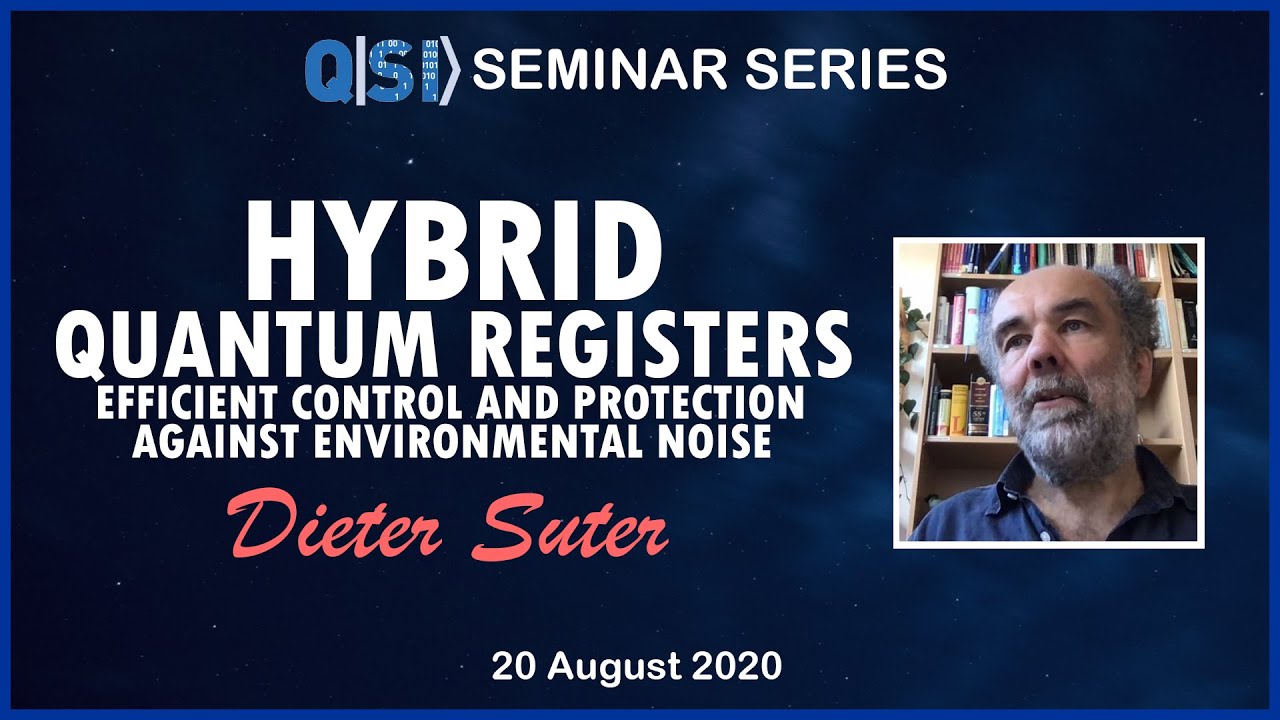
Hybrid Quantum Registers: Efficient control and protection against environmental noise
Keywords
Summary
160 words
Critical Evaluation
Value of the Information & Strength of the Argument
The talk provides valuable insights into the practical challenges of building hybrid quantum registers and presents original experimental results. The argumentation is solid, based on detailed explanations of the physical mechanisms and supported by experimental data. The speaker systematically addresses the issues of initialization, control, and decoherence, offering concrete solutions. The value lies in the demonstration of techniques to overcome the disparity in control speeds between electron and nuclear spins, and the protection of coherence during operations.
Scientific Rigor, Source Quality, Title Accuracy
The scientific rigor is high, as the speaker is an established researcher and the content is based on experimental work. However, specific sources are not cited within the talk, but the description provides links to the research group’s publications and interests. The title accurately reflects the content, focusing on hybrid quantum registers and their control and protection. The talk is well-structured and technically detailed, suitable for an audience with background in quantum physics.
165 words
Title / Content Match
The title accurately reflects the content, focusing on hybrid quantum registers and techniques for efficient control and protection against environmental noise.
Quality & Reliability
8/10
The talk is given by an expert experimental physicist, presenting original research with detailed technical explanations and experimental data. The content is consistent with established quantum physics principles. However, as a seminar presentation, it lacks peer-reviewed publication details and some claims are not fully referenced within the talk.
Key Moments
Markers derived by PSI from the transcript: the creator did not define chapters.
- Introduction to the seminar and speaker's background.
- Overview of quantum information processing and the network model.
- Introduction to NV centers in diamond and their properties.
- Explanation of initialization and readout of the electron spin using laser and photon counting.
- Discussion of nuclear spins as qubits and the challenges of controlling them.
- Demonstration of gate operations on electron and nuclear spins.
- Introduction of protected gate operations using dynamical decoupling.
- Experimental results showing improved nuclear spin polarization with orange laser.
- Discussion of the effects of radio-frequency fields on electron spin coherence.
- Conclusion and summary of the presented techniques.
Cited Sources
- Publications of the Suter group — List of publications by the speaker's group, providing further reading on the presented research.
- Research interests of the Suter group — Overview of the research topics of the group, including quantum information and spectroscopy.
- Group homepage — Homepage of the Suter group at TU Dortmund University.
- UTS Centre for Quantum Software and Information — Hosting institution of the seminar series.
- Dr Clara Javaherian — Host of the seminar and contact person.
Concurring Sources
- NV center quantum computing — General information on NV centers, consistent with the talk's description.
Contribution & Novelties
The talk presents original experimental techniques for controlling hybrid quantum registers, specifically addressing the challenge of slow nuclear spin control by using indirect microwave-driven methods and protected gate operations. The use of orange laser light to improve nuclear spin polarization is a notable contribution. The talk also highlights the importance of dynamical decoupling for maintaining coherence during nuclear spin operations.
Pour aller plus loin :
- Nitrogen-vacancy center — Overview of NV centers and their applications.
- Dynamical decoupling — Technique used to protect quantum coherence.
- Quantum register — Basic concept of a quantum register.
93 words
Radar Profile
The radar profile shows high scores in technical level and information quality, indicating a technically dense and informative presentation. The quantity of information is also high, but the overall score is slightly lower due to the lack of explicit citations within the talk.
💬 No comments were provided for analysis.