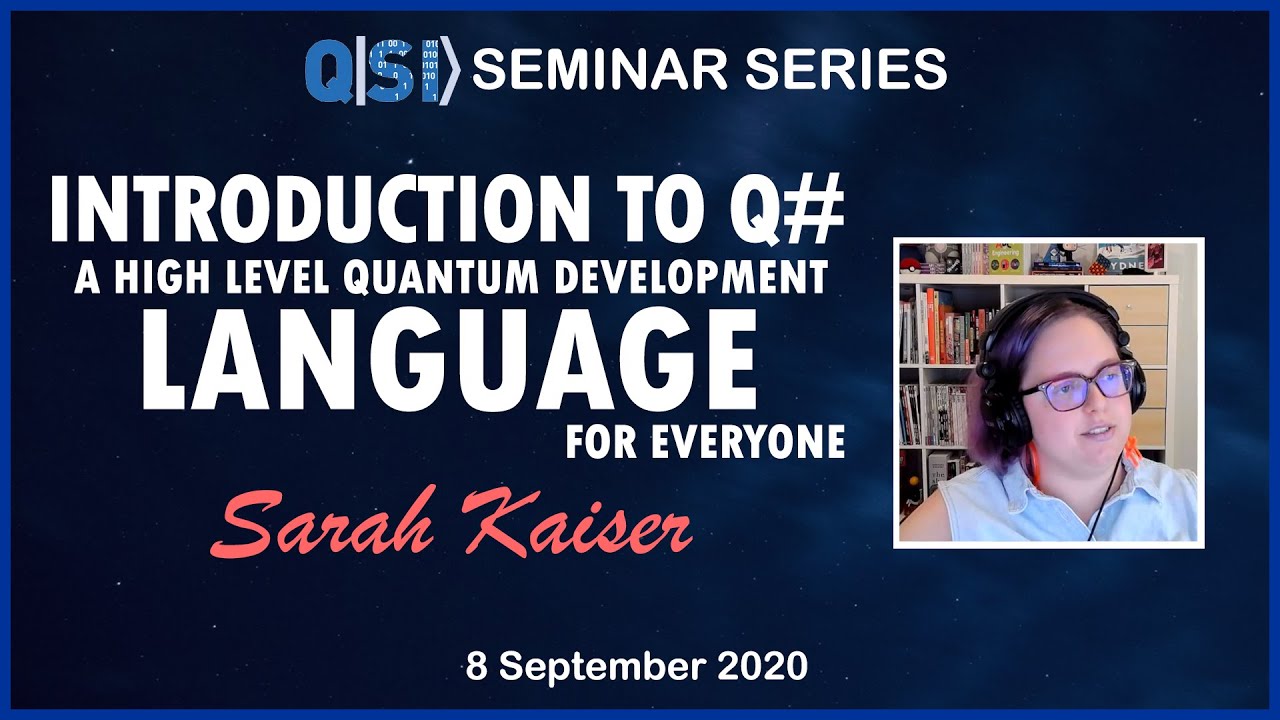
Introduction to Q#: A high level quantum development language for everyone
Keywords
Summary
188 words
Critical Evaluation
Value of the Information & Strength of the Argument
The talk provides valuable insights into Q# and quantum programming, with a clear and logical structure. The speaker’s arguments are well-supported by practical examples and her experience in the field. She effectively demonstrates the benefits of Q# for research, such as hardware abstraction and resource estimation, and makes a compelling case for open-source development in quantum computing. The case study on qRAM illustrates the practical application of Q# in a research context, adding credibility to her claims.
86 words
Title / Content Match
The title accurately reflects the content: a comprehensive introduction to Q# for a general audience.
Quality & Reliability
8/10
The talk is given by an experienced researcher and practitioner in quantum computing, with clear explanations and practical demonstrations. The content is consistent with established knowledge about Q# and quantum programming. The speaker provides references to open-source projects and resources, but the talk is primarily a tutorial rather than a rigorous scientific presentation.
Key Moments
Markers derived by PSI from the transcript: the creator did not define chapters.
- Introduction and speaker bio
- Overview of quantum software tools and selection criteria
- Introduction to Q# and the Quantum Development Kit
- Writing functions and operations in Q#
- Example: quantum random number generator
- Functors: adjoint and controlled operations
- Running Q# in Jupyter notebooks and other hosts
- Target machines: simulator, resource estimator, and trace
- Unit testing in Q# for research
- Case study: implementing qRAM in Q#
- Open-source tools and community resources
Cited Sources
- Q# Community — Community for Q# developers and users
- qRAM repository — Open-source implementation of qRAM in Q#
- Women in Quantum Computing & Applications — Organization supporting women in quantum computing
- Learn Quantum Computing with Python and Q# — Book by Sarah Kaiser and Chris Granade
- Sarah Kaiser's webpage — Personal website of the speaker
- UTS Centre for Quantum Software and Information — Hosting institution
- Chris Ferrie's webpage — Host's personal website
- Python Workshop: Quantum Information Science — Workshop materials by QuinnPhys
Concurring Sources
- Q# documentation — Official documentation aligns with the talk's content.
- Quantum Open Source Foundation — Lists many quantum software tools mentioned in the talk.
External References
Contribution & Novelties
The talk provides a practical introduction to Q# and demonstrates its application in quantum research, particularly through the qRAM case study. It highlights the importance of open-source development and reproducibility in quantum computing. The speaker’s perspective as an independent researcher adds value, as she shares real-world experiences and resources.
Pour aller plus loin :
- Q# documentation — Official documentation for Q# and the Quantum Development Kit.
- Quantum Open Source Foundation — Organization promoting open-source quantum software.
- Unitary Fund — Non-profit supporting open-source quantum projects.
- Quantum Computing Report — Overview of quantum computing landscape.
93 words
Radar Profile
The radar profile shows high scores in quantity and quality of information, with a moderate technical level. The talk is well-balanced, providing both theoretical and practical insights. The fiabilite_globale is high, reflecting the speaker's expertise and the consistency of the content.
💬 No comments were provided for analysis.