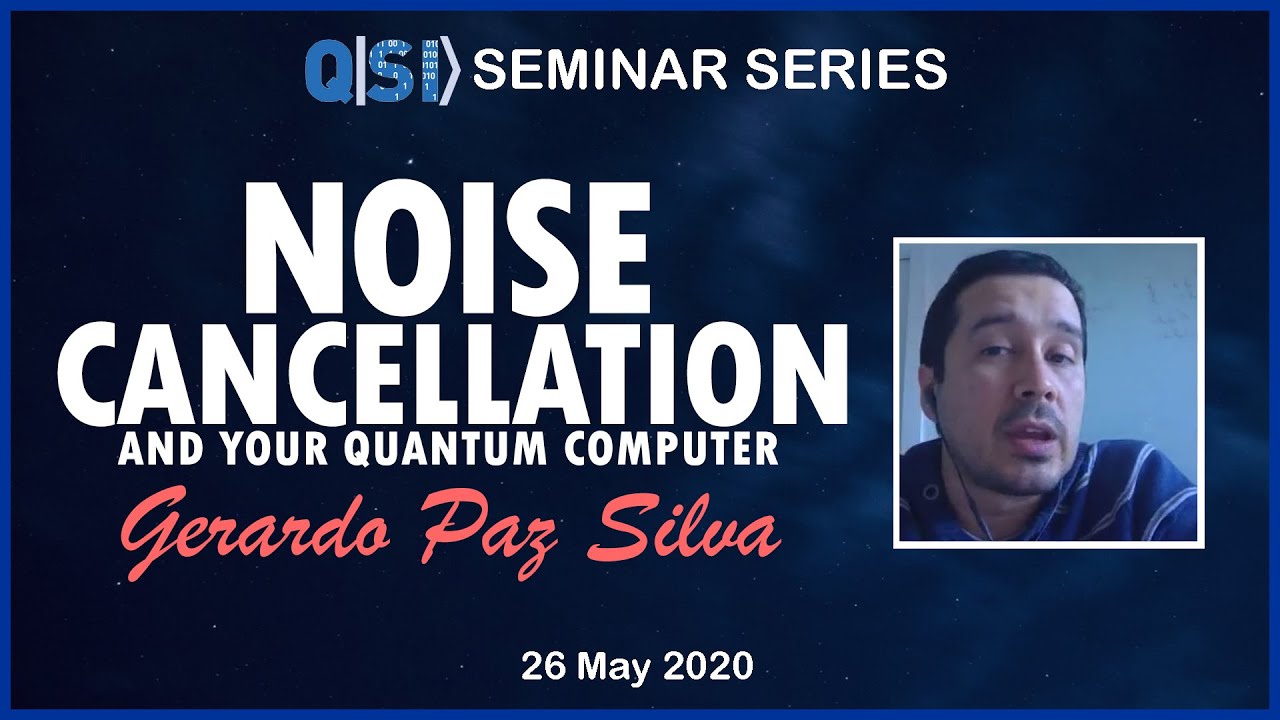
QSI Seminar: Dr Gerardo Paz Silva, Griffith U, Noise Cancellation and your quantum computer 27/05/20
Keywords
Summary
196 words
Critical Evaluation
Value of the Information & Strength of the Argument
The talk provides a valuable conceptual framework for understanding quantum noise spectroscopy and its connection to control. The argumentation is logically structured, starting from the general open quantum system formalism and progressively narrowing down to the specific challenges and the proposed solution. The speaker effectively uses mathematical derivations to support his claims, such as showing that only certain correlation functions affect the system dynamics. The presentation of the new approach is compelling, as it addresses known limitations of existing QNS protocols. However, the talk is primarily theoretical, and the practical implementation and experimental validation are not discussed in depth. The speaker acknowledges that a fully general protocol is still non-existent, but argues that focusing on relevant noise components is a pragmatic step forward.
Scientific Rigor, Source Quality, Title Accuracy
The talk demonstrates scientific rigor through the use of established mathematical frameworks and references to prior work in the field. The speaker mentions collaborations and funding sources, adding credibility. The title accurately reflects the content, which is centered on noise cancellation in quantum computers. The abstract and presentation are consistent. The talk does not include a formal citation list, but the speaker references key concepts and prior work, such as dynamical decoupling and filter functions, which are well-known in the literature. The description provides a link to the UTS Centre for Quantum Software and Information, which is relevant to the hosting institution. Overall, the scientific quality is high, though the lack of explicit citations in the talk itself is a minor weakness.
260 words
Title / Content Match
The title accurately reflects the content, focusing on noise cancellation techniques for quantum computers, with a specific emphasis on a new approach to quantum noise spectroscopy.
Quality & Reliability
8/10
The talk presents a novel theoretical approach to quantum noise spectroscopy, grounded in established physics and mathematical formalism. The speaker is an expert in the field, and the content is consistent with current research trends. However, the presentation is a seminar, not peer-reviewed, and the proposed method is not yet experimentally validated.
Key Moments
Markers derived by PSI from the transcript: the creator did not define chapters.
- Introduction to the problem of noise in quantum computers and the goal of noise cancellation.
- Discussion of open quantum systems and the role of bath correlations.
- Introduction of the filter function formalism and its importance in noise spectroscopy.
- Explanation of how filter functions can be used for noise suppression and characterization.
- Review of existing quantum noise spectroscopy protocols and their limitations.
- Presentation of the new approach: characterizing only relevant noise components.
- Illustration of the new approach with two paradigmatic examples.
- Discussion of potential applications, including bath thermometry and improved gate fidelities.
- Conclusion and outlook for future research.
Cited Sources
- UTS Centre for Quantum Software and Information — Hosting institution of the seminar; provides background on the research group.
Concurring Sources
- Quantum noise spectroscopy — General overview of QNS, consistent with the talk's description of the field.
- Dynamical decoupling — Technique for noise suppression, which the talk references as a related approach.
Contribution & Novelties
The talk presents a novel perspective on quantum noise spectroscopy by emphasizing the importance of characterizing only the noise components that are relevant to a given set of control capabilities. This approach could simplify the design of QNS protocols and make them more practical for real quantum devices. The speaker argues that by focusing on the relevant noise subspace, many of the theoretical difficulties in developing a fully general QNS protocol can be circumvented. This is a significant conceptual contribution that may guide future research in quantum control and noise mitigation.
Pour aller plus loin :
- Quantum noise spectroscopy — Provides an overview of the field and its applications.
- Dynamical decoupling — A key technique for noise suppression that is closely related to the talk’s content.
- Filter function formalism — A foundational paper on filter functions for quantum control.
- Open quantum systems — Background on the theoretical framework used in the talk.
152 words
Radar Profile
The radar profile shows high scores in technical level and information quality, indicating a dense, expert-level presentation. The moderate scores in quantity and reliability suggest that while the talk is informative, it is not exhaustive and relies on the speaker's expertise rather than extensive citations.