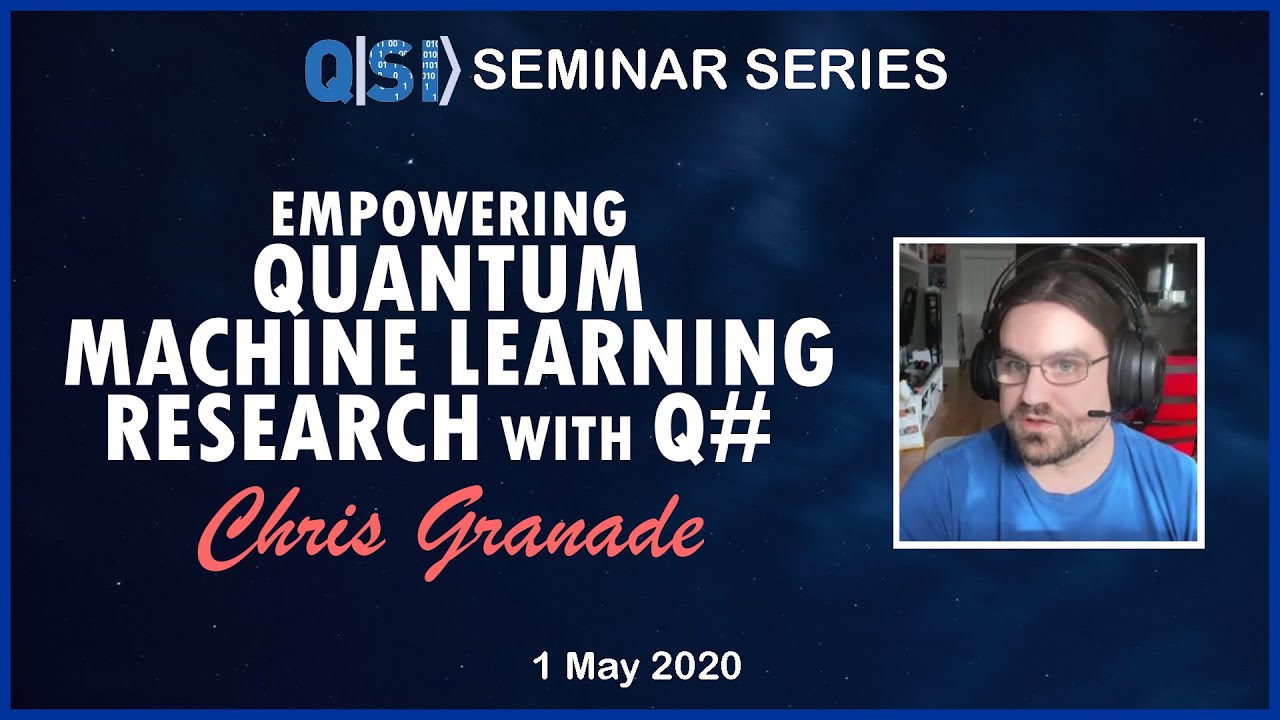
Empowering Quantum Machine Learning Research with Q#
Keywords
Summary
181 words
Critical Evaluation
Value of the Information & Strength of the Argument
The talk provides valuable insights into the practical aspects of quantum programming, particularly for quantum machine learning. The speaker demonstrates a concrete example (QCC classifier) and explains the underlying concepts clearly. The argumentation is solid, grounded in the speaker’s experience and the open-source resources provided. The emphasis on reproducibility and the use of containers is a strong point, as it addresses a real need in research. However, the talk is more of an overview and demonstration rather than a deep dive into the theoretical foundations or performance benchmarks, which limits its scientific depth.
102 words
Title / Content Match
The title accurately reflects the content, as the talk focuses on using Q# for quantum machine learning research, with a concrete example of a classifier.
Quality & Reliability
8/10
The talk is given by a researcher at Microsoft Quantum, with a strong background in quantum computing. The content is technically accurate and well-structured, but it is primarily a presentation of the Q# language and its capabilities rather than a peer-reviewed study. The speaker demonstrates practical examples and references open-source resources, which enhances credibility.
Key Moments
Markers derived by PSI from the transcript: the creator did not define chapters.
- Introduction to quantum development and its importance for cost estimation and debugging.
- Introduction to the QCC classifier and its application to a half-moon dataset.
- Explanation of the variational training process and the use of the Hadamard test.
- Overview of Q#'s design philosophy: quantum states are not first-class, programs are classical with side effects.
- Demonstration of Q# language features: partial application, iteration, and higher-level abstractions.
- Discussion of the Quantum Development Kit libraries and open-source repositories.
- Importance of reproducibility and the use of containers for research.
- Live demonstration of running Q# in a container using Visual Studio Codespaces.
Cited Sources
- Microsoft Quantum Open Source Release — Announcement of the open-source release of the Quantum Development Kit.
- Microsoft Quantum Documentation — Official documentation for Q# and the Quantum Development Kit.
- Jupyter Notebook for Q# — Interactive notebook environment for Q#.
- Quantum Katas and Tutorials — Tutorials and exercises for learning quantum computing with Q#.
- Q# Community — Community resources for Q#.
- Microsoft Quantum — General information about Microsoft Quantum.
- UTS Centre for Quantum Software and Information — Hosting institution for the seminar.
- Chris Ferrie's UTS profile — Profile of the host, A/Prof Chris Ferrie.
Concurring Sources
- Microsoft Quantum Documentation — Official documentation aligns with the talk's description of Q# features.
- Quantum Katas — Tutorials that support the learning approach mentioned in the talk.
Contribution & Novelties
The talk provides a practical introduction to using Q# for quantum machine learning, demonstrating the QCC classifier and the associated library. It highlights the design philosophy of Q# and its advantages for research, such as portability and reproducibility. The emphasis on reproducible research through containers is a valuable contribution.
Pour aller plus loin :
- Quantum machine learning — Overview of the field.
- Variational quantum eigensolver — Related variational algorithm.
- Q# documentation — Official language reference.
75 words
Radar Profile
The radar profile shows high scores across all dimensions, indicating a well-rounded and informative presentation. The talk is technically strong, with good information quality and reliability, though it is not a peer-reviewed study.