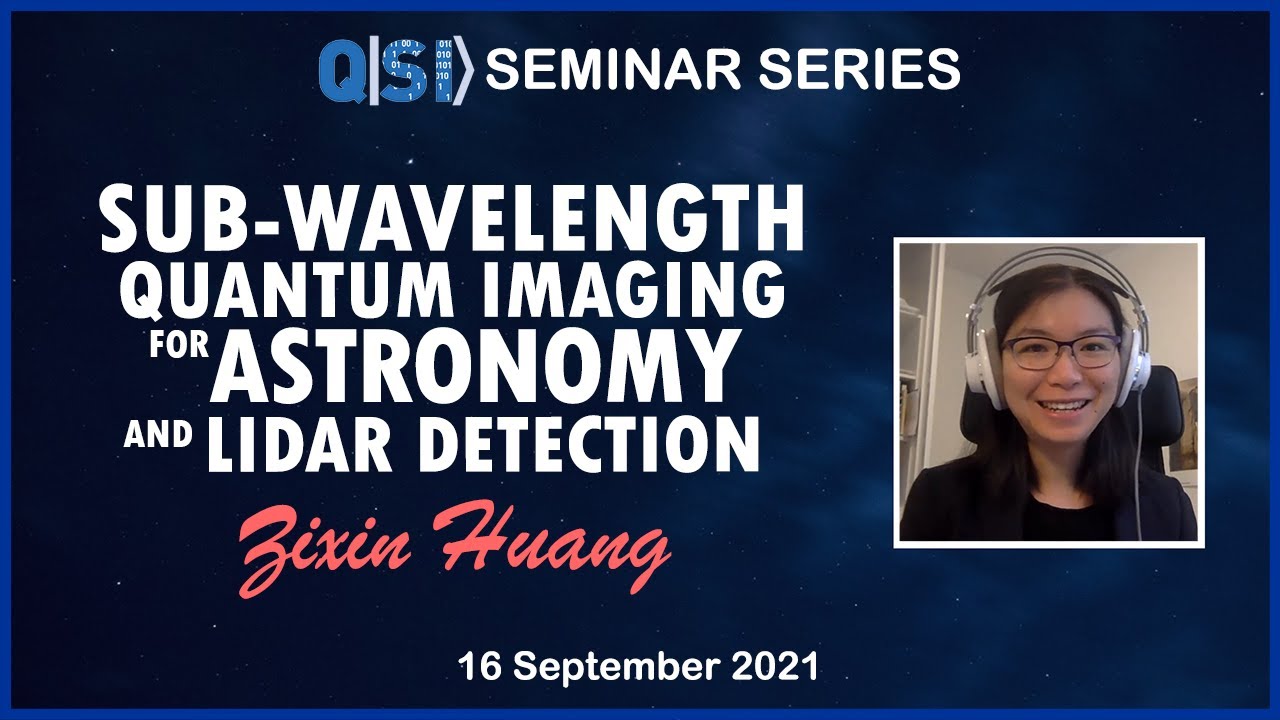
Sub-wavelength quantum imaging for astronomy and LIDAR detection
Keywords
Summary
169 words
Critical Evaluation
Value of the Information & Strength of the Argument
The talk provides a clear and rigorous exposition of advanced quantum metrology concepts. The speaker systematically builds from the two-source problem to the N-source generalization, using mathematical derivations to support each step. The argumentation is solid, with references to known results and a logical flow. The value of the information is high for researchers in quantum optics and metrology, as it presents novel techniques and potential applications.
Scientific Rigor, Source Quality, Title Accuracy
The presentation is scientifically rigorous, with proper mathematical formalism and references to published literature. The speaker cites relevant papers and acknowledges collaborators. The title accurately reflects the content, and the talk stays on topic throughout. The sources are credible, including the speaker’s own publications and those of other researchers in the field.
134 words
Title / Content Match
The title accurately reflects the content, covering quantum imaging techniques applied to astronomy and LIDAR.
Quality & Reliability
8/10
The talk presents original research in quantum metrology, with mathematical derivations and references to published work. The speaker is a postdoctoral fellow at a recognized institution, and the content is technical and consistent with known literature.
Key Moments
Markers derived by PSI from the transcript: the creator did not define chapters.
- Introduction to Rayleigh criterion and its limitations.
- Explanation of quantum Fisher information and Rayleigh's curse.
- Optimal measurement using spatial mode sorting.
- Application to LIDAR: entangled photons and time-frequency trade-off.
- Generalization to N sources and purification method.
- Quantum hypothesis testing for exoplanet detection.
- Comparison of classical and quantum relative entropy.
- Conclusion and future directions.
Cited Sources
- Peter Rohde's profile — Host of the seminar and collaborator.
- Centre for Quantum Software and Information — Hosting institution.
- Zixin Huang's website — Speaker's personal page with publications.
Concurring Sources
- Quantum Fisher information — Supports the mathematical framework used.
- Rayleigh criterion — Background on the classical resolution limit.
Contribution & Novelties
The talk presents original contributions to quantum imaging, including a generalization to N sources and applications to LIDAR and exoplanet detection. The purification method simplifies the computation of quantum Fisher information, and the use of entangled photons to overcome the time-frequency trade-off is a novel concept.
Pour aller plus loin :
- Quantum Fisher information — Relevant to the core metrology concepts.
- Rayleigh criterion — Background on the classical limit.
- Quantum illumination — Related to quantum LIDAR applications.
77 words
Radar Profile
The radar profile shows high scores in technical level and information quality, indicating a specialized and rigorous presentation. The lower score in quantity of information reflects the focused scope of the talk, while the overall balance suggests a well-structured seminar.