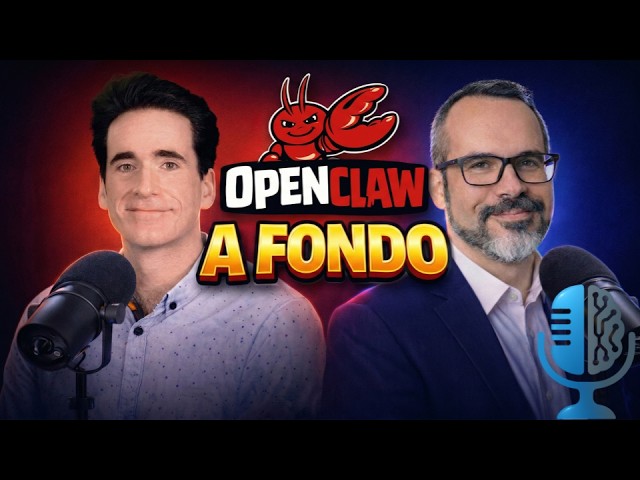
OpenClaw: anatomía de un agente de IA
Keywords
Summary
134 words
Critical Evaluation
Value of the Information & Strength of the Argument
The value of the information lies in its practical insights into the architecture and use of OpenClaw, based on the speakers’ direct experience and technical knowledge. The argumentation is solid, as they explain the system’s components clearly and provide concrete examples, such as the WhatsApp anecdote and the memory management. They also critically assess the utility and security implications, offering a nuanced perspective. However, the discussion is largely anecdotal and lacks formal evidence or citations, which slightly weakens the argumentation.
Scientific Rigor, Source Quality, Title Accuracy
The scientific rigor is moderate: the hosts demonstrate technical expertise but do not cite specific sources or studies. The only provided link is to their own podcast page, which does not serve as a reference for the claims made. The title accurately reflects the content, focusing on the anatomy of OpenClaw. The discussion is coherent and well-structured, but the lack of external references and the reliance on personal experience reduce the overall rigor.
168 words
Title / Content Match
The title accurately reflects the content, which focuses on the anatomy and technical workings of OpenClaw, an AI agent.
Quality & Reliability
7/10
The discussion is based on the speakers' expertise and direct experience with OpenClaw, but lacks formal citations or verification of claims. The technical details are plausible and align with known AI agent architectures, but the lack of sources and the anecdotal nature reduce the overall reliability.
Key Moments
Markers derived by PSI from the transcript: the creator did not define chapters.
- Introduction to OpenClaw and the anecdote about Peter Steinberger's WhatsApp message.
- Discussion on the utility of OpenClaw and comparison with ChatGPT.
- History of the project: from WhatsApp Rel War to Cloudbot, and the name change issues.
- Technical architecture: the agentic loop, tool use, and channels.
- Memory system: soul.md, memory.md, user.md, and SQLite database.
- Proactive features: herbit (cron job) and browsing with Playwright.
- Security concerns: prompt injection, token consumption, and the Moldbot incident.
- Discussion on the future of OpenClaw and its adoption.
Cited Sources
- Tertulia IA Podcast — Official podcast page with additional information and links.
Concurring Sources
- OpenClaw GitHub repository — Official repository for OpenClaw, providing code and documentation.
Contribution & Novelties
The episode provides a practical, hands-on overview of OpenClaw’s architecture and use cases, which is valuable for those interested in AI agents. It demystifies the system by explaining its components (memory, channels, agentic loop) in an accessible way. The discussion also highlights real-world considerations like token costs and security risks, which are often overlooked in theoretical discussions.
Pour aller plus loin :
- AI agent — Foundational concept for understanding autonomous agents.
- Prompt injection — Key security vulnerability discussed in the episode.
- Playwright — Browser automation tool used by OpenClaw for web interactions.
92 words
Radar Profile
The radar profile shows high scores in information quantity and technical level, indicating a content-rich and technically deep discussion. The lower scores in reliability and quality reflect the lack of formal citations and the anecdotal nature of the presentation.
💬 No comments were provided for analysis.