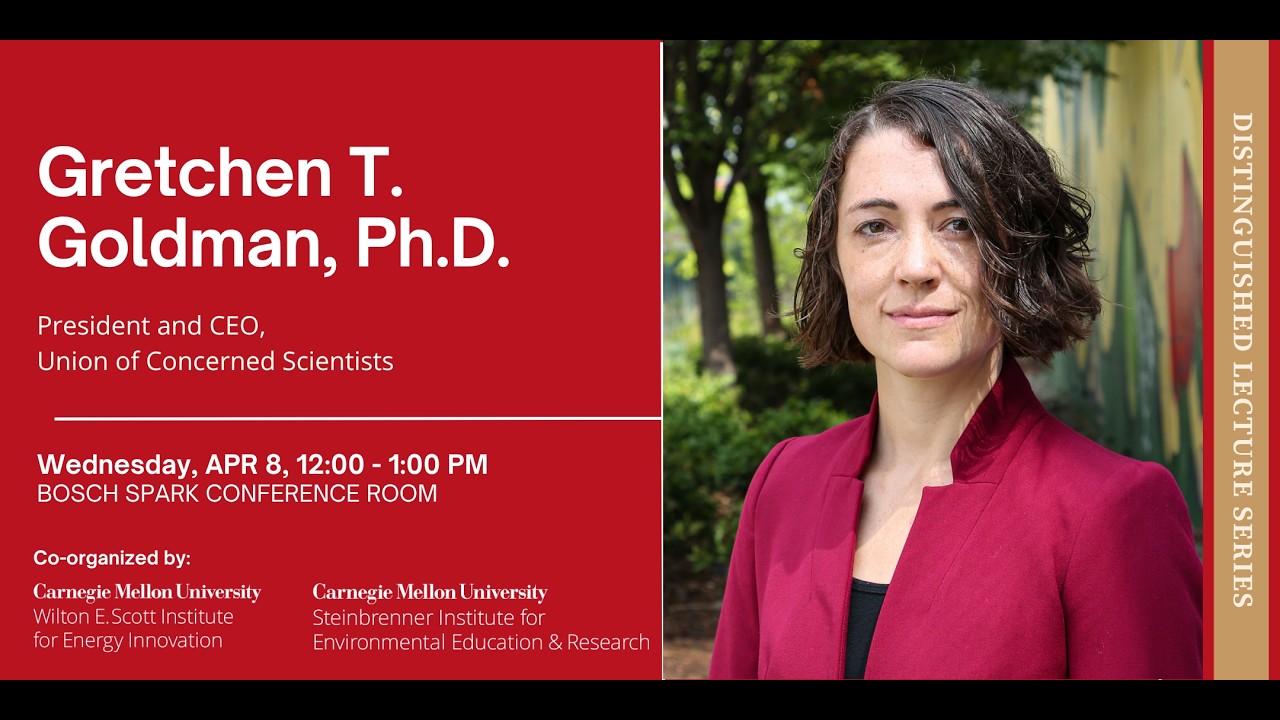
Distinguished Lecture with Gretchen Goldman
Keywords
Summary
202 words
Critical Evaluation
Value of the Information & Strength of the Argument
The lecture provides valuable insights into the current challenges facing science in federal policy, backed by the speaker’s direct experience and data from UCS tracking. The argumentation is coherent and well-supported, though it presents a specific political perspective. The speaker effectively uses examples and data to illustrate her points, making a compelling case for the importance of scientific integrity and the need for the scientific community to respond.
Scientific Rigor, Source Quality, Title Accuracy
The lecture demonstrates scientific rigor through the use of data from UCS reports and references to specific incidents and policies. The speaker’s credentials lend credibility, and the content is well-organized. The title accurately reflects the content. No external sources are cited in the description, but the speaker references UCS reports and specific events.
136 words
Title / Content Match
The title accurately reflects the content: a distinguished lecture by Gretchen Goldman on science policy.
Quality & Reliability
8/10
The lecture is delivered by a highly qualified expert with extensive experience in science policy, including roles at OSTP and UCS. The content is well-structured, evidence-based, and references specific reports and data. However, as an opinion piece, it presents a particular perspective and may not cover all viewpoints.
Key Moments
Markers derived by PSI from the transcript: the creator did not define chapters.
- Introduction by Daniel Tkacik and Costa Samaras
- Gretchen Goldman begins her talk, outlining her career and the role of scientists
- Discussion of the Union of Concerned Scientists and its science network
- Analysis of attacks on science and staffing cuts at federal agencies
- Examples of dismantled checks and balances, including statistical agencies and advisory committees
- Strategies for the scientific community to respond, including rapid mobilization and independent science
- Case study of the National Center for Atmospheric Research and independent science efforts
- Encouragement for audience engagement and conclusion
Cited Sources
- Union of Concerned Scientists — Mentioned as the organization led by the speaker, with a science network of 26,000 experts.
Concurring Sources
- Union of Concerned Scientists — The organization's reports on attacks on science align with the speaker's claims.
Contribution & Novelties
The lecture provides an insider perspective on the current state of science policy, offering a detailed account of the challenges and potential responses. It emphasizes the importance of independent science and provides concrete examples of how the scientific community can mobilize.
Pour aller plus loin :
- Scientific Integrity — Provides background on the concept and its importance.
- Union of Concerned Scientists — The organization’s website with resources on science advocacy.
- Office of Science and Technology Policy — The federal office where the speaker served, relevant to understanding the policy context.
90 words
Radar Profile
The radar profile shows high scores in quantity and quality of information, reflecting the speaker's expertise and the depth of content. The technical level is moderate, suitable for a general academic audience. Overall, the lecture is highly reliable and informative.
💬 No comments were provided for analysis.