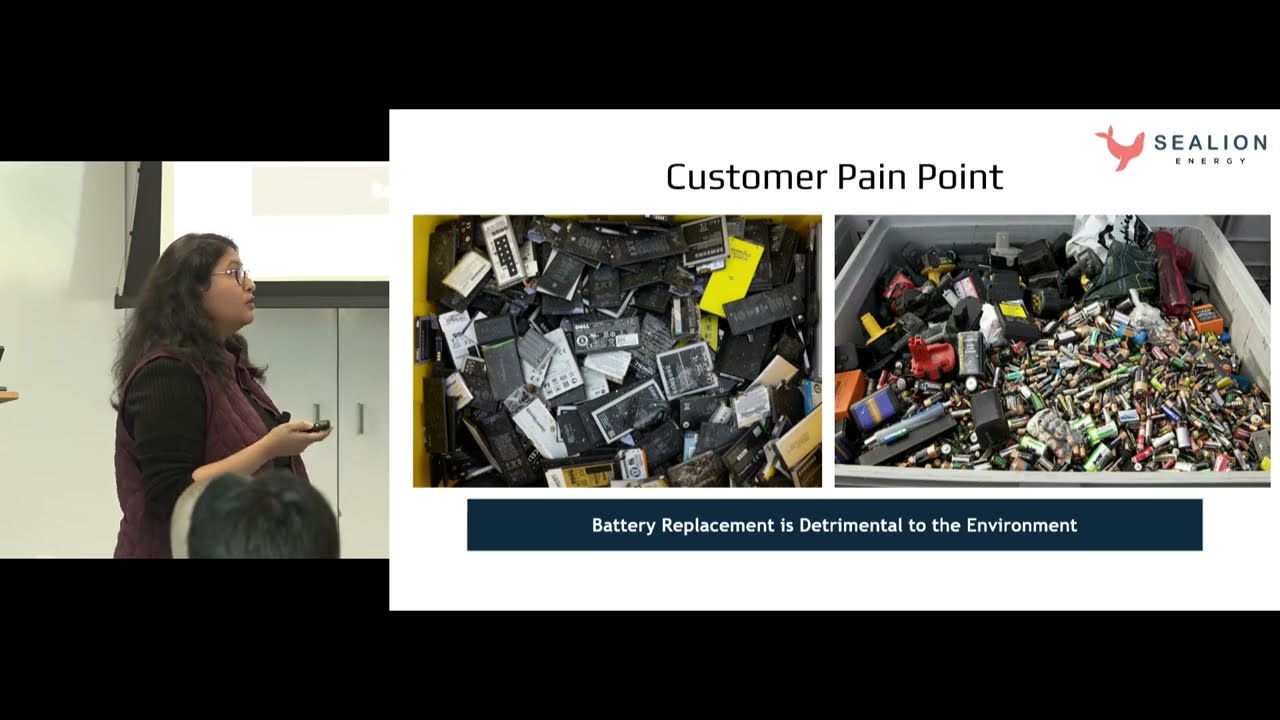
Entrepreneurship Lecture with SeaLion Energy's Renuka Hyderkhan
Keywords
Summary
153 words
Critical Evaluation
Value of the Information & Strength of the Argument
The talk provides valuable insights into the entrepreneurial journey of a scientist, detailing specific programs and funding mechanisms. The argumentation is based on personal experience and technical knowledge, with claims about the technology’s benefits (10x cycle life, 1-3% cost increase) presented without detailed evidence. The speaker’s credibility as a co-founder and postdoc strengthens the narrative, but the lack of independent verification limits the scientific rigor.
Scientific Rigor, Source Quality, Title Accuracy
The talk is a first-person account, so sources are primarily the speaker’s own experience and the programs mentioned. No external sources are cited. The title accurately reflects the content. The technical claims are plausible but not backed by published data in the talk. The Q&A provides additional context but does not include external references.
134 words
Title / Content Match
The title accurately reflects the content: a lecture on entrepreneurship featuring Renuka Hyderkhan of SeaLion Energy.
Quality & Reliability
7/10
The talk is a first-person account of an entrepreneur's journey, with technical details about battery coating technology. It is not peer-reviewed but provides specific information about programs, funding, and technical approach. The speaker is a postdoc and co-founder, lending credibility. However, claims about 10x cycle life and cost are not independently verified.
Key Moments
Markers derived by PSI from the transcript: the creator did not define chapters.
- Introduction by Daniel Tkacik, Executive Director of Scott Institute
- Hyderkhan begins talk, asks audience composition
- Background: PhD in India, semiconductor research
- Transition to entrepreneurship, CTTEC and patent
- Chevron Studio program, go-to-market strategy
- NSF I-Corps, SBIR funding, $1.6M award
- SeaLion technology: CVD coating, 10x cycle life
- Target customers, market analysis, business model
- Q&A: recycling, competition, cost, scalability
- Closing remarks
Cited Sources
- Scott Institute for Energy Innovation — Host of the lecture, provides funding and support for energy startups.
- SeaLion Energy — Company founded by the speaker, developing battery coating technology.
- ARPA-E — Funding agency that supported the research.
- US Department of Energy — Funding agency for the research.
- National Renewable Energy Laboratory (NREL) — Partner for testing and certification.
Concurring Sources
- Scott Institute for Energy Innovation — Supports energy startups and research, consistent with the talk's context.
- SeaLion Energy — Company website, likely describes the technology and mission.
Contribution & Novelties
The talk provides a first-hand account of the entrepreneurial journey from academia to startup, highlighting specific programs and funding mechanisms. The technical innovation of using CVD to apply nanoscale conducting plastic coatings to battery materials is presented as a novel approach to extend battery life and safety.
Pour aller plus loin :
- Chemical vapor deposition — Overview of the deposition technique used.
- Battery cycle life — Explanation of battery degradation and cycle life.
- NSF I-Corps — Program for customer discovery and entrepreneurship training.
- SBIR program — Small Business Innovation Research grants mentioned in the talk.
95 words
Radar Profile
The radar profile shows balanced scores across information quantity, quality, technical level, and reliability, with a slight dip in reliability due to the lack of independent verification. The talk is informative and technically sound but relies on personal testimony.
💬 No comments were provided for analysis.