Quantum Computing Hardware - Superconductor, spin, photonic, trapped ion
Keywords
Summary
150 words
Critical Evaluation
Value of the Information & Strength of the Argument
The talk provides a solid introduction to the hardware aspects of quantum computing, explaining complex concepts in an accessible manner. The speaker uses analogies (e.g., bridge resonance for dispersive readout) to aid understanding. The argumentation is based on established physics and engineering principles, and the speaker references his own books for further details. However, the talk lacks critical evaluation of the technologies’ pros and cons, and the discussion of photonic and trapped ion qubits is incomplete due to time constraints.
Scientific Rigor, Source Quality, Title Accuracy
The speaker references his own books and general literature, but specific sources are not cited in the talk. The title accurately reflects the content, and the talk is well-structured. The speaker’s academic background and industry experience lend credibility, but the lack of explicit citations and the introductory nature limit the rigor.
146 words
Title / Content Match
The title accurately reflects the content, covering the four main qubit technologies mentioned.
Quality & Reliability
8/10
The talk is given by an academic with industry experience, presenting established concepts and referencing literature. The content is accurate but lacks deep critical analysis and is introductory in nature.
Key Moments
Markers derived by PSI from the transcript: the creator did not define chapters.
- Introduction and overview of the talk's scope.
- Introduction to the DiVincenzo criteria.
- Explanation of the five DiVincenzo criteria in detail.
- Overview of a quantum computer's architecture, including classical control and dilution refrigerator.
- Superconducting qubits: Josephson junction and anharmonic oscillator.
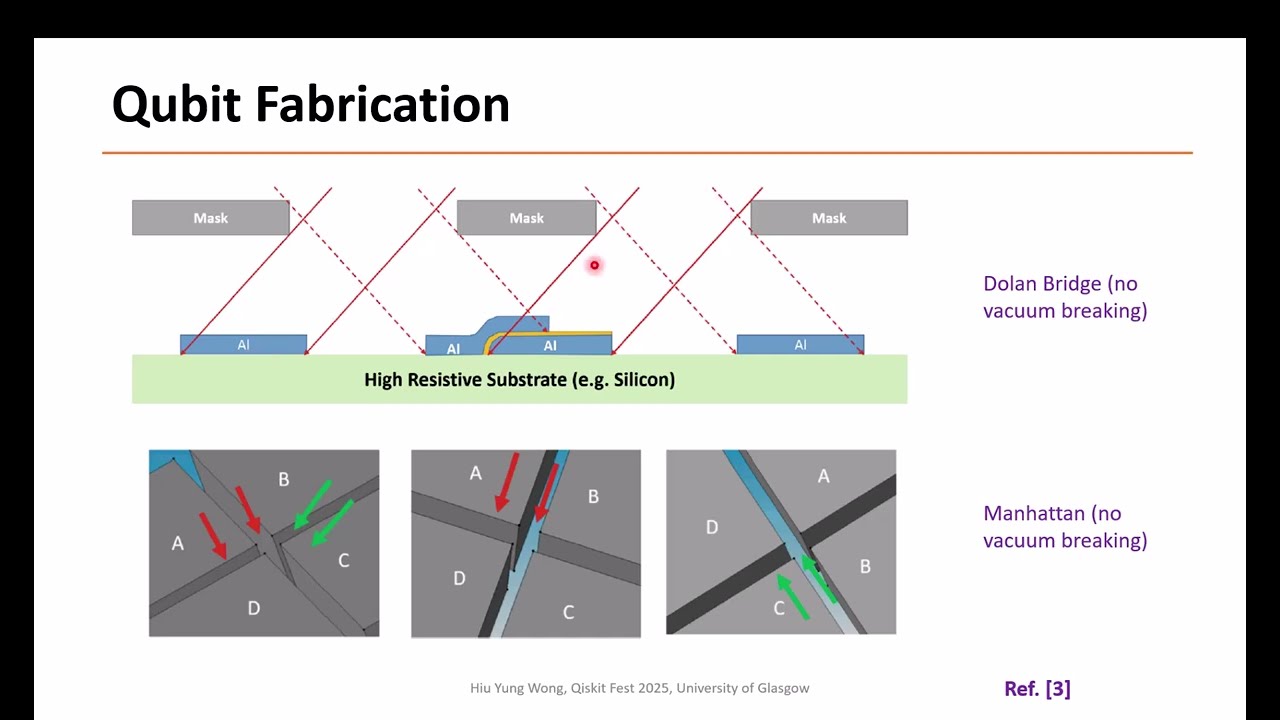
- Superconducting qubits: fabrication methods and coherence times.
- Superconducting qubits: single-qubit gates via microwave pulses.
- Superconducting qubits: two-qubit gates via flux control.
- Superconducting qubits: dispersive readout.
- Silicon spin qubits: basic principles and coherence times.
Cited Sources
- Introduction to Quantum Computing — Book by the speaker, mentioned as complementary material.
- Quantum Computing Hardware and Architecture — Book by the speaker, covering superconducting and silicon qubits.
Concurring Sources
- DiVincenzo's criteria — The criteria are widely accepted as necessary for quantum computing.
- Superconducting qubits — General information on superconducting qubits.
Contribution & Novelties
The talk provides a concise, comparative overview of four qubit technologies, highlighting the DiVincenzo criteria as a framework. It is particularly useful for beginners to understand the hardware constraints. The speaker’s engineering perspective adds practical insights.
Pour aller plus loin :
- DiVincenzo’s criteria — The five criteria for a quantum computer, central to the talk.
- Transmon qubit — A type of superconducting qubit discussed in the talk.
- Silicon spin qubit — Quantum dots used for spin qubits, as mentioned.
- Trapped ion quantum computer — Overview of trapped ion qubits, one of the four architectures.
94 words
Radar Profile
The radar profile shows high scores in information quality and reliability, moderate in quantity and technical level. This indicates a well-explained but introductory talk, suitable for beginners but not for advanced researchers.