L15 No Cloning Theorem, CNOT with LSB control qubit, Implement SWAP using CNOT
Keywords
Summary
162 words
Critical Evaluation
Value of the Information & Strength of the Argument
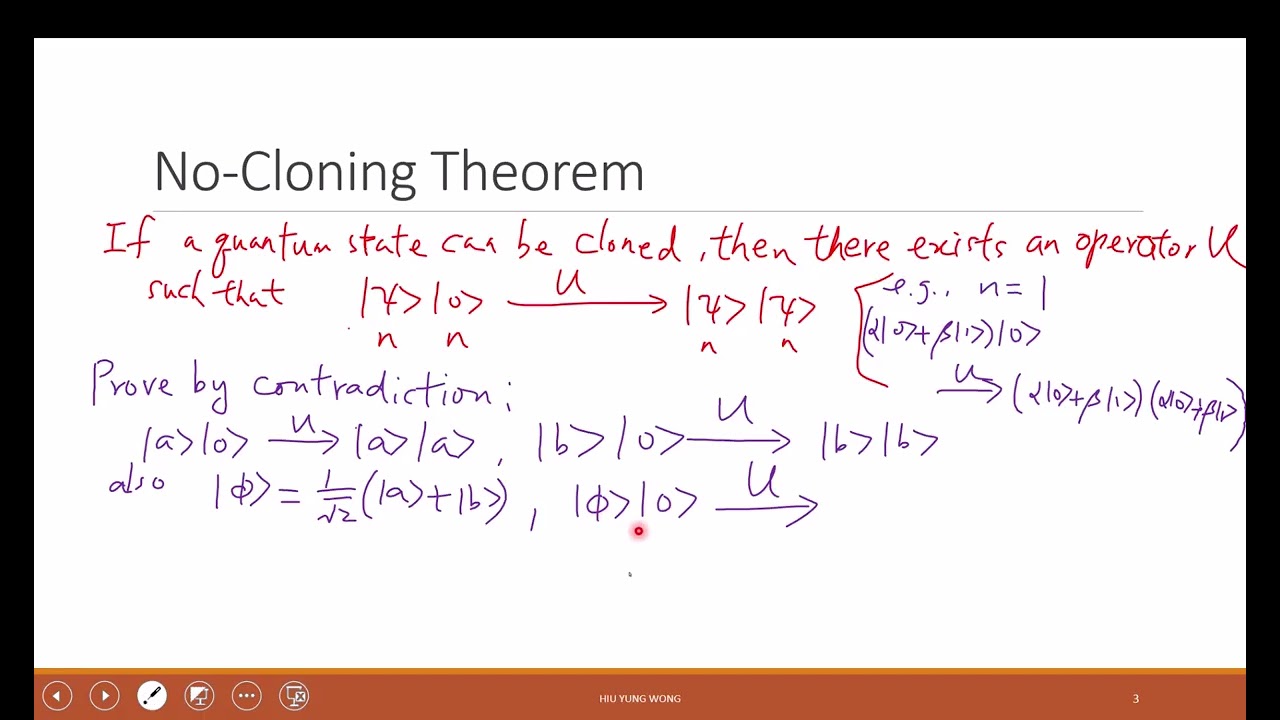
The lecture provides valuable insights into fundamental quantum computing concepts. The no-cloning theorem is presented with a clear proof by contradiction, which is pedagogically effective. The instructor emphasizes the importance of understanding tensor products and matrix multiplication, which are essential for quantum circuit analysis. The argumentation is solid, with step-by-step derivations and frequent checks for understanding. The use of examples, such as converting standard basis to Bell states, reinforces the concepts. The lecture also addresses common pitfalls, like the order of gates in matrix multiplication, which is crucial for correct circuit analysis.
Scientific Rigor, Source Quality, Title Accuracy
The lecture is scientifically rigorous, adhering to standard quantum mechanics and quantum computing principles. The instructor uses correct notation and provides derivations that are mathematically sound. The sources are not explicitly cited, but the content aligns with established textbooks and resources. The title accurately reflects the content, covering the no-cloning theorem, CNOT with LSB control, and SWAP implementation. The lecture is well-structured and suitable for an academic audience. No comments were provided, so no analysis of public trends is possible.
187 words
Title / Content Match
The title accurately reflects the content: the lecture covers the no-cloning theorem, CNOT with LSB control, and SWAP implementation using CNOT.
Quality & Reliability
8/10
The lecture is a formal tutorial on quantum computing, presenting the no-cloning theorem and circuit analysis with mathematical rigor. The instructor derives results step-by-step, uses standard notation, and references IBM Quantum experience. The content is consistent with established quantum computing principles. Minor issues: some informal asides and a few unclear moments, but overall reliable.
Key Moments
Markers derived by PSI from the transcript: the creator did not define chapters.
- Introduction to the lecture and the no-cloning theorem.
- Proof of the no-cloning theorem by contradiction.
- Discussion on quantum teleportation and why it does not violate the no-cloning theorem.
- Review of tensor product notation and standard basis for multi-qubit systems.
- Introduction to the Bell states and their matrix representation.
- Explanation of the quantum circuit for generating Bell states using Hadamard and CNOT gates.
- Discussion on the order of gates in matrix multiplication and the importance of MSB/LSB conventions.
- Derivation of the matrix representation of the circuit and verification of unitarity.
- Application of the circuit to standard basis vectors to obtain Bell states.
- Mention of IBM Quantum implementation and future topics like SWAP gate.
Cited Sources
- Quantum Computing, TCAD, Semicond by Hiu-Yung Wong - Playlist — The playlist containing this lecture and related course materials.
Concurring Sources
- No-cloning theorem - Wikipedia — The theorem is a standard result in quantum computing, and the lecture's proof aligns with established literature.
- Quantum circuit - Wikipedia — The lecture's approach to circuit analysis matches standard practices in quantum computing.
Contribution & Novelties
The lecture provides a clear and detailed explanation of the no-cloning theorem and its proof, which is a fundamental concept in quantum computing. It also offers a thorough walkthrough of quantum circuit analysis, including the construction of Bell states and the importance of gate order. The instructor’s emphasis on the distinction between MSB and LSB and the correct application of tensor products is particularly valuable for students. The lecture bridges theoretical concepts with practical implementation on IBM Quantum.
Pour aller plus loin :
- No-cloning theorem — Provides a comprehensive overview and proof of the theorem.
- Quantum circuit — Explains the basics of quantum circuits and gate operations.
- Bell state — Details the Bell states and their role in quantum information.
- CNOT gate — Describes the CNOT gate and its matrix representation.
- Quantum teleportation — Discusses quantum teleportation and its relation to the no-cloning theorem.
144 words
Radar Profile
The radar profile shows high scores across all dimensions, indicating a well-balanced and reliable educational resource. The lecture excels in providing detailed information and technical depth, with strong rigor and source quality. The overall high scores reflect its suitability for learners seeking a solid understanding of quantum computing fundamentals.