6) Solving Schrödinger Equation and Poisson Equation for SiGe Double Quantum Dot in QTCAD®
Keywords
Summary
147 words
Critical Evaluation
Value of the Information & Strength of the Argument
The video provides a clear, step-by-step demonstration of using QTCAD for quantum dot simulation. The value lies in its practical guidance, showing exactly how to set up and run simulations, including handling of files, materials, and solver parameters. The argumentation is solid as the presenter explains the reasoning behind each step, such as why adaptive meshing is used and how the k.p model is applied. However, the video does not delve into the underlying physics or validate the results against experimental data, which limits its depth for advanced users.
Scientific Rigor, Source Quality, Title Accuracy
The tutorial is rigorous in its methodology, following a logical sequence and explaining the purpose of each command. The sources are limited to the QTCAD software documentation and the tutorial series itself, with no external references provided. The title accurately reflects the content, which is solving Schrödinger and Poisson equations for a SiGe double quantum dot. The presenter’s explanations are consistent with standard TCAD practices, though no independent verification is offered.
175 words
Title / Content Match
The title accurately describes the content: solving Schrödinger and Poisson equations for a SiGe double quantum dot using QTCAD.
Quality & Reliability
8/10
The tutorial is based on a specific software (QTCAD) and demonstrates a practical workflow. The author explains the steps clearly and provides context for the physics involved, but does not provide external references or validation of the results. The content is reproducible if the software is available.
Key Moments
Markers derived by PSI from the transcript: the creator did not define chapters.
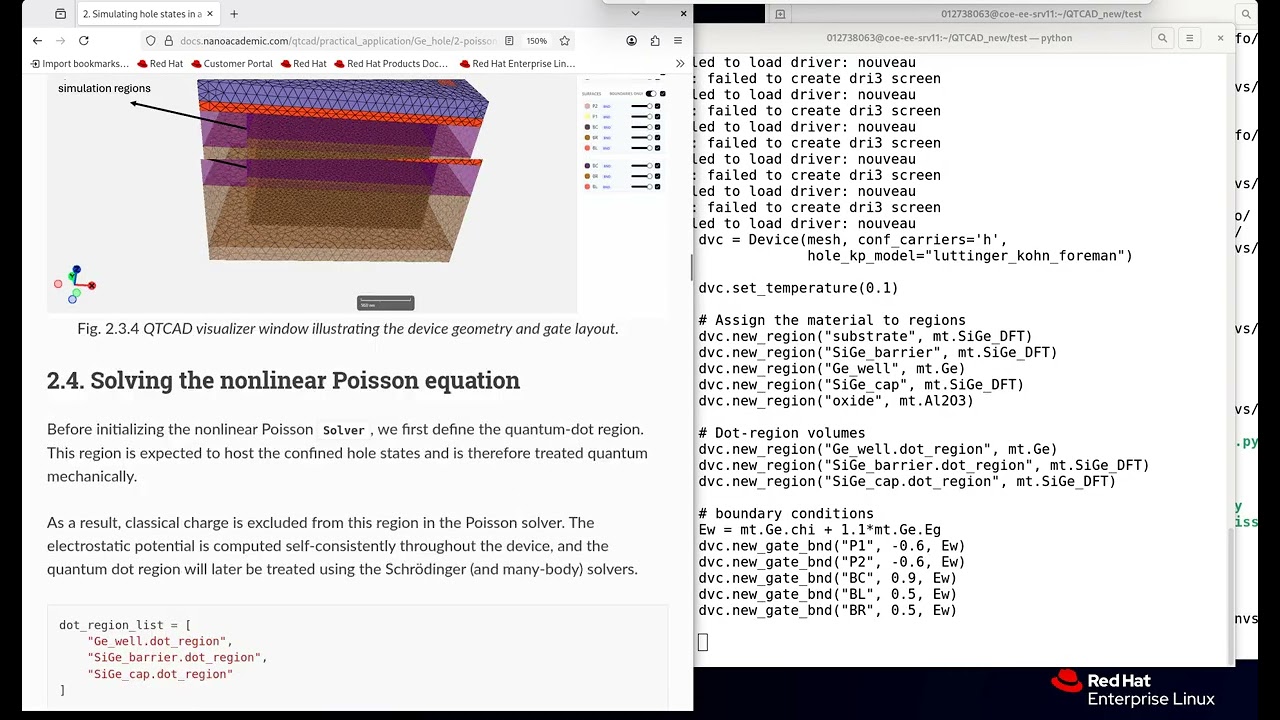
- Introduction to the tutorial and overview of the simulation goal.
- Importing necessary libraries and setting up the environment.
- Loading the mesh and defining the device.
- Assigning materials to regions, including silicon germanium.
- Setting boundary conditions and initial potential.
- Solving the Poisson equation with adaptive meshing.
- Saving the potential profile and preparing for Schrödinger solver.
- Setting up and solving the Schrödinger equation for six eigenstates.
- Displaying eigenenergies and plotting results.
Cited Sources
- QTCAD documentation — Referenced as the software used for simulation.
Concurring Sources
- QTCAD documentation — The software's official documentation supports the workflow demonstrated.
Contribution & Novelties
This tutorial provides a practical, step-by-step guide to simulating a SiGe double quantum dot using QTCAD, which is valuable for researchers and engineers in quantum computing. It demonstrates the integration of Poisson and Schrödinger solvers with adaptive meshing, a technique not commonly covered in basic tutorials. The video also highlights the use of k.p models for hole confinement, which is a specialized topic.
Pour aller plus loin :
- k·p perturbation theory — Provides background on the band structure calculation method used.
- Quantum dot — General information on quantum dots and their applications.
- Poisson’s equation — Mathematical foundation for electrostatic potential calculation.
101 words
Radar Profile
The radar profile shows high scores across all dimensions, indicating a well-rounded tutorial with strong technical depth, reliable methodology, and clear presentation. The balance between information quantity and quality is particularly good.
💬 Sur les 0 commentaires analysés, aucune tendance n'est disponible.