L2 Vector Space, Inner Product, Bra Ket Notation
Keywords
Summary
173 words
Critical Evaluation
Value of the Information & Strength of the Argument
The lecture provides a solid conceptual foundation for linear algebra in quantum computing. The instructor effectively uses the 2D geometric analogy to build intuition for abstract vector spaces. The step-by-step derivation of the inner product formula, from the geometric definition to the algebraic one, is clear and persuasive. He also addresses common pitfalls, such as the non-commutativity of inner products in complex spaces and the need for complex conjugation. The argumentation is sound, though informal, relying on examples and persuasion rather than rigorous proofs. The interactive format, with questions to the audience, helps reinforce understanding. The value lies in its pedagogical clarity and the emphasis on concepts that are crucial for quantum mechanics, such as projection and orthogonality.
Scientific Rigor, Source Quality, Title Accuracy
The scientific rigor is appropriate for an introductory lecture. The mathematical definitions are standard and correct. The instructor does not cite external sources within the lecture, but he references his own book and a companion playlist. The title accurately reflects the content, which is a focused tutorial on vector spaces, inner products, and bra-ket notation. The lecture is well-structured and the explanations are coherent. The instructor’s informal style, while engaging, occasionally leads to imprecise statements, but these are clarified through examples. The absence of formal citations is typical for a course lecture, but the content aligns with established linear algebra and quantum mechanics textbooks.
237 words
Title / Content Match
The title accurately reflects the content: the lecture covers vector spaces, inner products, and introduces bra-ket notation.
Quality & Reliability
7/10
The content is a pedagogical lecture on linear algebra fundamentals for quantum computing. The mathematical definitions and derivations are standard and correct, but the presentation is informal and relies on persuasive examples rather than rigorous proofs. The instructor is an academic, but the video is a course lecture, not peer-reviewed.
Key Moments
Markers derived by PSI from the transcript: the creator did not define chapters.
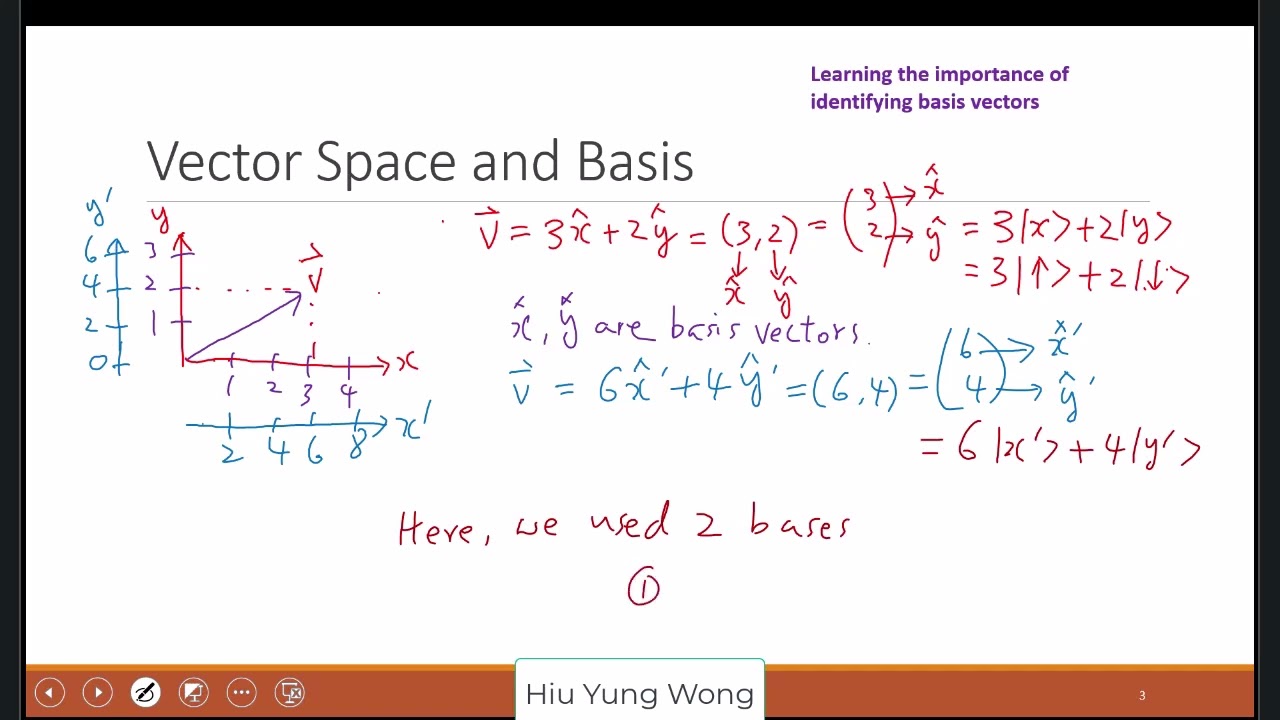
- Introduction to vector space and basis using 2D coordinates.
- Discussion on the importance of basis and representation of vectors.
- Introduction to inner product with geometric interpretation as projection.
- Algebraic definition of inner product using transpose and complex conjugate.
- Generalization to n-dimensional complex vector spaces.
- Introduction to bra-ket notation and its relation to inner products.
- Summary and emphasis on the importance of basis in quantum computing.
Cited Sources
- Quantum Computing, TCAD, Semicond by Hiu-Yung Wong - Playlist — The instructor refers to this playlist as the course resource.
Concurring Sources
- Linear Algebra (Wikipedia) — The lecture's content aligns with standard linear algebra concepts.
- Quantum Mechanics (Wikipedia) — The lecture's content is foundational for quantum mechanics.
Contribution & Novelties
The lecture provides a clear and accessible introduction to linear algebra concepts essential for quantum computing. Its novelty lies in the pedagogical approach, using 2D geometric analogies to build intuition for abstract vector spaces and inner products. The emphasis on the importance of basis and the step-by-step derivation of the inner product formula are particularly effective. The lecture also introduces bra-ket notation in a way that connects it to familiar linear algebra operations.
Pour aller plus loin :
- Vector space — Foundational concept.
- Inner product space — Generalization of the inner product.
- Bra–ket notation — Standard notation in quantum mechanics.
- Complex conjugate — Key operation in the inner product definition.
- Orthonormal basis — Important for simplifying inner products.
118 words
Radar Profile
The radar profile shows a balanced performance across all dimensions, with slightly higher scores in quality of information and technical level, reflecting the lecture's solid mathematical content and clear explanations. The lower score in quantity of information is due to the lecture's focus on a few core concepts rather than a broad survey.