L18C Algorithm Complexity and Grover Algorithm Part I
Keywords
Summary
134 words
Critical Evaluation
Value of the Information & Strength of the Argument
The video provides a valuable introduction to algorithm complexity and Grover’s algorithm, making abstract concepts accessible through concrete examples. The instructor’s argumentation is solid, building from basic complexity definitions to the specific quantum oracle construction. He clearly explains the significance of speedup and the overheads involved in quantum algorithms. The step-by-step verification of the oracle enhances the credibility of the explanation.
Scientific Rigor, Source Quality, Title Accuracy
The scientific rigor is high for an introductory lecture. The instructor correctly explains complexity classes and the oracle model. However, no formal sources are cited, and the presentation relies on the instructor’s expertise. The title accurately reflects the content, and the lecture is well-structured. No comments were provided for analysis.
126 words
Title / Content Match
The title accurately reflects the content, covering algorithm complexity and the first part of Grover's algorithm.
Quality & Reliability
8/10
The video provides a clear and accurate introduction to computational complexity and Grover's algorithm, with a concrete example of constructing a quantum oracle. The instructor demonstrates deep understanding and correct technical details, though the presentation is informal and lacks formal proofs.
Key Moments
Markers derived by PSI from the transcript: the creator did not define chapters.
- Introduction to algorithm complexity and its importance.
- Example of addition to illustrate linear complexity.
- Explanation of big-O notation and ignoring constants.
- Comparison of linear, square root, and logarithmic complexity.
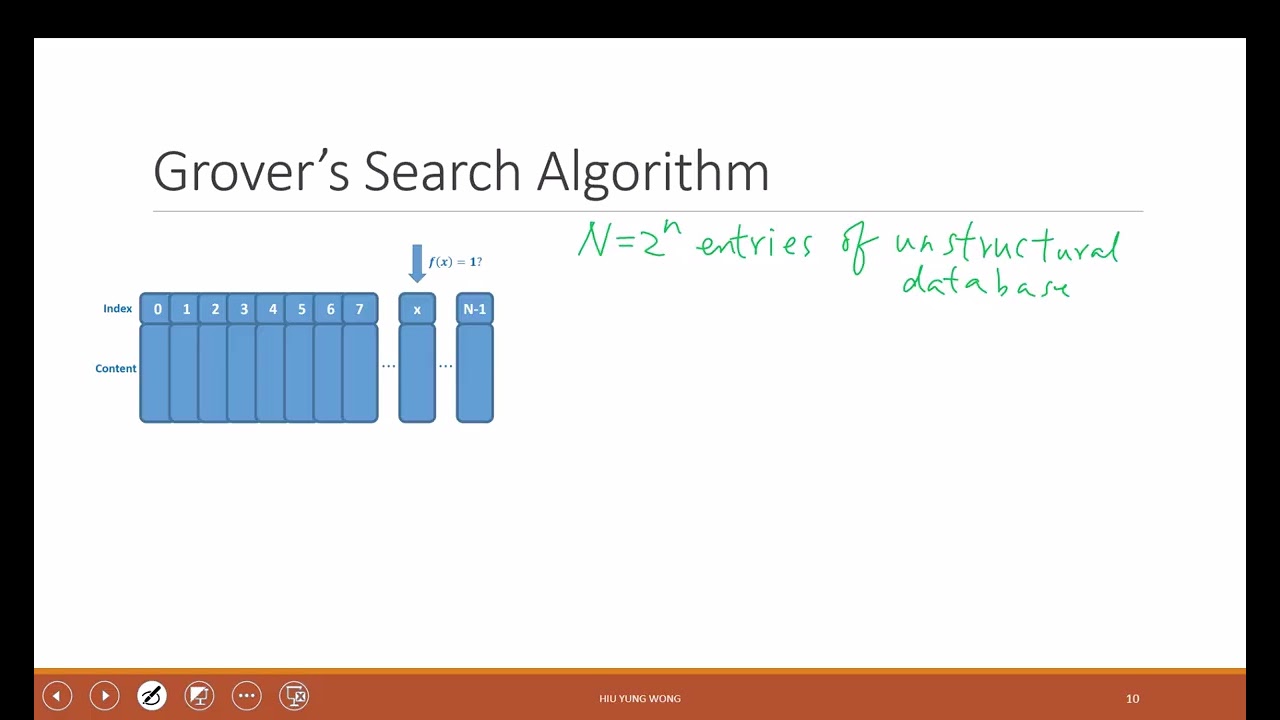
- Introduction to Grover's algorithm and unstructured search problem.
- Explanation of classical search requiring N/2 operations on average.
- Quantum oracle example for Grover's algorithm.
- Construction of the oracle circuit with controlled-NOT gates.
- Verification of the oracle for the target input.
- Discussion on the oracle's behavior for non-target inputs.
Cited Sources
- Quantum Computing, TCAD, Semicond by Hiu-Yung Wong - Playlist — The video is part of a playlist on quantum computing, providing context for the lecture series.
Concurring Sources
- Grover's algorithm - Wikipedia — Confirms the quadratic speedup of Grover's algorithm for unstructured search.
- Quantum oracle - Wikipedia — Describes the oracle model used in quantum algorithms, consistent with the video's explanation.
Contribution & Novelties
The video offers a clear pedagogical explanation of algorithm complexity and Grover’s algorithm, with a concrete example of constructing a quantum oracle. It bridges the gap between theoretical concepts and practical implementation, making it valuable for students.
Pour aller plus loin :
- Grover’s algorithm - Wikipedia — Detailed overview of the algorithm, its applications, and complexity.
- Quantum oracle - Wikipedia — Explanation of the oracle model in quantum computing.
- Big O notation - Wikipedia — Formal definition and examples of asymptotic notation.
82 words
Radar Profile
The radar profile shows high scores in information quantity, quality, and reliability, with a slightly lower technical level, indicating a well-balanced introductory lecture that is both informative and accessible.